The Verigin problem with phase transition as a Wasserstein flow
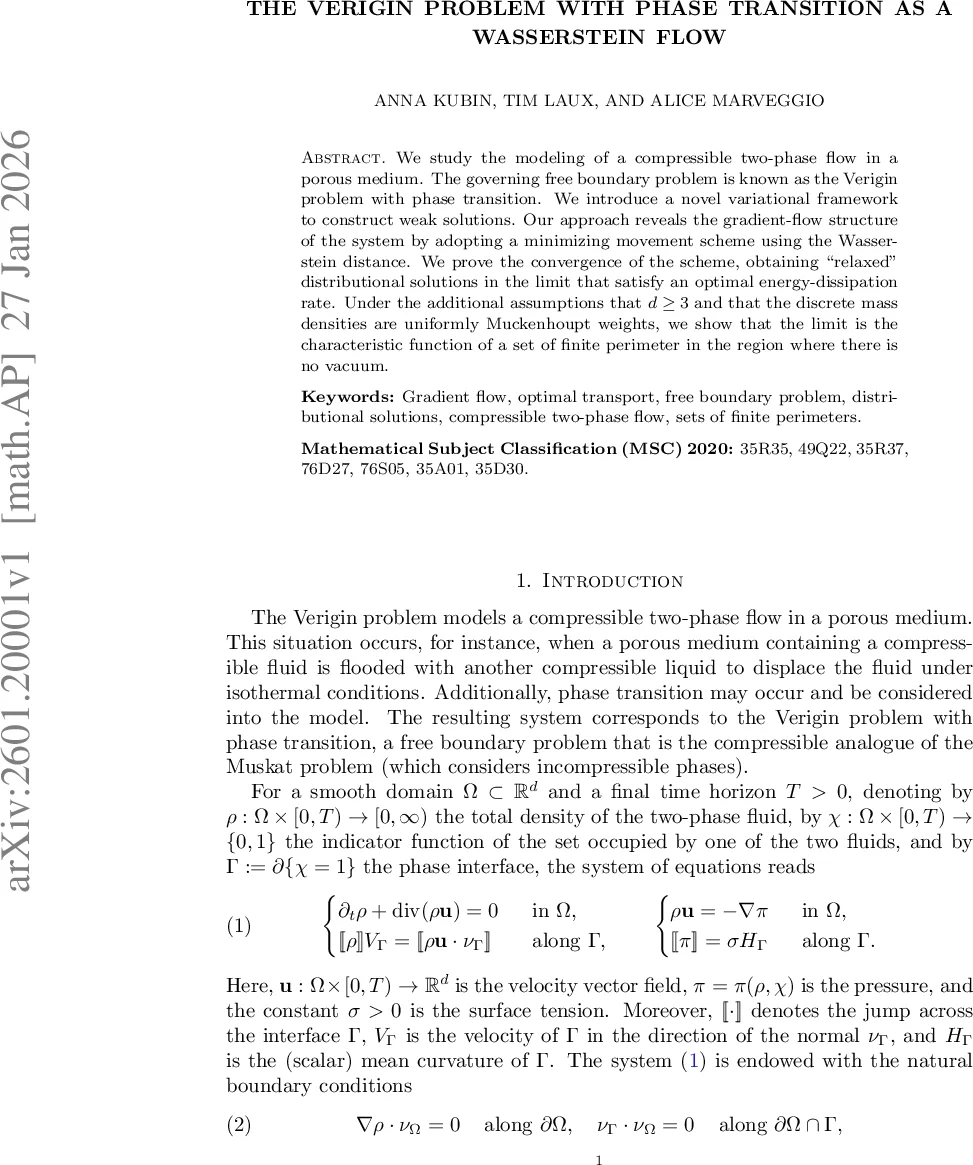
We study the modeling of a compressible two-phase flow in a porous medium. The governing free boundary problem is known as the Verigin problem with phase transition. We introduce a novel variational framework to construct weak solutions. Our approach reveals the gradient-flow structure of the system by adopting a minimizing movement scheme using the Wasserstein distance. We prove the convergence of the scheme, obtaining ``relaxed" distributional solutions in the limit that satisfy an optimal energy-dissipation rate. Under the additional assumptions that $d \geq 3$ and that the discrete mass densities are uniformly Muckenhoupt weights, we show that the limit is the characteristic function of a set of finite perimeter in the region where there is no vacuum.
💡 Research Summary
The paper addresses the Verigin problem with phase transition, a free‑boundary model describing the flow of two compressible fluids in a porous medium where phase change may occur. While classical results have only provided short‑time existence and stability for smooth solutions, a rigorous long‑time theory for weak solutions has been lacking. The authors develop a variational framework that reveals a gradient‑flow structure of the system with respect to the quadratic Wasserstein distance, and they construct weak solutions via a minimizing‑movement (JKO‑type) scheme.
The total energy functional is
\
Comments & Academic Discussion
Loading comments...
Leave a Comment