Detecting half-quantum superconducting vortices by spin-qubit relaxometry
Half-quantum vortices in spin-triplet superconductors are predicted to harbor Majorana zero modes and may provide a viable avenue to topological quantum computation. Here, we introduce a novel approach for directly measuring the half-integer-quantized magnetic fluxes, $Φ= h / (4e)$, carried by such half-quantum vortices via spin-qubit relaxometry. We consider a superconducting strip with a narrow pinch point at which vortices cross quasi-periodically below a spin qubit as a result of a bias current. We demonstrate that the relaxation rate of the spin qubit exhibits a pronounced peak if the vortex-crossing frequency matches the transition frequency of the spin qubit and conclude that the magnetic flux $Φ$ of a single vortex can be obtained by dividing the corresponding voltage along the strip with the transition frequency. We discuss experimental constraints on implementing our proposed setup in spin-triplet candidate materials like UTe$_2$, UPt$_3$, and URhGe.
💡 Research Summary
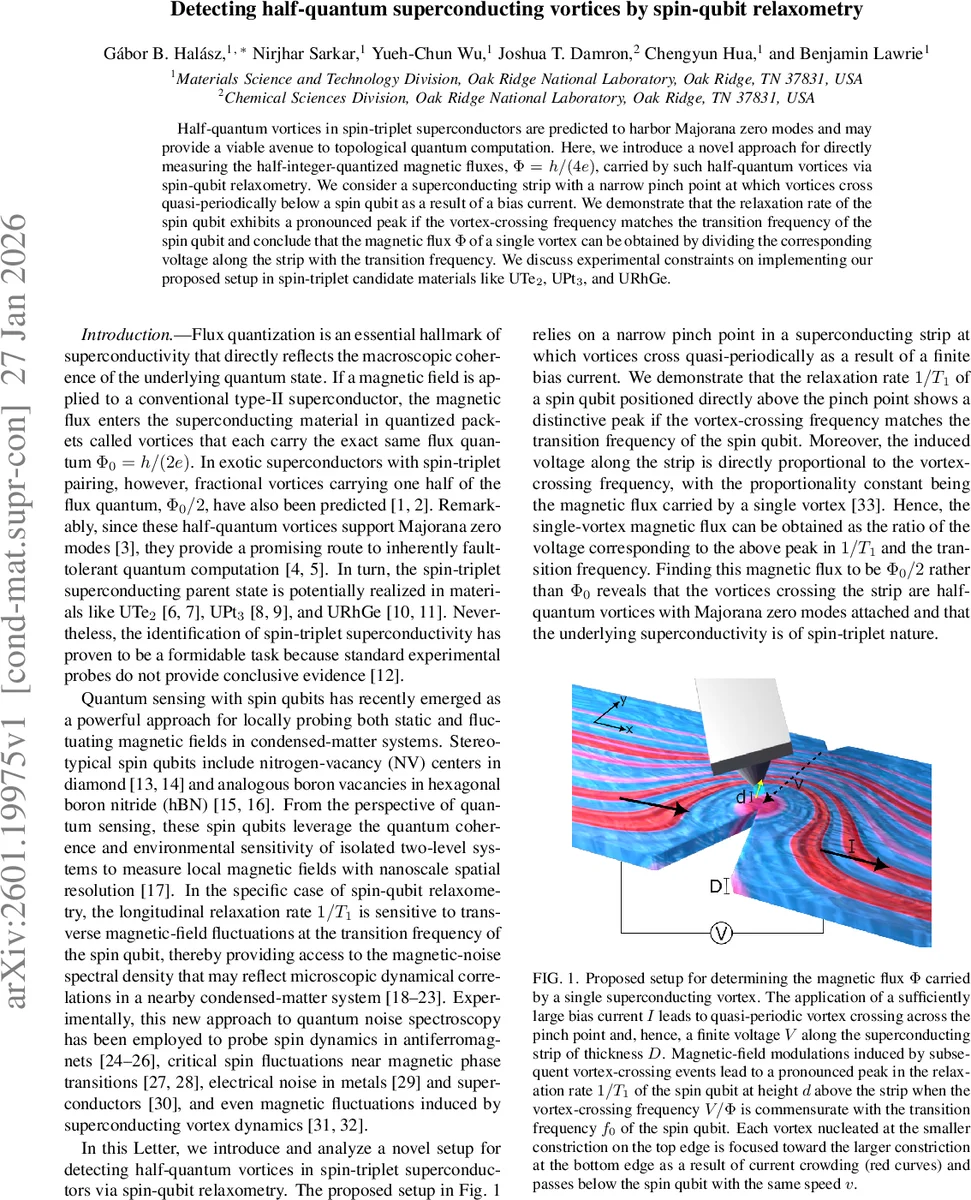
The manuscript proposes a concrete experimental scheme to directly detect half‑quantum vortices (HQVs) in candidate spin‑triplet superconductors by exploiting the magnetic‑noise spectroscopy capabilities of spin‑qubits (e.g., nitrogen‑vacancy (NV) centers in diamond or boron‑vacancy defects in hexagonal boron nitride). The key idea is to fabricate a thin superconducting strip (thickness D ≈ 100 nm) that contains a narrow “pinch point” on one edge and a much wider constriction on the opposite edge. When a bias current I is applied, vortices nucleate at the small edge, are guided by current crowding, and cross the strip at a quasi‑periodic rate f = 1/T. Each crossing generates a voltage V = Φ f along the strip, where Φ is the magnetic flux carried by a single vortex. For ordinary Abrikosov vortices Φ = Φ₀ = h/2e, whereas for HQVs Φ = Φ₀/2.
A spin‑qubit is positioned a distance d (≈ 100 nm) above the strip, directly over the crossing line. As a vortex passes beneath, the time‑dependent magnetic field at the qubit, B(t), is calculated using the London model (λ ≫ D) and the Biot‑Savart law. The authors obtain analytic expressions for the non‑zero components B_y(t) and B_z(t) in the form B_i(t) = (Φ/4πλ²) K_i(γ, θ), where γ = d/D and θ = vt/D (v is the vortex speed). The field pulse is short compared with the inter‑vortex interval T, so a train of nearly identical pulses produces a quasi‑periodic magnetic signal whose Fourier spectrum contains sharp lines at multiples of the fundamental frequency f.
The longitudinal relaxation rate of the qubit, Γ = 1/T₁, is derived from Fermi’s golden rule and expressed as an integral over the magnetic‑noise spectral density at the qubit transition frequency f₀ (typically ≈ 3 GHz for NV centers). Assuming the inter‑vortex interval fluctuates weakly (Gaussian variance τ with α = τ/T ≪ 1), the relaxation rate factorizes into a geometry‑dependent term F(γ, Df₀/v) and a universal function G(α, β) with β = Φ f₀/V. The function G exhibits pronounced peaks whenever β = n (n ∈ ℕ), i.e., when the vortex‑crossing frequency matches the qubit transition frequency (or its harmonics). Consequently, the relaxation rate shows a series of voltage‑dependent peaks at V_n = Φ f₀/n. The largest peak at V₁ = Φ f₀ provides a direct measurement of the vortex flux: Φ = V₁/f₀.
Using realistic material parameters for spin‑triplet candidates (penetration depth λ ≈ 1 µm, vortex speed v ≈ 10⁴ m s⁻¹, strip thickness D ≈ 100 nm, qubit distance d ≈ 100 nm), the authors estimate Γ⁻¹ ≈ 0.5–1 ms, well within the detection window of current spin‑qubit relaxometry techniques. For a conventional vortex the fundamental voltage is V₁ ≈ Φ₀ f₀ ≈ 6 µV, whereas for an HQV it is halved to ≈ 3 µV. These voltages are experimentally accessible with low‑noise cryogenic electronics.
The paper discusses practical constraints: the need for a clean, reproducible pinching geometry to ensure quasi‑periodic vortex motion, the requirement that τ/T remain small (otherwise the peaks broaden and disappear), and the necessity of maintaining the qubit at a distance that balances signal strength against vortex trajectory deviations. It also notes that while observing Φ = Φ₀/2 strongly suggests HQVs and associated Majorana modes, complementary probes (e.g., tunnelling spectroscopy, spin‑polarized STM) would be valuable for confirming the topological nature of the bound states.
Overall, the work introduces a novel, all‑magnetic detection method that converts the quantized flux of moving vortices into a measurable voltage‑frequency relationship via spin‑qubit relaxation. The theoretical analysis is thorough, the predicted signal strengths are realistic, and the approach offers a clear pathway to experimentally verify half‑quantum vortices and, by extension, the existence of Majorana zero modes in spin‑triplet superconductors such as UTe₂, UPt₃, and URhGe. Future extensions could involve optimizing the pinching geometry, employing superconducting resonators to enhance magnetic coupling, or integrating other quantum sensors to broaden the frequency range and improve sensitivity.
Comments & Academic Discussion
Loading comments...
Leave a Comment