Stability properties of adapted tangent sheaves on Kähler--Einstein log Fano pairs
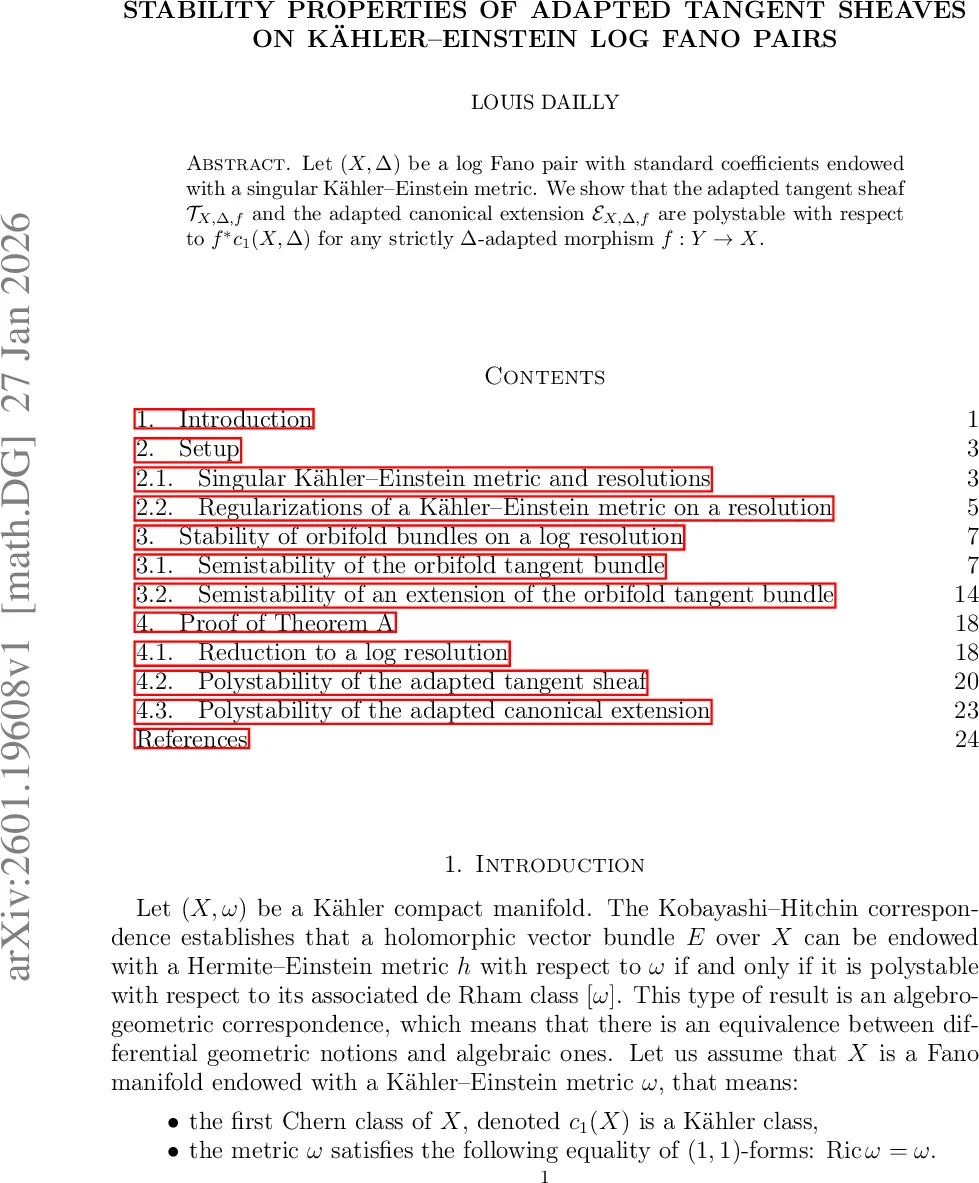
Let $(X, Δ)$ be a log Fano pair with standard coefficients endowed with a singular Kähler–Einstein metric. We show that the adapted tangent sheaf $\mathcal{T}{X, Δ, f}$ and the adapted canonical extension $\mathcal{E}{X, Δ, f}$ are polystable with respect to $f^*c_1(X, Δ)$ for any strictly $Δ$-adapted morphism $f: Y \to X$.
💡 Research Summary
The paper studies the stability properties of adapted tangent sheaves on log Fano pairs equipped with singular Kähler–Einstein metrics. Let (X,Δ) be a log Fano pair with standard coefficients (i.e., a normal projective variety X together with a Q‑divisor Δ whose coefficients belong to {1−1/m | m∈ℕ} and such that (X,Δ) is klt and –(K_X+Δ) is Q‑ample). Assume that X carries a singular Kähler–Einstein metric ω_Φ solving the Monge–Ampère equation (ω+dd^cΦ)^n = e^{−Φ} μ_h. For any strictly Δ‑adapted morphism f : Y→X (finite Galois, ramification indices prescribed by the coefficients of Δ), the author defines the adapted tangent sheaf 𝒯_{X,Δ,f} and the adapted canonical extension ℰ_{X,Δ,f}. The main result (Theorem A) asserts that both sheaves are polystable with respect to the pull‑back class f^*c₁(X,Δ).
The proof proceeds by passing to a log resolution π : \tilde X→X, where the pair ( \tilde X, \tilde Δ = π^{-1}*Δ ) becomes log smooth and admits a smooth orbi‑étale structure in the sense of Guenancia–Taji. Pulling back the Kähler–Einstein metric yields a family of orbifold Kähler forms ω{t,ε}=π^*ω+tbω+dd^c φ_{t,ε} obtained via Demailly’s regularization and an orbifold version of Yau’s theorem. The Ricci curvature of ω_{t,ε} can be expressed as Ric ω_{t,ε}=ω_{t,ε}+dd^c(ψ_ε−φ_{t,ε})−t bω−∑ a_i θ_{i,ε}, where the θ_{i,ε} encode the contributions of the exceptional divisors.
Using these metrics, the author studies the orbifold tangent bundle T(\tilde X,\tilde Δ). For any saturated orbifold subsheaf F⊂T, the slope μ_{ω_{t,ε}}(F) is computed via Chern–Weil theory and Bedford–Taylor integration. A key technical step is to resolve the ideal generated by a global section s∈H⁰(∧^r T⊗(det F)^{-1}) and to show that the contributions from the exceptional divisor vanish after pulling back to a resolution μ : Z→\tilde X. This yields the inequality μ_{π^*c₁(X,Δ)}(F) ≤ μ_{π^*c₁(X,Δ)}(T), establishing semistability of the orbifold tangent bundle. An analogous argument gives semistability of the orbifold canonical extension.
To upgrade semistability to polystability, the paper constructs an adapted cover \hat Y→Y over which the adapted sheaves become honest vector bundles. On this cover the Donaldson–Uhlenbeck–Yau theorem (in its orbifold form) applies, providing Hermite–Einstein metrics on 𝒯_{X,Δ,f} and ℰ_{X,Δ,f}. Consequently, both sheaves are polystable with respect to f^*c₁(X,Δ).
Finally, Corollary B shows that if the Chern class equality 2(n+1)c₂(X,Δ)−n c₁(X,Δ)²=0 holds, then (X,Δ) is uniformized by a finite quotient of projective space, i.e. (X,Δ) ≅ (ℙⁿ/G, Δ_G). This recovers the equality case of the Miyaoka–Yau inequality for log Fano pairs.
Overall, the work extends Tian’s classical result on the polystability of the tangent bundle of smooth Fano manifolds to the singular, log setting with orbifold structures, introducing a systematic use of adapted morphisms, orbifold regularizations, and adapted covers to bridge differential‑geometric techniques with algebraic stability theory.
Comments & Academic Discussion
Loading comments...
Leave a Comment