Coupled Majorana modes in a dual vortex of the Kitaev honeycomb model
The Kitaev model is exactly solvable in terms of Majorana fermions hopping on a honeycomb lattice and coupled to a static $\mathbb{Z}_2$ gauge field, giving the possibility of $π$-vortices in hexagonal plaquettes. In the vortex-full sector and in the presence of a time-reversal-breaking three-spin term of strength $κ$, the energy spectrum is gapped and the ground state possesses an even Chern number. An isolated vortex-free plaquette acts as a ``dual vortex’’ and binds a fermionic mode at finite energy $ε$ in the bulk gap. This mode is equivalent to two coupled Majorana zero modes located on the same dual vortex. In a continuum approximation, we analytically compute the Majorana wavefunctions and their coupling $ε$ in the two limits of small or large $κ$. The analytical approach is confirmed by numerical perturbation theory directly on the lattice. The latter is in excellent agreement with the full numerics on a finite-size system. We contrast our results with states bound to an isolated vortex in a topological superconductor with even Chern number.
💡 Research Summary
The paper investigates bound states that appear when a single “dual vortex” – a plaquette without a π‑flux – is introduced into the vortex‑full sector of the Kitaev honeycomb model. In the vortex‑full background every hexagon carries a π‑flux (w = −1), and the addition of a time‑reversal‑breaking three‑spin term of strength κ opens a bulk gap and yields an even Chern number (ν = +2 for 0 < κ < J/2, ν = −2 for κ > J/2). A dual vortex therefore corresponds to a local reversal of the Z₂ gauge field, creating a defect that can trap low‑energy excitations.
The authors separate the Hamiltonian into a dominant part that generates the bulk gap and a perturbative part that creates and couples Majorana zero modes (MZMs). They treat two opposite limits analytically:
-
Small‑J limit (κ ≫ J). With J set to zero the model decomposes into two independent triangular sub‑lattices (black and white sites) each threaded by a uniform π/2 flux per triangle. The resulting band structure consists of two symmetric bands ±E(k) separated by a large gap 2√3 κ. Introducing a half‑infinite string of flipped links creates a dual vortex; in the continuum description this defect hosts two uncoupled Majorana zero modes localized at the same point. Their wavefunctions are obtained from a Dirac‑type equation and have a modified Bessel‑K form.
-
Small‑κ limit (J ≫ κ). Here the nearest‑neighbour hopping dominates and the bulk spectrum resembles that of graphene with two Dirac cones. The three‑spin term acts as a small mass term that gaps the cones. A dual vortex reverses the sign of this mass locally, again binding two Majorana zero modes at zero energy in the continuum approximation.
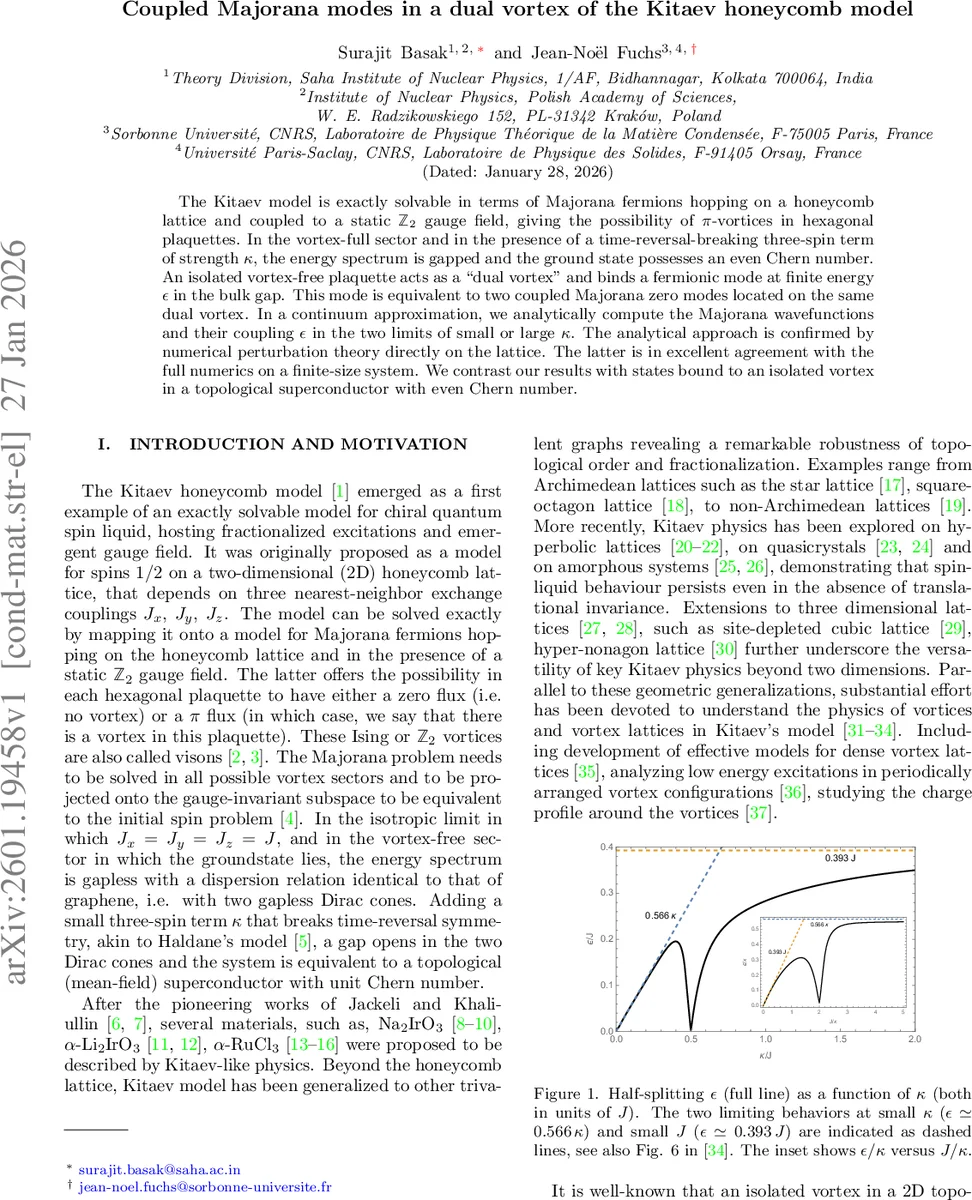
In both limits the two Majoranas are initially decoupled (ε = 0). The authors then re‑introduce the subdominant hopping (J in the first case, κ in the second) as a perturbation. First‑order perturbation theory yields an energy splitting 2ε proportional to the overlap of the two Majorana wavefunctions. Analytically they find
- ε ≈ 0.566 κ for κ → 0 (small‑κ regime),
- ε ≈ 0.393 J for J → 0 (small‑J regime).
These coefficients match the numerical data presented in Fig. 1 of the paper. To validate the analytical results, the authors perform two independent numerical checks: (i) lattice‑based perturbation theory directly evaluates the matrix element responsible for the splitting, and (ii) exact diagonalisation of finite‑size systems with periodic boundary conditions provides the full spectrum. Both approaches reproduce the analytical ε‑dependence with high precision, confirming that perturbation theory is reliable away from the critical point κ = J/2 where the bulk gap closes.
The work draws a clear parallel with two‑dimensional topological superconductors of class D. In systems with an odd Chern number a single vortex binds a solitary Majorana zero mode at exactly zero energy. By contrast, an even Chern number forces the vortex to bind a pair of Majoranas that hybridise into a finite‑energy fermionic mode, analogous to the Caroli‑de Gennes‑Matricon bound states in conventional type‑II superconductors. The dual vortex in the Kitaev model thus provides a concrete lattice realization of the “even‑Chern” scenario, offering a platform where the coupling between two Majoranas can be tuned continuously by varying κ/J.
The authors conclude that the dual‑vortex bound state enriches the catalogue of excitations in Kitaev‑type spin liquids and could be exploited for quantum‑information purposes. Because the energy splitting ε can be made arbitrarily small (by approaching κ = 0 or J = 0) while remaining protected by the bulk gap, the pair of Majoranas constitutes a robust, controllable qubit candidate. Moreover, the ability to engineer and manipulate dual vortices may enable experimental probes of non‑Abelian statistics in systems where the underlying Chern number is even, opening new avenues for topological quantum computation beyond the conventional odd‑Chern Majorana platforms.
Comments & Academic Discussion
Loading comments...
Leave a Comment