Dissipative Solutions to a Compressible Non-Newtonian Korteweg System with Density-Dependent Viscous Stress Tensor
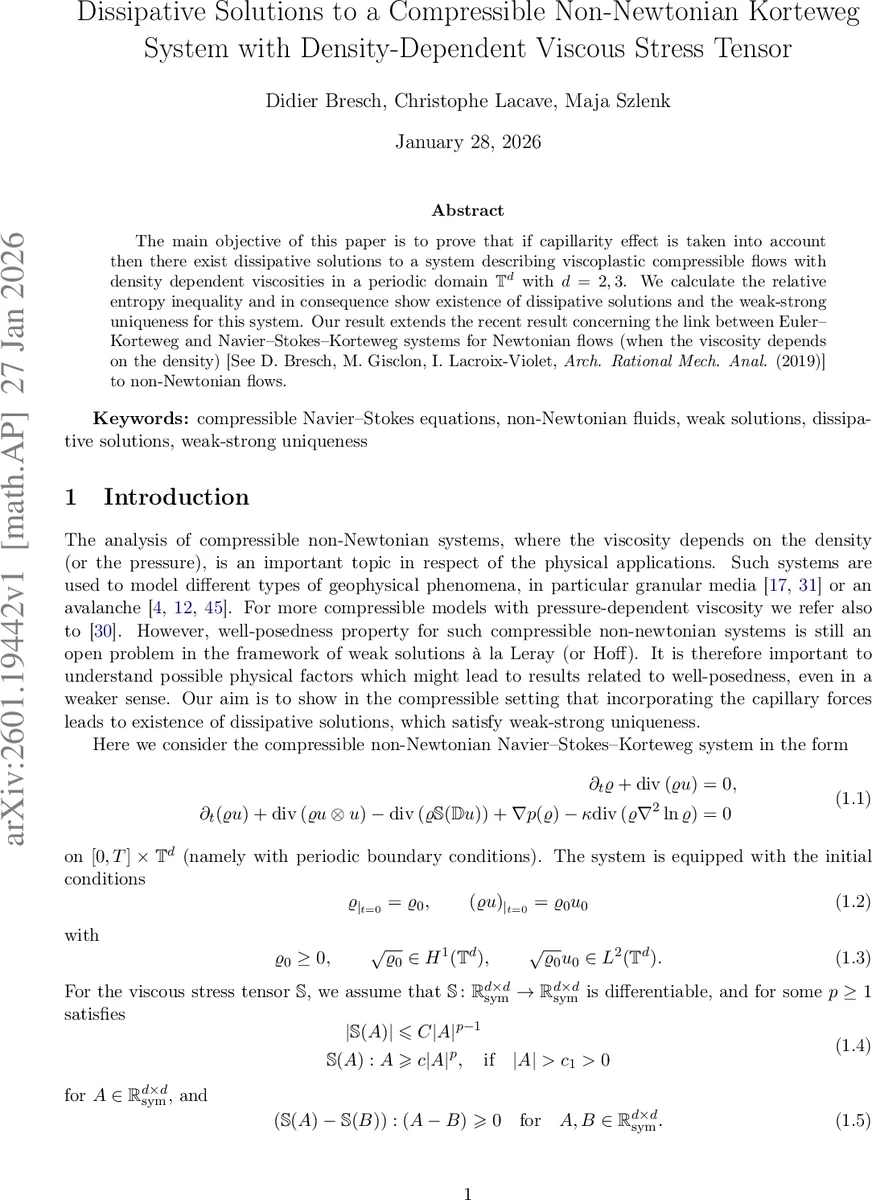
The main objective of this paper is to prove that if capillarity effect is taken into account then there exist dissipative solutions to a system describing viscoplastic compressible flows with density dependent viscosities in a periodic domain $\T^d$ with $d=2,3$. We calculate the relative entropy inequality and in consequence show existence of dissipative solutions and the weak-strong uniqueness for this system. Our result extends the recent result concerning the link between Euler–Korteweg and Navier–Stokes–Korteweg systems for Newtonian flows (when the viscosity depends on the density) [See D.~Bresch, M. Gisclon, I. Lacroix-Violet, {\it Arch. Rational Mech. Anal.} (2019)] to non-Newtonian flows.
💡 Research Summary
The paper addresses the global existence of dissipative (or “measure‑valued”) solutions for a compressible, non‑Newtonian fluid model that incorporates Korteweg capillarity effects and density‑dependent viscosities, set on the periodic torus 𝕋ᵈ with d = 2 or 3. The governing equations consist of the continuity equation and a momentum balance in which the viscous stress tensor S(Du) is a nonlinear, monotone operator of p‑Laplacian type (e.g., S(Du)=|Du|^{p‑2}Du or S(Du)=δDu+|Du|) satisfying growth and coercivity conditions (1.4)–(1.5). The pressure law p(ρ) is smooth, strictly increasing, and obeys two‑sided power‑law bounds with exponent γ > 1. A Korteweg term κ div(ρ ∇² ln ρ) models capillarity; the particular choice K(ρ)=1/ρ leads to the convenient form div (ρ ∇² ln ρ).
The authors adopt the relative‑entropy framework pioneered by Lions and later extended to compressible Navier–Stokes–Korteweg systems. They define a relative entropy functional
E(t)=½∫{𝕋ᵈ}ρ|u−v|² + κρ|∇ln ρ−∇ln r|² dx + ∫{𝕋ᵈ}H(ρ|r)dx,
where (r,v) is a smooth test pair and H(ρ|r) is the Bregman distance associated with the pressure potential. For any weak solution (ρ,u) satisfying the basic energy inequality (2.2), they derive a detailed relative‑entropy inequality (Proposition 2.2) that contains dissipative terms involving the monotone stress tensor, the capillarity contribution, and the pressure defect. Crucially, the monotonicity of S ensures that the term –ρ(S(Du)−S(Dv)):(Du−Dv) is non‑positive, providing a rigorous control of the nonlinear viscous dissipation.
To construct solutions, the paper introduces a Galerkin approximation together with an artificial higher‑order viscosity ε|Du|^{q‑2}Du (q>p) to guarantee uniform bounds. The regularized system enjoys a standard energy estimate, and the capillarity term yields the crucial estimate ∇√ρ∈L^∞(0,T;L²) and ∇ln ρ∈L²(0,T;L²). These bounds are independent of ε and allow passage to the limit. Using compactness tools (Aubin–Lions lemma) and Minty’s monotonicity method, the authors let ε→0 and subsequently remove any auxiliary regularization, showing that the limit satisfies the relative‑entropy inequality of Definition 2.4. Hence a global‑in‑time dissipative solution exists for arbitrary admissible initial data (ρ₀≥0, √ρ₀∈H¹, √ρ₀u₀∈L²).
A direct corollary of the relative‑entropy inequality is a Grönwall‑type estimate that yields weak‑strong uniqueness: if a strong solution (r,v) exists on a time interval, any dissipative solution with the same initial data coincides with it on that interval. This result extends the recent work of Bresch, Gisclon, and Lacroix‑Violet (2019) from Newtonian (density‑dependent) fluids to the fully non‑Newtonian setting.
The paper situates its contribution within the literature: previous results on density‑dependent viscosities dealt mainly with Newtonian stresses or one‑dimensional non‑Newtonian models; the present work is the first to treat multi‑dimensional, fully non‑Newtonian stresses together with Korteweg capillarity in a dissipative‑solution framework. The authors also provide auxiliary lemmas on the structure of the Korteweg tensor and on functional inequalities needed for the analysis.
In conclusion, the inclusion of capillarity restores enough compactness to handle the nonlinear, density‑dependent, non‑Newtonian stress, leading to global existence of dissipative solutions and a robust weak‑strong uniqueness principle. The methodology opens the way for further investigations into more complex boundary conditions, external forces, and numerical approximations of such compressible non‑Newtonian Korteweg flows.
Comments & Academic Discussion
Loading comments...
Leave a Comment