False and partial Eisenstein series related to unimodal sequences
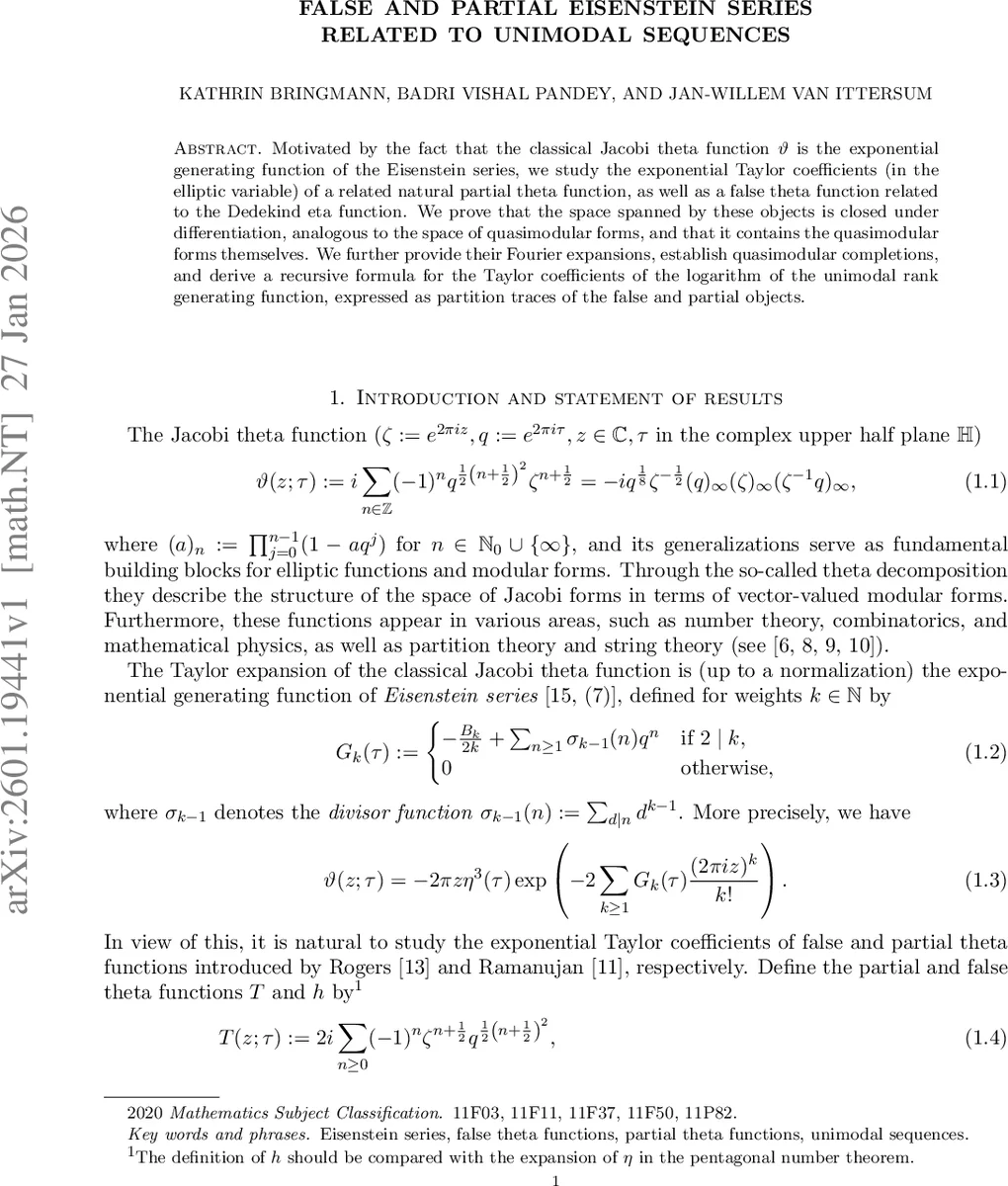
Motivated by the fact that the classical Jacobi theta function $\vartheta$ is the exponential generating function of the Eisenstein series, we study the exponential Taylor coefficients (in the elliptic variable) of a related natural partial theta function, as well as a false theta function related to the Dedekind eta function. We prove that the space spanned by these objects is closed under differentiation, analogous to the space of quasimodular forms, and that it contains the quasimodular forms themselves. We further provide their Fourier expansions, establish quasimodular completions, and derive a recursive formula for the Taylor coefficients of the logarithm of the unimodal rank generating function, expressed as partition traces of the false and partial objects.
💡 Research Summary
The paper investigates exponential Taylor coefficients of two non‑modular theta‑type functions— a partial theta function introduced by Rogers and a false theta function related to the Dedekind eta function— and shows that these coefficients behave in many ways like classical Eisenstein series. Starting from the well‑known identity that the Jacobi theta function’s Taylor expansion generates the Eisenstein series (G_k(\tau)), the authors define the partial theta function
\
Comments & Academic Discussion
Loading comments...
Leave a Comment