Bridging the Socio-Emotional Gap: The Functional Dimension of Human-AI Collaboration for Software Engineering
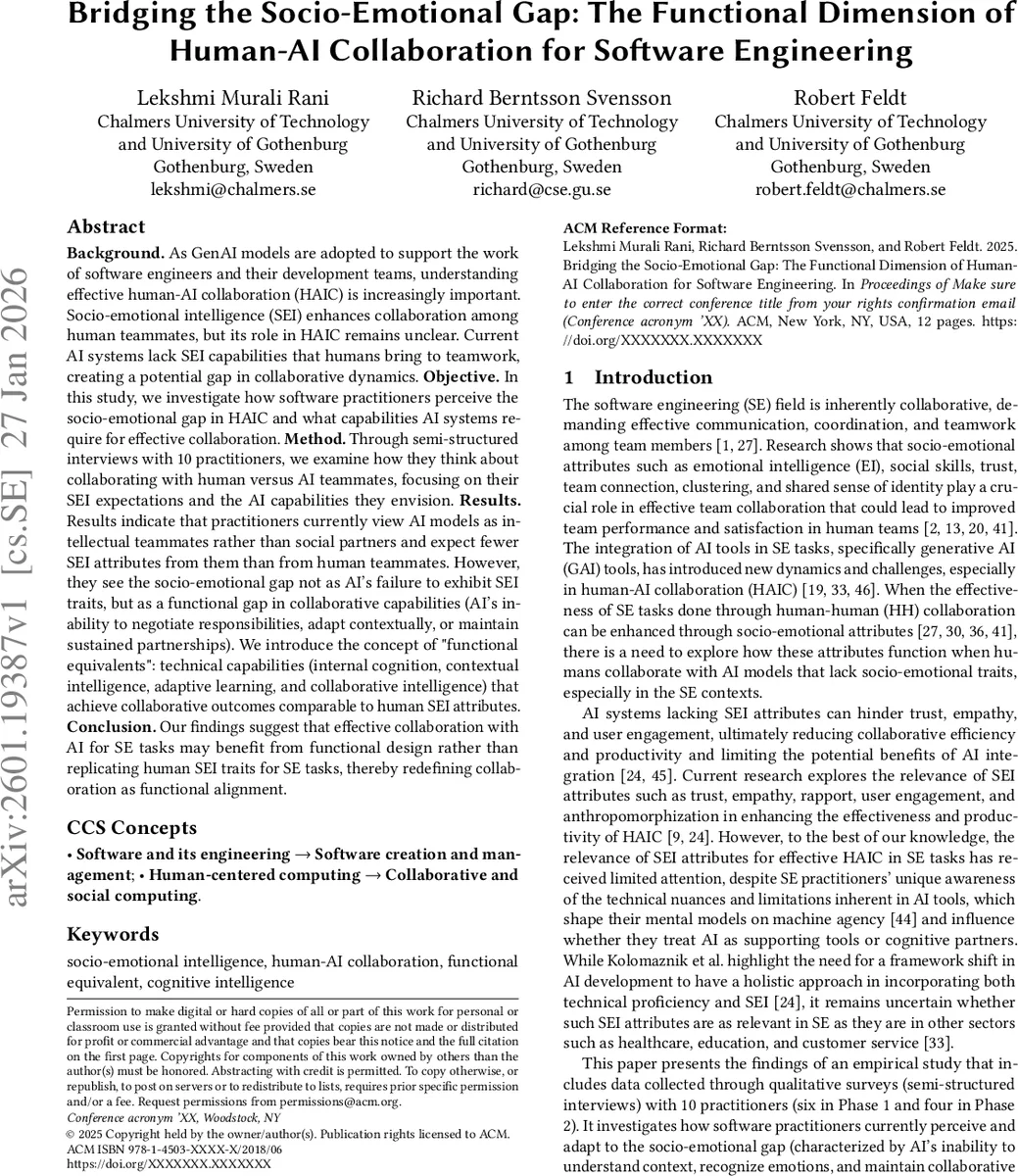
As GenAI models are adopted to support software engineers and their development teams, understanding effective human-AI collaboration (HAIC) is increasingly important. Socio-emotional intelligence (SEI) enhances collaboration among human teammates, but its role in HAIC remains unclear. Current AI systems lack SEI capabilities that humans bring to teamwork, creating a potential gap in collaborative dynamics. In this study, we investigate how software practitioners perceive the socio-emotional gap in HAIC and what capabilities AI systems require for effective collaboration. Through semi-structured interviews with 10 practitioners, we examine how they think about collaborating with human versus AI teammates, focusing on their SEI expectations and the AI capabilities they envision. Results indicate that practitioners currently view AI models as intellectual teammates rather than social partners and expect fewer SEI attributes from them than from human teammates. However, they see the socio-emotional gap not as AIs failure to exhibit SEI traits, but as a functional gap in collaborative capabilities (AIs inability to negotiate responsibilities, adapt contextually, or maintain sustained partnerships). We introduce the concept of functional equivalents: technical capabilities (internal cognition, contextual intelligence, adaptive learning, and collaborative intelligence) that achieve collaborative outcomes comparable to human SEI attributes. Our findings suggest that effective collaboration with AI for SE tasks may benefit from functional design rather than replicating human SEI traits for SE tasks, thereby redefining collaboration as functional alignment.
💡 Research Summary
The paper investigates the “socio‑emotional gap” that emerges when software engineers collaborate with generative AI (GenAI) tools. While socio‑emotional intelligence (SEI) – encompassing empathy, trust, relationship management, and other affective skills – is known to boost human‑human team performance, its relevance to human‑AI collaboration (HAIC) in software engineering has been under‑explored. To fill this gap, the authors conducted semi‑structured interviews with ten practitioners (six in an initial exploratory phase and four in a validation phase). Participants were selected for a minimum of three years of software engineering experience and at least one year of active GenAI usage, ensuring a technically proficient sample.
The interview protocol was built around the ESCI‑U (Emotional and Social Competency Inventory‑U) framework, which separates competencies into emotional, social, and cognitive clusters. Through iterative thematic analysis (Braun & Clarke’s six‑step method), the researchers identified seven major themes, of which three were most salient for the research questions.
Key findings:
-
Perception of AI as an Intellectual Teammate – Practitioners view AI primarily as a source of knowledge, code snippets, or problem‑solving suggestions. They do not expect AI to exhibit the same SEI attributes they demand from human teammates (e.g., empathy, rapport, trust).
-
Functional Nature of the Gap – The “socio‑emotional gap” is not framed as a failure of AI to display emotions; rather, it is a functional deficiency. AI tools currently cannot negotiate responsibilities, adapt dynamically to shifting project contexts, or sustain long‑term partnership dynamics. These capabilities are essential for effective collaboration but are absent in today’s GenAI.
-
Functional Equivalents Concept – To bridge the gap, the authors propose “functional equivalents”: a set of technical capabilities that can achieve the same collaborative outcomes as human SEI traits without mimicking affective behavior. The four proposed equivalents are:
- Internal Cognition – Meta‑awareness of the AI’s own state, limitations, and intentions, communicated transparently to human partners.
- Contextual Intelligence – Real‑time interpretation of domain‑specific, team‑cultural, and situational cues to tailor suggestions appropriately.
- Adaptive Learning – Continuous incorporation of user feedback and workflow patterns to personalize assistance and improve over time.
- Collaborative Intelligence – Automated role allocation, responsibility negotiation, and workflow orchestration that align AI actions with human team processes.
The authors argue that implementing these functional equivalents re‑positions AI from a passive tool to an active collaborative partner, thereby delivering the trust, coordination, and shared‑mental‑model benefits traditionally attributed to SEI.
Methodologically, the study is limited by its small, purposively sampled cohort and reliance on qualitative self‑reports. No quantitative performance metrics or prototype implementations of the functional equivalents are presented, leaving open questions about feasibility, scalability, and evaluation. Nonetheless, the work makes a valuable contribution by reframing HAIC design goals: rather than attempting to endow AI with human‑like emotions, developers should focus on functional alignment that satisfies the collaborative purposes of SEI.
Implications for practice include:
- Tool Designers should prioritize transparency (internal cognition) and context‑aware suggestion mechanisms over affective chat features.
- Team Leaders can set realistic expectations for AI partners, emphasizing functional roles (e.g., responsibility negotiation) rather than emotional support.
- Researchers have a clear agenda to prototype, measure, and refine the four functional equivalents, potentially integrating them into existing coding assistants or AI‑driven project management platforms.
In sum, the paper advances HAIC theory by introducing a functional‑centric perspective, offering a concrete framework that aligns AI capabilities with the collaborative needs of software engineering teams, and suggesting a pragmatic path forward for both research and industry.
Comments & Academic Discussion
Loading comments...
Leave a Comment