Polyhedral design with blended $n$-sided interpolants
A new parametric surface representation is proposed that interpolates the vertices of a given closed mesh of arbitrary topology. Smoothly connecting quadrilateral patches are created by blending local, multi-sided quadratic interpolants. In the non-four-sided case, this requires a special parameterization technique involving rational curves. Appropriate handling of triangular subpatches and alternative subpatch representations are also discussed.
💡 Research Summary
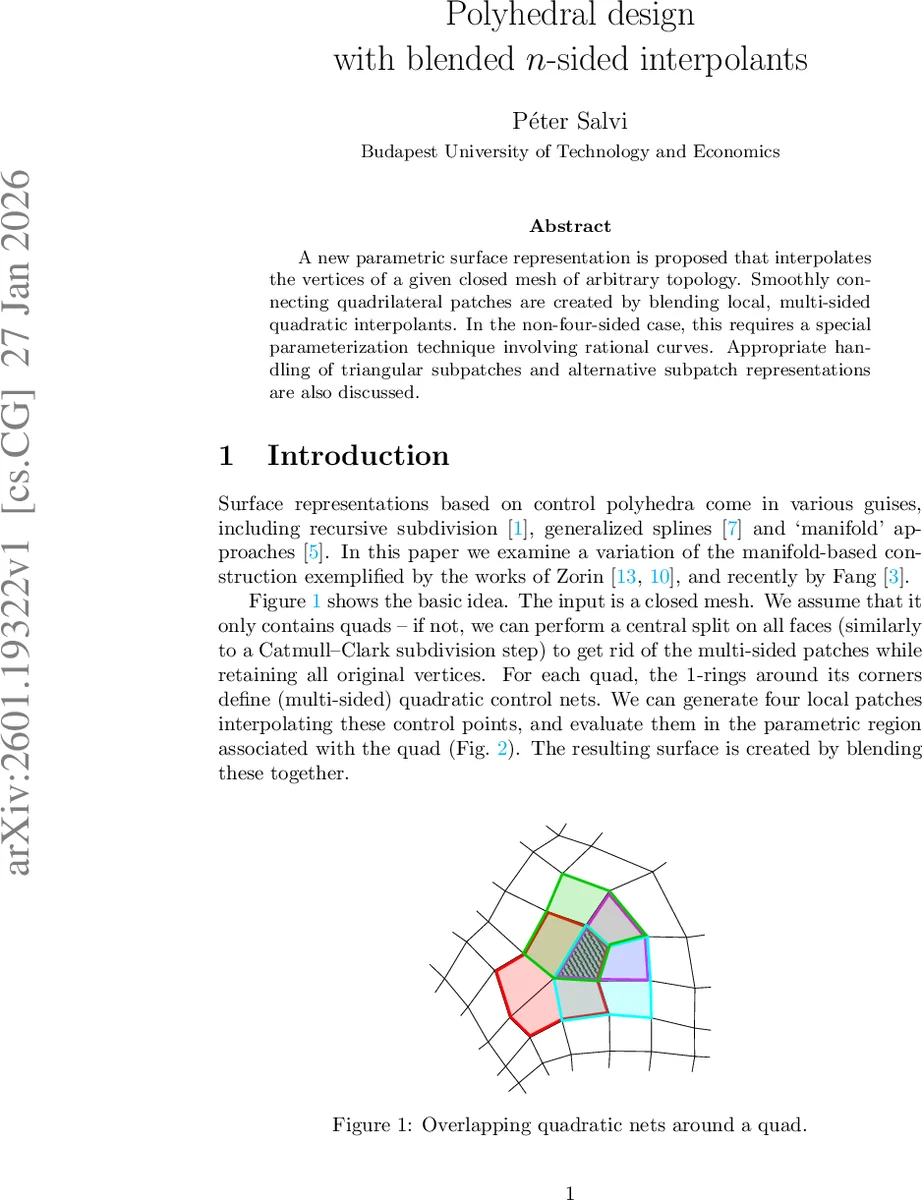
The paper introduces a novel parametric surface construction that interpolates the vertices of a closed mesh of arbitrary topology. The method first converts any non‑quadrilateral faces into quads by a central split, similar to a Catmull–Clark subdivision step, thereby preserving the original vertices while creating a uniform set of quadrilateral patches. For regular meshes (all vertices of valence 4) each quad’s 1‑ring defines a quadratic control net consisting of corner points Cᵢ, edge points Eᵢ, and a central point M. A tensor‑product quadratic Bézier patch I(u,v) = ΣΣ Pᵢⱼ B₂ᵢ(u) B₂ⱼ(v) is built from these control points, and four such local patches are blended over the quad using a separable blending function Φ(u,v)=Ψ(u)·Ψ(v). Ψ is a Hermite blend (k=2 in the experiments) that satisfies Ψ(0)=1, Ψ(1)=0 and has vanishing derivatives at the ends, ensuring smooth transitions between patches.
Irregular vertices (valence ≠ 4) generate n‑sided control nets. The authors extend quadratic Bézier patches to a Quadratic Generalized Bézier (QGB) formulation that works on any regular n‑gon. Using generalized barycentric (Wachspress) coordinates λᵢ, they define side‑specific parameters sᵢ(u,v) and dᵢ(u,v) and construct the surface as a weighted sum of side‑wise quadratic Bézier curves and a global weight B₀(u,v). For n=4 the QGB reduces to the regular tensor‑product patch; for n=3 it becomes a quadratic triangular Bézier patch.
A critical challenge is mapping the unit square domain
Comments & Academic Discussion
Loading comments...
Leave a Comment