AC Response Across the Metal Insulator Transition of YBCO Josephson Junctions Fabricated with a Helium Ion Beam
Using focused helium ion beam (FHIB) irradiation, we fabricated in-plane, high-Tc YBCO Josephson junctions. By varying the dose of the irradiation, we tune the junction barriers from metallic (SNS) to insulating (SIS) and investigate how this transition affects microwave-driven dynamics. As the barrier transitions from metallic to insulating, the oscillatory response of the Shapiro steps to the RF power changes dramatically. On either side of the metal-insulator transition, the devices exhibit clean integer Shapiro steps without half-integer features, demonstrating that the current–phase relation is dominated by the first harmonic and that the excess current is minimal. The current-voltage response is well-described by the resistively, capacitively shunted junction model assuming a single-harmonic current–phase relation. This behavior indicates well-controlled junction properties suitable for a wide range of superconducting electronics, including detectors, mixers, and high-density integrated circuits.
💡 Research Summary
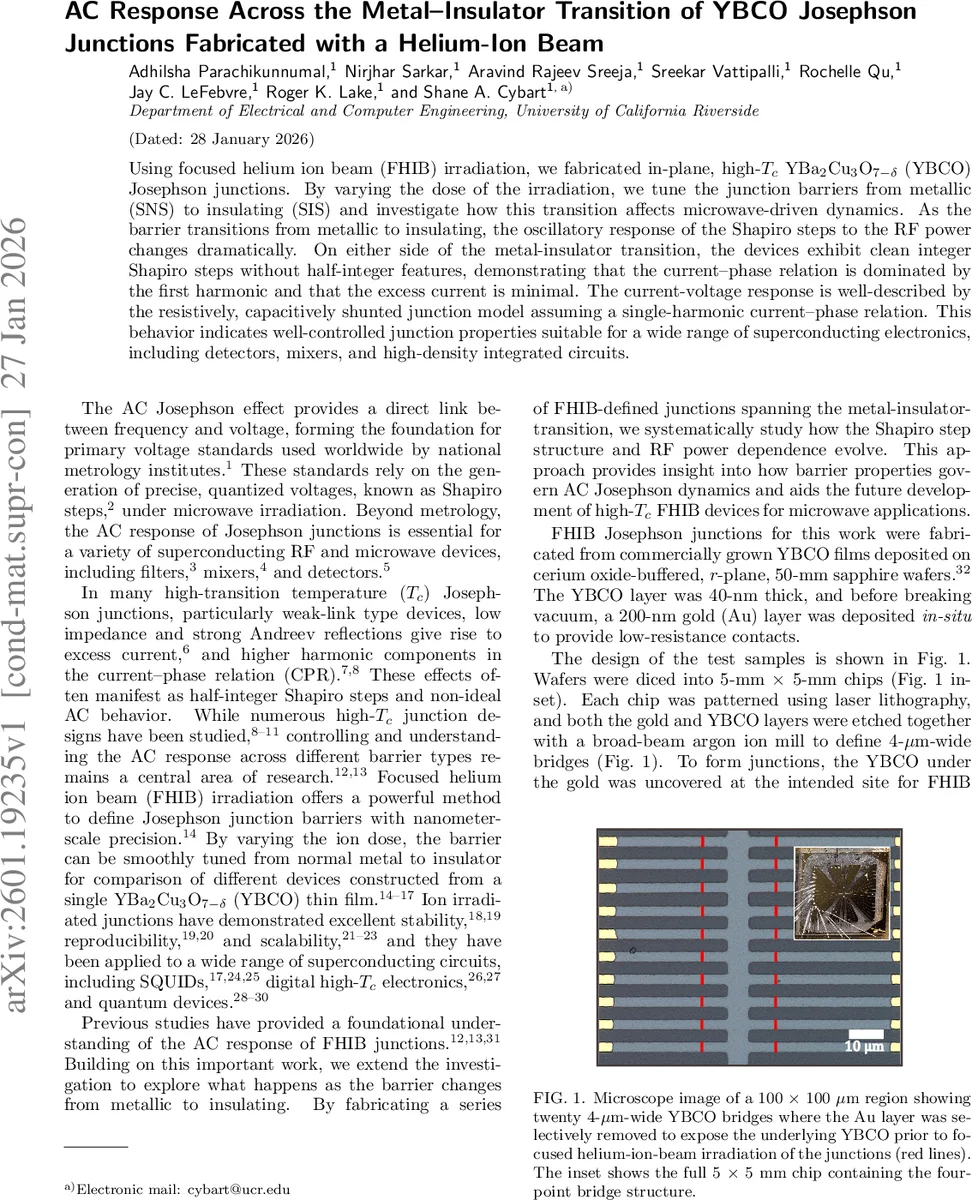
In this work the authors employ focused helium ion beam (FHIB) irradiation to fabricate in‑plane Josephson junctions from a 40 nm YBa₂Cu₃O₇₋δ (YBCO) thin film capped with a 200 nm Au contact layer. By varying the ion dose from 1.6 × 10¹⁶ to 3.4 × 10¹⁶ ions cm⁻² they continuously tune the barrier from a metallic normal metal (SNS) to an insulating (SIS) regime, with an intermediate dose (2.4 × 10¹⁶ ions cm⁻²) that sits at the metal‑insulator crossover. Standard four‑point transport measurements confirm the expected temperature dependence: the SNS devices follow the de Gennes (1 – T/T_c)² law for I_c(T) and show a linearly decreasing resistance, whereas the SIS devices display an increasing resistance on cooling and a low‑temperature saturation of I_c.
The AC response is probed by applying an 18 GHz microwave signal through a coaxial antenna positioned inside a PPMS. Shapiro steps are recorded for a range of microwave powers. Remarkably, both SNS and SIS junctions exhibit only integer steps (n = 0–4) with no half‑integer or anomalous features, indicating that the current‑phase relation (CPR) is dominated by the first harmonic (I_s = I_c sin φ) and that excess current is negligible. The step amplitudes follow Bessel‑like oscillations as a function of microwave power, consistent with the classic AC Josephson effect.
To quantify the deviations from the ideal model, the authors compare the measured step amplitudes with predictions from the Kautz model for low reduced frequency (Ω = f/f_c < 1). Using the experimentally extracted I_cR products (≈54 µV for the SNS device at 30 K and ≈150 µV for the SIS device at 1.6 K) they obtain reduced frequencies Ω ≈ 0.69 and 0.25, respectively. The observed maximum step currents are roughly 60 % of the Kautz ideal values for the SNS junction and 59 % for the SIS junction. These discrepancies are attributed to a combination of thermal noise, the finite junction length (≈3 nm) relative to the Josephson penetration depth, and the fact that the devices lie between the point‑contact and long‑junction limits.
Further insight is gained by numerical simulations of a modified resistively and capacitively shunted junction (RCSJ) model that includes thermal noise and a possible third harmonic in the CPR. By fitting the oscillatory region of the normalized zero‑voltage step amplitude, the authors find that a third‑harmonic amplitude of only 2 % of the first harmonic best reproduces the data. This small non‑sinusoidal component confirms that the CPR remains essentially sinusoidal across the metal‑insulator transition.
A particularly striking result is obtained for the crossover device (2.4 × 10¹⁶ ions cm⁻²). At low microwave power the Shapiro step amplitude exhibits the long‑period oscillations characteristic of a metallic barrier, while at higher power the oscillations abruptly switch to the short‑period behavior typical of an insulating barrier. This power‑induced transition is reproducible across multiple chips and underscores the sensitivity of the AC dynamics to the underlying barrier conductivity.
Overall, the study demonstrates that FHIB irradiation provides a powerful, dose‑controlled method to engineer YBCO Josephson junctions with precisely tunable barrier properties. The ability to maintain clean integer Shapiro steps and a nearly pure sinusoidal CPR across the metal‑insulator transition makes these junctions highly attractive for superconducting microwave applications such as detectors, mixers, primary voltage standards, and high‑density superconducting integrated circuits.
Comments & Academic Discussion
Loading comments...
Leave a Comment