Geometry-Grounded Gaussian Splatting
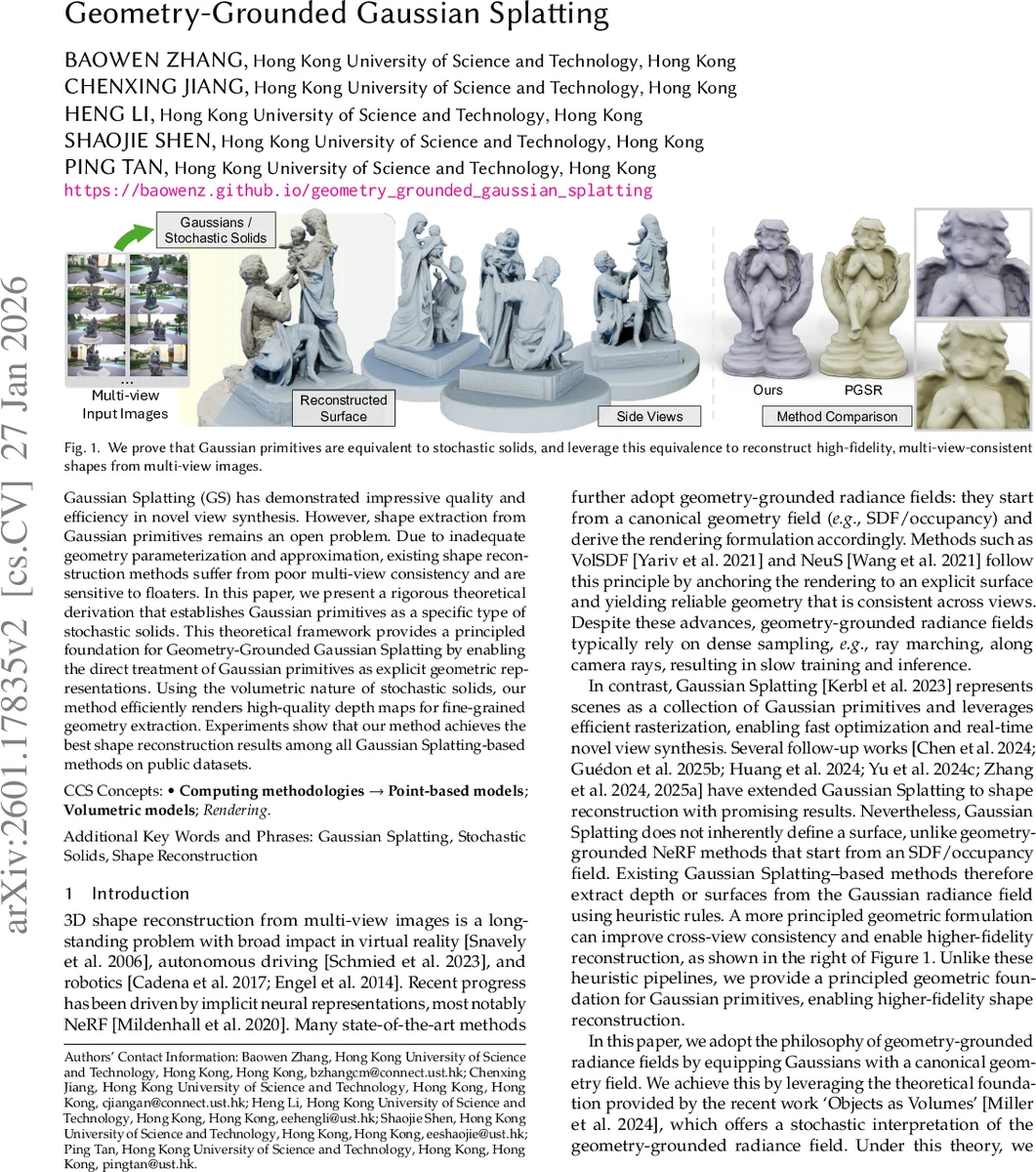
Gaussian Splatting (GS) has demonstrated impressive quality and efficiency in novel view synthesis. However, shape extraction from Gaussian primitives remains an open problem. Due to inadequate geometry parameterization and approximation, existing shape reconstruction methods suffer from poor multi-view consistency and are sensitive to floaters. In this paper, we present a rigorous theoretical derivation that establishes Gaussian primitives as a specific type of stochastic solids. This theoretical framework provides a principled foundation for Geometry-Grounded Gaussian Splatting by enabling the direct treatment of Gaussian primitives as explicit geometric representations. Using the volumetric nature of stochastic solids, our method efficiently renders high-quality depth maps for fine-grained geometry extraction. Experiments show that our method achieves the best shape reconstruction results among all Gaussian Splatting-based methods on public datasets.
💡 Research Summary
The paper addresses the long‑standing problem of extracting reliable geometry from Gaussian Splatting (GS), a representation that excels at novel‑view synthesis but lacks an intrinsic surface definition. By leveraging the stochastic‑solid framework introduced in “Objects as Volumes” (Miller et al., 2024), the authors prove that a 3D Gaussian primitive can be interpreted as a stochastic opaque solid whose occupancy O and vacancy v satisfy v = 1 − G(x), where G(x) is the Gaussian density. This equivalence shows that the volumetric rendering of such a solid matches the rasterized alpha‑blending used in conventional GS, providing a rigorous geometric foundation for the primitives.
Building on this theory, the authors devise a depth‑rendering pipeline. Instead of the heuristic median‑depth definition (the point where transmittance drops to 0.5) used by prior GS‑based methods, they model attenuation continuously via the derived σ coefficient, yielding a smooth, monotonic transmittance curve. The median depth tₘₑd is then located precisely by binary search on the transmittance curve. Crucially, they derive a closed‑form gradient of tₘₑd with respect to all Gaussian parameters (position, covariance, opacity), enabling back‑propagation of a depth loss directly into the GS representation.
Experiments on public multi‑view datasets (DTU, Tanks & Temples) and additional complex scenes demonstrate that the proposed Geometry‑Grounded Gaussian Splatting (GG‑GS) achieves the lowest Chamfer distances and highest F‑scores among all GS‑based reconstruction methods. The method produces smooth, multi‑view‑consistent depth maps, eliminates floating artifacts, and retains the real‑time training and inference speed characteristic of GS because the depth rendering adds negligible overhead.
In summary, the work provides a mathematically sound bridge between GS and explicit geometry, introduces an efficient, differentiable depth extraction technique, and sets a new state‑of‑the‑art for shape reconstruction using Gaussian primitives. This advancement opens the door for high‑fidelity, real‑time 3D reconstruction in applications such as robotics, AR/VR, and autonomous navigation.
Comments & Academic Discussion
Loading comments...
Leave a Comment