coTherapist: A Behavior-Aligned Small Language Model to Support Mental Healthcare Experts
Access to mental healthcare is increasingly strained by workforce shortages and rising demand, motivating the development of intelligent systems that can support mental healthcare experts. We introduce coTherapist, a unified framework utilizing a small language model to emulate core therapeutic competencies through domain-specific fine-tuning, retrieval augmentation, and agentic reasoning. Evaluation on clinical queries demonstrates that coTherapist generates more relevant and clinically grounded responses than contemporary baselines. Using our novel T-BARS rubric and psychometric profiling, we confirm coTherapist exhibits high empathy and therapist-consistent personality traits. Furthermore, human evaluation by domain experts validates that coTherapist delivers accurate, trustworthy, and safe responses. coTherapist was deployed and tested by clinical experts. Collectively, these findings demonstrate that small models can be engineered to exhibit expert-like behavior, offering a scalable pathway for digital mental health tools.
💡 Research Summary
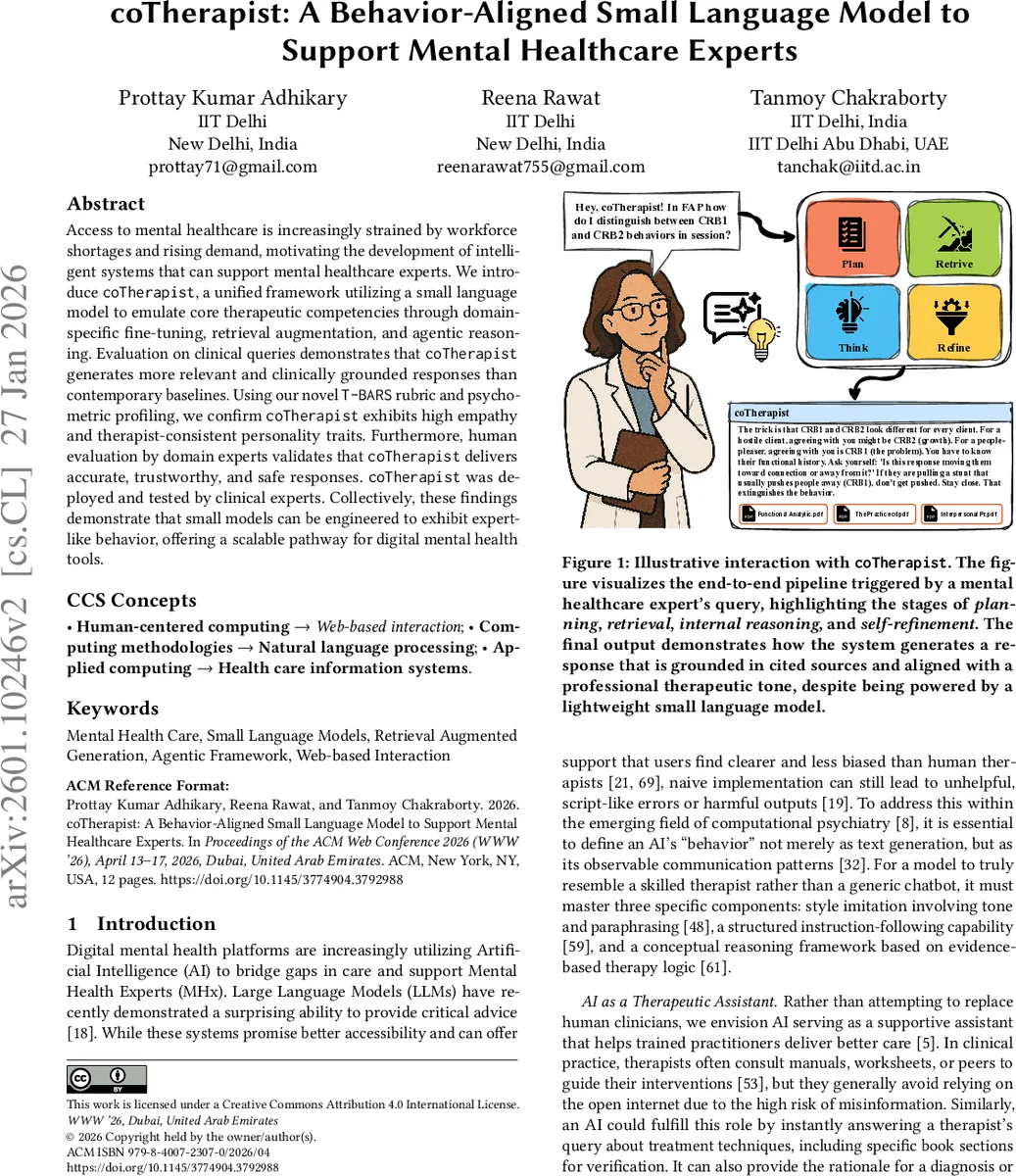
The paper presents coTherapist, a compact yet clinically competent AI assistant designed to support mental‑health professionals rather than replace them. Using a 1‑billion‑parameter LLaMA 3.2‑Instruct model as a base, the authors apply a multi‑stage engineering pipeline: (1) domain‑adaptive pre‑training on a newly curated Psychotherapy Knowledge Corpus (PsyKC) of over 800 million tokens, which aggregates textbooks, lecture transcripts, therapy manuals, diagnostic guidelines, and related resources; each entry is annotated with primary topic, therapeutic modality, and specific disorder metadata to enable precise retrieval. (2) LoRA fine‑tuning to align the model’s conversational style with therapist‑like behaviors such as reflective listening, validation, and paraphrasing. (3) Retrieval‑augmented generation (RAG) that fetches the top‑3 relevant passages from PsyKC for every clinical query, ensuring that responses are grounded in evidence‑based material. (4) An agentic reasoning loop called “Plan‑Retrieve‑Think‑Refine” that mirrors a therapist’s workflow: the system first drafts a plan, retrieves supporting documents, performs internal step‑by‑step reasoning, and finally passes the draft through a self‑critique module that checks safety, factual grounding, and tone.
To evaluate the system, the authors introduce T‑BARS, a novel therapist‑behavior rating scale covering four pillars—Behavioral Style, Conceptual Reasoning, Relational Competence, and Technique Execution—broken down into 20 sub‑skills. They combine automated LLM judges with human expert assessments (15 clinicians) and standard NLG metrics (BLEU, ROUGE‑L, BERTScore, InfoLM). Across all metrics, coTherapist outperforms contemporary baselines, especially in empathy (a 0.3‑point gain, roughly 30 % improvement) and safety (near‑zero harmful utterances). Human raters preferred coTherapist’s answers in 87 % of cases, citing higher relevance, clearer rationale, and more therapeutic tone.
Importantly, the study demonstrates that a small model can achieve clinically useful performance while keeping computational costs low enough for edge deployment in resource‑constrained settings (e.g., community clinics, mobile devices). The authors also report a pilot deployment where clinicians used coTherapist to quickly retrieve protocol excerpts, obtain phrasing suggestions, and verify diagnostic reasoning, reporting noticeable time savings and increased confidence in evidence‑based decision making.
Overall, the work argues that “behavioral alignment”—focusing on the observable communication patterns of a therapist—can be more impactful than raw language generation capacity. By integrating domain‑specific pre‑training, style fine‑tuning, retrieval grounding, and structured internal reasoning, coTherapist showcases a scalable pathway for building trustworthy, empathetic AI assistants in mental‑health care.
Comments & Academic Discussion
Loading comments...
Leave a Comment