Automating Box Folding: Sequence Extraction and Ranking Methodologies
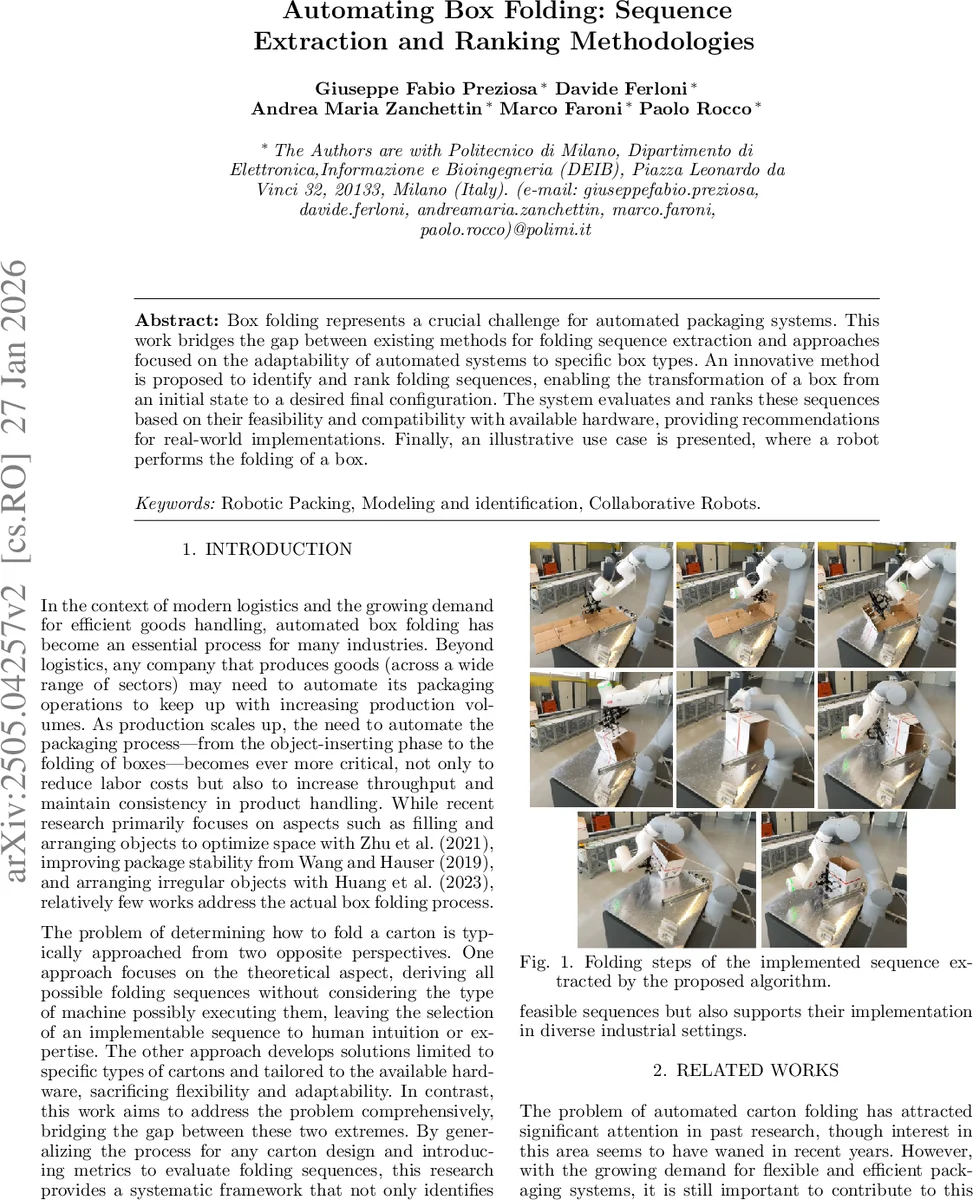
Box folding represents a crucial challenge for automated packaging systems. This work bridges the gap between existing methods for folding sequence extraction and approaches focused on the adaptability of automated systems to specific box types. An innovative method is proposed to identify and rank folding sequences, enabling the transformation of a box from an initial state to a desired final configuration. The system evaluates and ranks these sequences based on their feasibility and compatibility with available hardware, providing recommendations for real-world implementations. Finally, an illustrative use case is presented, where a robot performs the folding of a box.
💡 Research Summary
The paper addresses a fundamental challenge in modern automated packaging: the systematic generation and selection of feasible box‑folding sequences that can be directly executed by industrial robots. While prior work has either focused on exhaustive theoretical enumeration of folding orders without regard to machine constraints, or on hardware‑specific solutions that lack generality, this study proposes a unified framework that bridges the two extremes.
Modeling – The authors adopt a kinematic mechanism representation where each panel is a rigid link and each crease is a revolute joint. The structural dependencies among panels are captured in a binary connectivity matrix C, which encodes parent‑child relationships (i.e., a motion of a parent panel influences its children). The complete state of a box at any time t is defined as S = {θ, C}, where θ is the vector of joint angles. Physical attributes (height, width, thickness) and spatial centroids of panels are stored in matrices D and P, enabling accurate geometric calculations. A dynamic graph Gₜ = (V, Eₜ) reflects the evolving topology and degrees of freedom throughout the folding process.
Sequence Extraction – The folding task is formalized as a discrete‑time control problem. At each step only one joint may rotate (action vector uₜ), ensuring a clear, collision‑free progression. A collision‑checking function C C(Sₜ, uₜ) validates each candidate move. All admissible actions are organized into a decision tree where each node stores the current state, its parent, and the action that generated it. The authors employ the back‑tracking algorithm of Gurari and Eitan (1999), a depth‑first search that prunes any branch failing the collision test. Every path that reaches the target state S_f is recorded as a feasible folding sequence σ. This exhaustive yet efficient exploration guarantees that no valid ordering is omitted.
Evaluation Metrics – The novelty of the work lies in three cost functions designed to rank the feasible sequences according to practical robot constraints:
-
Bounding‑Box Volume (C_vol) – For each intermediate state Sₜ the smallest axis‑aligned bounding box volume V(Sₜ) = l·w·h is computed. The cumulative volume Σ V(Sₜ) over the whole sequence is minimized, promoting compact folding and reducing the chance of external collisions.
-
Maximum Dimension (C_dim) – The largest side of the bounding box, MaxDim(Sₜ) = max(l, w, h), is summed across all steps. Minimizing this metric directly addresses robot workspace limits, ensuring that the box never exceeds the robot’s reachable envelope.
-
Aerial Folds (C_aerial) – An indicator a(Sₜ) flags whether a fold occurs “in the air” (i.e., without support from the workbench). The total count Σ a(Sₜ) is minimized because aerial folds are more susceptible to gravity‑induced variability and material flex, leading to lower repeatability.
These metrics can be used individually or combined via weighted sums, allowing system integrators to prioritize criteria that match their hardware capabilities (e.g., limited reach, limited force, or need for high repeatability).
Implementation and Case Study – The methodology was implemented on a 6‑axis industrial robot equipped with a custom gripper. A simple three‑panel cardboard box served as the test object. Simulation generated twelve candidate sequences; after evaluating them with the three cost functions, the two lowest‑cost sequences were selected for real‑world execution. The robot successfully completed the folding in 1.8 seconds without any collisions, outperforming traditional fixture‑based systems that typically require 3–4 seconds and need hardware redesign for each new box geometry.
Strengths – The paper’s strengths include a rigorous mathematical formulation, an exhaustive yet computationally tractable search algorithm, and practical evaluation metrics that map directly onto robot design constraints. The experimental validation demonstrates that the approach is not merely theoretical but can be deployed on existing industrial hardware.
Limitations and Future Work – The current model treats panel material properties (thickness, elasticity) as static parameters, which limits accuracy for highly flexible or anisotropic materials. The decision‑tree search scales poorly with the number of joints; for complex cartons with many panels the combinatorial explosion may become prohibitive. The authors suggest integrating heuristic pruning, reinforcement‑learning policies, or machine‑learning‑based approximations to mitigate this. Additionally, incorporating real‑time sensor feedback (vision, force/torque) could enable adaptive replanning when unexpected disturbances occur.
Conclusion – By unifying general folding‑sequence extraction with hardware‑aware ranking, the paper provides a valuable bridge between theoretical kinematics and practical robotics. Its contribution paves the way for more flexible, scalable, and cost‑effective automated packaging lines capable of handling a wide variety of box designs without extensive fixture redesigns. Future extensions that address material non‑linearity and real‑time adaptability will further enhance its applicability in high‑throughput manufacturing environments.
Comments & Academic Discussion
Loading comments...
Leave a Comment