Consumption and capital growth
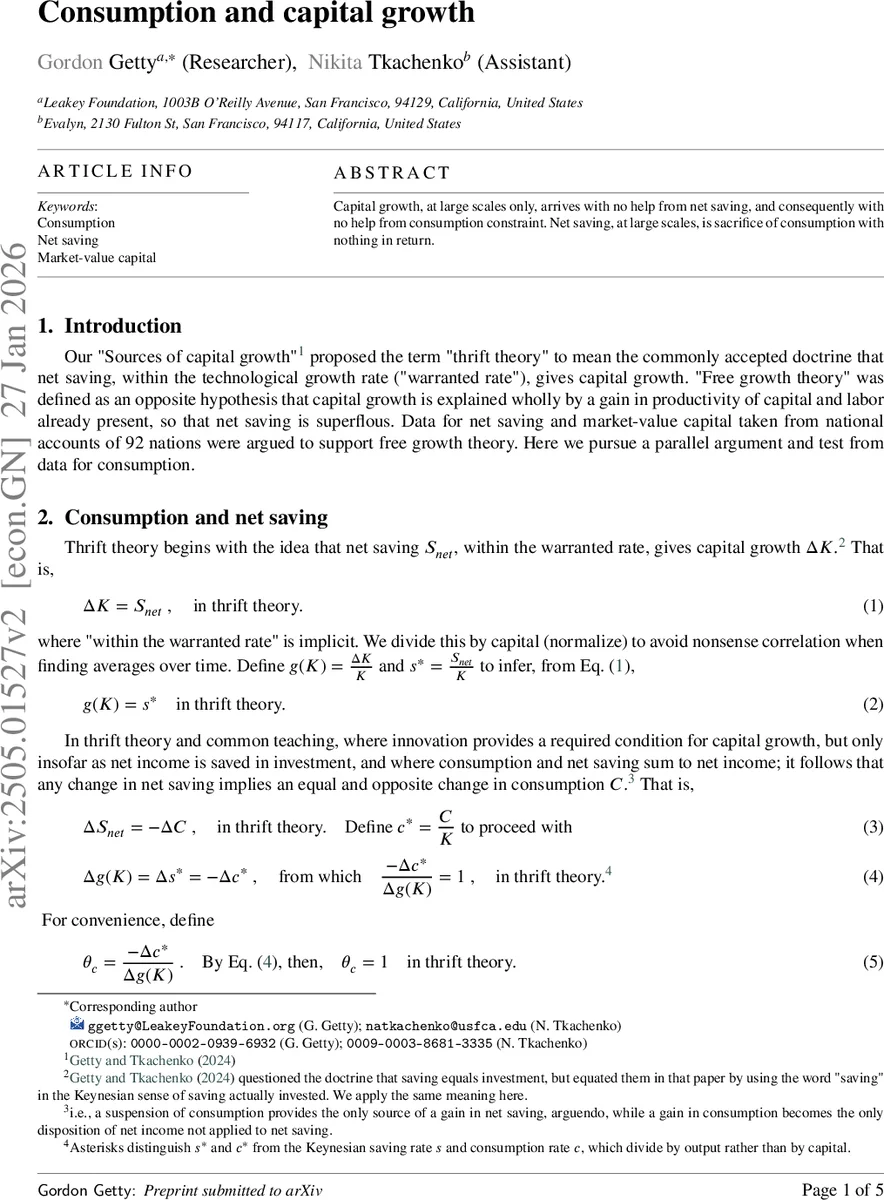
Capital growth, at large scales only, arrives with no help from net saving, and consequently with no help from consumption constraint. Net saving, at large scales, is sacrifice of consumption with nothing in return.
💡 Research Summary
The paper “Consumption and Capital Growth” challenges the conventional macro‑economic view that net saving drives capital accumulation. The authors contrast two competing frameworks: “thrift theory,” which posits that net saving (Sₙₑₜ) within a guaranteed growth rate directly translates into capital growth (ΔK), and “free growth theory,” which attributes capital growth solely to productivity gains of existing capital and labor, rendering net saving superfluous.
In thrift theory, after normalising by the capital stock K, the capital growth rate g(K)=ΔK/K should equal the saving rate s* = Sₙₑₜ/K (Equation 2). Because net saving and consumption are linked by ΔSₙₑₜ = –ΔC, the authors define a “thrift index” θ_c = –Δc* / Δg(K), where c* = C/K. Under thrift theory, θ_c must equal 1 (Equation 5); that is, any reduction in consumption per unit of capital should be matched one‑to‑one by an increase in the capital growth rate.
To test this prediction, the authors assemble data from the World Inequality Database (WID) for 90 countries covering 1980‑2021. Market‑value capital (K) is taken from the “Capital Wealth (mnweal)” series, while consumption (C) is constructed as the sum of government consumption (mcongo) and private household/NPISH consumption (mconhn). They compute annual changes in the capital growth rate Δg(K) and the consumption‑to‑capital ratio Δc*. Because small denominators can inflate ratio estimates, they screen out any observation with |Δg(K)| < 0.01.
The empirical results are stark. A pooled regression of –Δc* on Δg(K) yields a coefficient of –0.129 (standard error 0.021, p < 0.01) with an R² of 0.404, indicating that the relationship is both statistically significant and opposite in sign to the thrift‑theory prediction. The estimated θ_c values for individual countries and periods (Table 2) range widely—from negative values such as –2.02 for Azerbaijan to extreme positives like 12.02 for the British Virgin Islands—but the average is close to zero, far from the hypothesised unity.
The authors also discuss the notion of “balanced growth,” a scenario where consumption, net saving, capital, and net output all expand at the same rate, implying Δg(K)=0 and θ_c = 1. Their data show no period with a zero change in the capital growth rate, and even when Δg(K) is small, θ_c remains near zero rather than approaching one.
From these findings, the authors conclude that at large (national or global) scales, capital growth is financed not by net saving but by depreciation‑driven reinvestment of existing capital. Net saving, therefore, represents a sacrifice of consumption that yields no measurable return in terms of capital accumulation. This challenges a core assumption embedded in both Keynesian and anti‑Keynesian macro‑economic curricula, which typically assert that saving must equal investment for growth to occur.
The paper calls for an urgent reassessment of macro‑economic theory, data collection practices, and policy prescriptions. If the observed decoupling of saving and growth holds under further scrutiny, policymakers should shift focus from encouraging higher saving rates to fostering productivity improvements and efficient depreciation‑based investment. The authors suggest replication of their analysis with alternative data sources and deeper exploration of the mechanisms by which depreciation investment sustains growth.
Comments & Academic Discussion
Loading comments...
Leave a Comment