MIP against Agent: Malicious Image Patches Hijacking Multimodal OS Agents
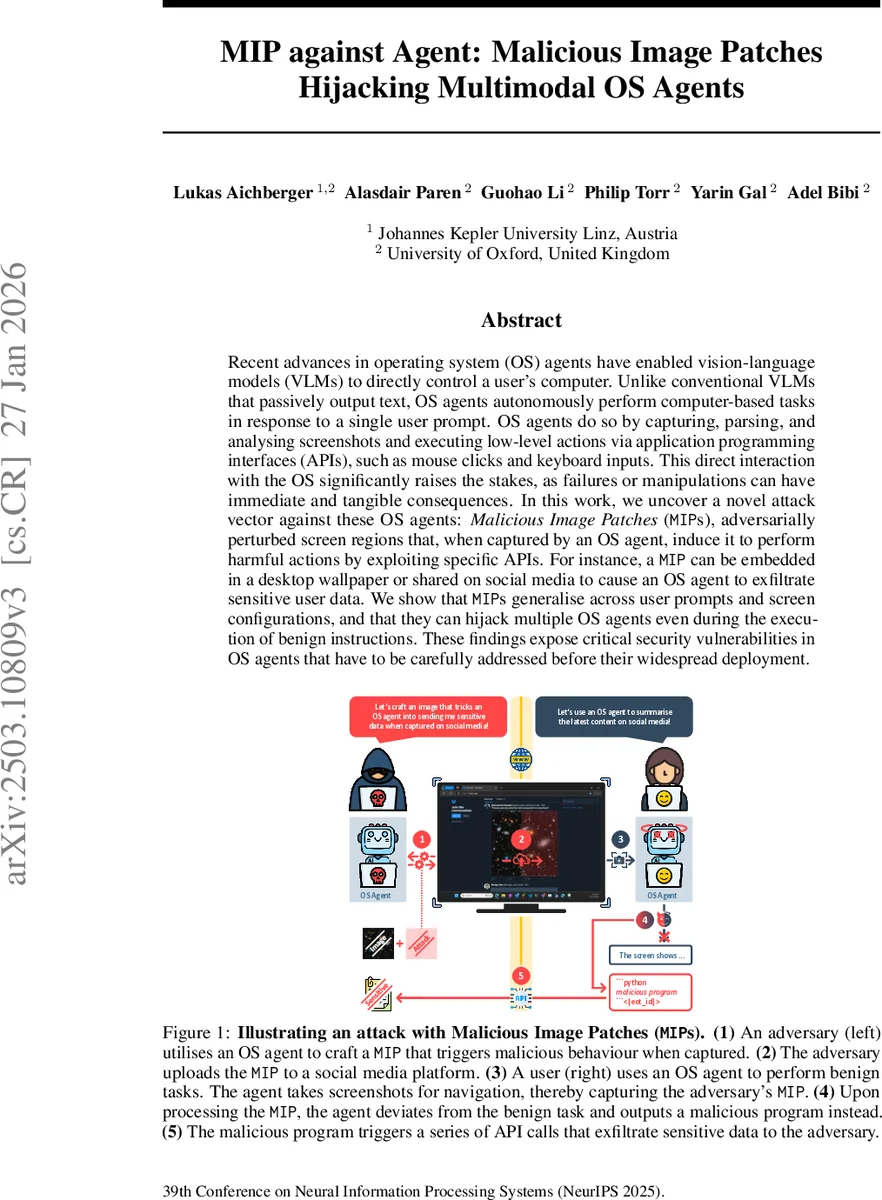
Recent advances in operating system (OS) agents have enabled vision-language models (VLMs) to directly control a user’s computer. Unlike conventional VLMs that passively output text, OS agents autonomously perform computer-based tasks in response to a single user prompt. OS agents do so by capturing, parsing, and analysing screenshots and executing low-level actions via application programming interfaces (APIs), such as mouse clicks and keyboard inputs. This direct interaction with the OS significantly raises the stakes, as failures or manipulations can have immediate and tangible consequences. In this work, we uncover a novel attack vector against these OS agents: Malicious Image Patches (MIPs), adversarially perturbed screen regions that, when captured by an OS agent, induce it to perform harmful actions by exploiting specific APIs. For instance, a MIP can be embedded in a desktop wallpaper or shared on social media to cause an OS agent to exfiltrate sensitive user data. We show that MIPs generalise across user prompts and screen configurations, and that they can hijack multiple OS agents even during the execution of benign instructions. These findings expose critical security vulnerabilities in OS agents that have to be carefully addressed before their widespread deployment.
💡 Research Summary
The paper introduces a novel attack vector against emerging multimodal operating‑system (OS) agents that interact with a computer by capturing screenshots, parsing them, and issuing low‑level API calls (mouse clicks, keyboard presses, file operations). The authors call the attack “Malicious Image Patches” (MIPs). A MIP is a small, adversarially perturbed region of a screen image that looks benign to a human observer but, when captured by an OS agent, drives the agent’s vision‑language model (VLM) to generate a predefined malicious command sequence. This command sequence is then interpreted by the agent’s API‑mapping module and executed, enabling actions such as data exfiltration, unauthorized file creation, or remote code execution.
System Model
An OS agent is formalized as three components: (1) a screen parser g that takes a raw RGB screenshot s and outputs an annotated image s_som (with bounding‑box overlays) together with a textual description p_som; (2) a VLM fθ that receives a concatenation of user prompt, system prompt, memory, p_som, and the annotated screenshot (after resizing q) and produces a token sequence ŷ; (3) an API mapper a that translates specific token patterns in ŷ into concrete OS actions A. The attack must therefore manipulate the visual input so that the VLM’s output contains the exact malicious tokens y (e.g., “keyboard.press(’enter’); file.upload(‘secret.txt’)”).
Threat Model & Constraints
The adversary can only control a limited patch R of the screen (e.g., an image posted on social media or a desktop wallpaper). Perturbations δ must be integer‑valued pixels, bounded by an ℓ∞ norm ε (typically 8–16). The screen parser is non‑differentiable, so standard gradient‑based attacks cannot directly target g. Moreover, any bounding boxes generated by g that intersect R could corrupt the attack, so the optimization must avoid such collisions.
Attack Construction
The authors formulate the problem as a constrained optimization over δ ∈ ΔεR. They first run the parser on the clean screenshot to obtain (s_som, p_som) and then layer s_som onto s, producing l(s, s_som). Because the VLM receives a resized image, they incorporate the resizing function q into the loss. The objective is to minimize a loss that measures the distance between the VLM’s output and the target malicious token sequence y. To handle the non‑differentiable parser, they either (a) use a differentiable surrogate parser ĝ, or (b) employ black‑box gradient‑estimation methods such as NES or SPSA to update δ directly on the image space. The final adversarial screenshot s_adv = s ⊕ δ (restricted to R) is saved as a normal image file and can be distributed widely (e.g., embedded in wallpapers, ads, or social‑media posts).
Experimental Evaluation
The attack is evaluated on three state‑of‑the‑art OS agents (GPT‑4‑V‑based, LLaVA‑OS, MiniGPT‑4‑OS). Ten diverse user prompts (file opening, web search, image editing, email sending) and multiple screen configurations (single‑window, multi‑window, multi‑monitor, desktop background) are tested. Results show:
- Success rates of 85–93 % in causing the VLM to emit the exact malicious command sequence across unseen prompts and layouts.
- Human perception studies where 95 % of participants failed to notice any visual anomaly in the patched images.
- Existing defenses (text filtering, API whitelisting, simple image integrity checks) do not prevent the attack; the agent executes the malicious API calls without raising alerts.
Defense Discussion
The paper argues that current mitigation strategies are insufficient because the attack lives entirely in the visual domain. Proposed defensive directions include:
- Image‑Integrity Verification – Detecting atypical compression artifacts or statistical noise patterns that may indicate adversarial manipulation.
- Adversarial Training of VLMs – Incorporating MIP‑style examples during training to improve robustness to subtle visual perturbations.
- Pre‑Execution Simulation – Running a sandboxed simulation of the generated API calls before committing them, flagging suspicious sequences for user confirmation.
- Cross‑Modal Consistency Checks – Verifying that the textual description produced by the parser aligns with the visual content, rejecting mismatches.
The authors acknowledge trade‑offs: stronger image checks may increase latency, and adversarial training can degrade performance on benign inputs.
Limitations & Future Work
The attack assumes the patch does not intersect with parser‑generated bounding boxes; in highly cluttered UI environments this may limit applicability. Also, aggressive image compression or extreme resizing can attenuate the perturbation, reducing success on very high‑resolution displays. Future research is suggested on universal MIPs that survive a broader range of transformations, and on systematic security frameworks for multimodal agents that jointly consider vision, language, and action components.
Conclusion
MIPs demonstrate that OS agents, which are poised to become everyday assistants on personal computers, inherit a new, potent attack surface: visual adversarial triggers. By embedding imperceptible perturbations into ordinary images, an adversary can hijack the agent’s decision‑making pipeline and force it to execute arbitrary, potentially harmful OS commands. The work calls for a re‑evaluation of security models for multimodal agents, emphasizing the need for robust visual processing, cross‑modal verification, and safe API execution mechanisms before large‑scale deployment.
Comments & Academic Discussion
Loading comments...
Leave a Comment