An Extension of the $sl(n)$ Polynomial to Knotted 4-Valent Graphs
We use planar 4-valent graphs and a graphical calculus involving such graphs to construct an invariant for balanced-oriented, knotted 4-valent graphs. Our invariant is an extension of the $sl(n)$ polynomial for classical knots and links. We also provide a minimal generating set of Reidemeister-type moves for diagrams of balanced-oriented, knotted 4-valent graphs.
💡 Research Summary
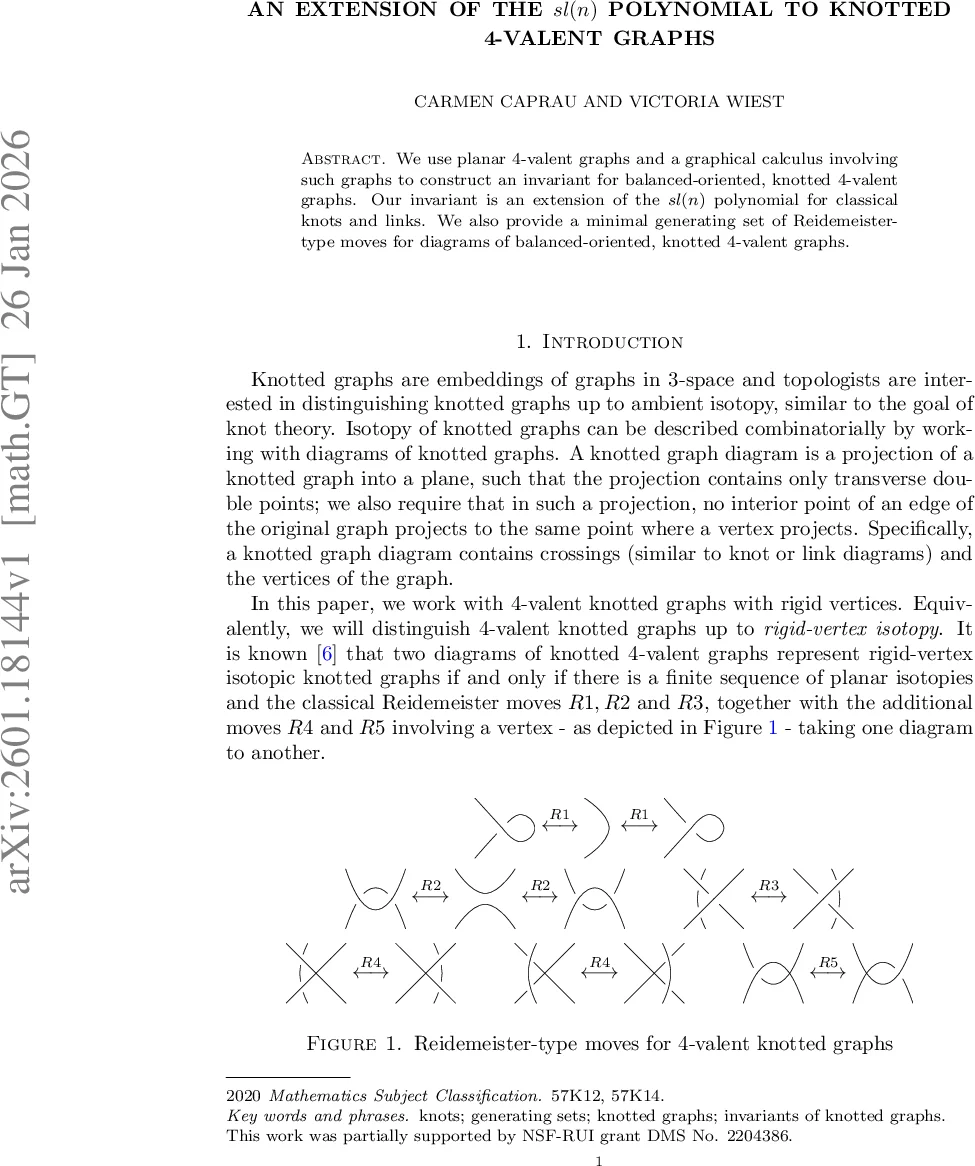
This paper, titled “An Extension of the $sl(n)$ Polynomial to Knotted 4-Valent Graphs,” by Carmen Caprau and Victoria Wiest, makes two primary contributions to the theory of knotted graphs. First, it constructs a new polynomial invariant, denoted P, for balanced-oriented knotted 4-valent graphs with rigid vertices, which extends the well-known $sl(n)$ polynomial invariant for classical knots and links. Second, it identifies a minimal generating set of Reidemeister-type moves for diagrams of such graphs, significantly simplifying the proof of invariance for P and other potential invariants.
The invariant P is built using a graphical calculus based on skein relations. Given a diagram D of a knotted graph, its crossings are resolved using skein relations identical to those for the $sl(n)$ polynomial (Figure 3). This process yields a linear combination of states, which are diagrams of planar 4-valent graphs containing only the balanced-oriented vertices (of types In-In-Out-Out and In-Out-In-Out). These planar graphs are then evaluated using a novel set of graphical skein relations (Figure 4). These relations provide rules for: converting an In-Out-In-Out vertex into a linear combination of graphs with In-In-Out-Out vertices; evaluating graphs containing loops or bigons; and simplifying graphs based on local configurations like triangles. Proposition 2.2 proves the uniqueness of this evaluation process under the given rules, ensuring P is well-defined. The invariant ultimately takes values in the ring Z
Comments & Academic Discussion
Loading comments...
Leave a Comment