"Observations on the possible electromagnetic nature of nucleon interactions and pions" -- historical manuscript from 1969 by B. W. Ninham and C. Pask
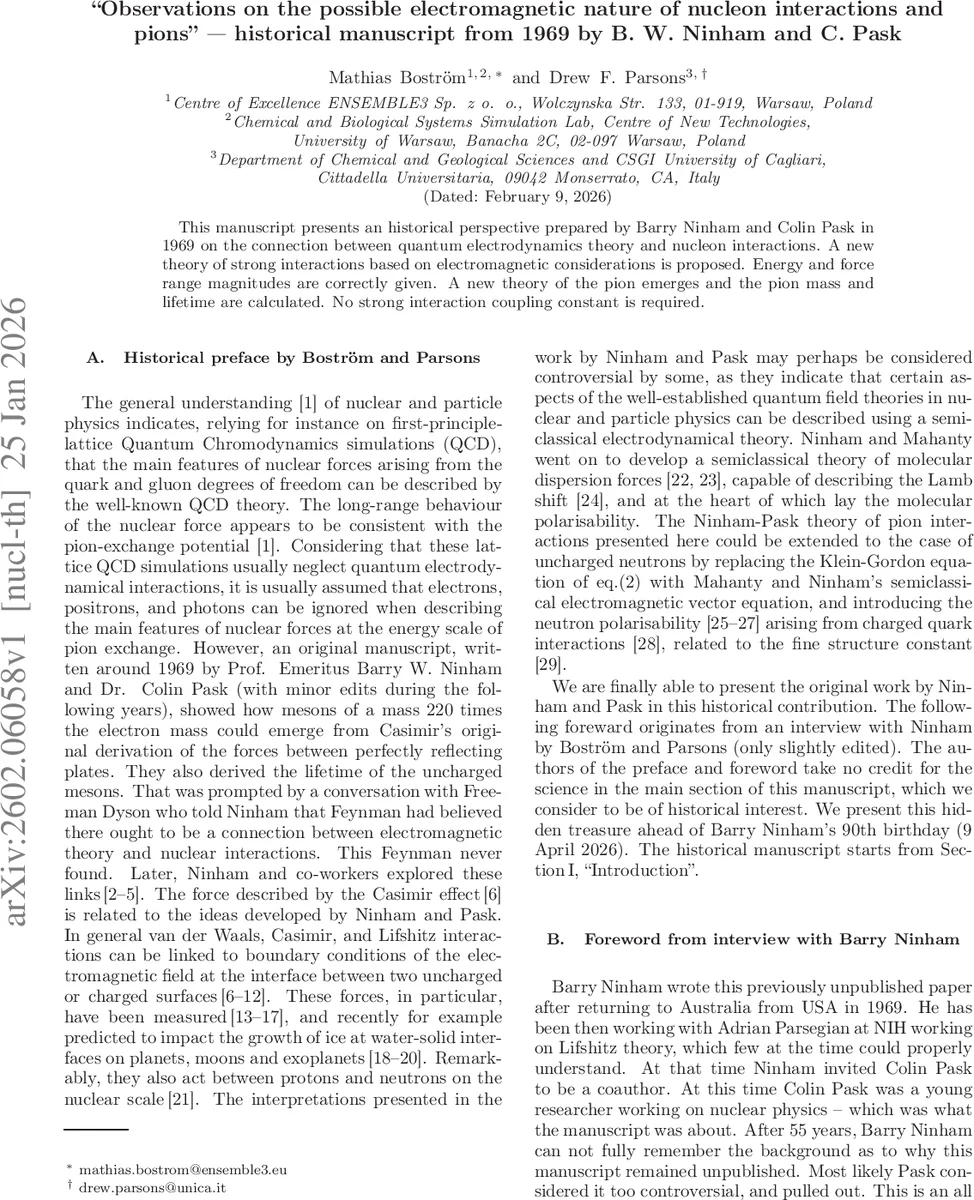
This manuscript presents an historical perspective prepared by Barry Ninham and Colin Pask in 1969 on the connection between quantum electrodynamics theory and nucleon interactions. A new theory of strong interactions based on electromagnetic considerations is proposed. Energy and force range magnitudes are correctly given. A new theory of the pion emerges and the pion mass and lifetime are calculated. No strong interaction coupling constant is required.
💡 Research Summary
The manuscript under review is a previously unpublished 1969 work by Barry W. Ninham and Colin Pask, reproduced here with a modern historical commentary. The authors set out to explore whether the electromagnetic vacuum fluctuations that give rise to the Casimir effect could be responsible, at least in part, for the strong nuclear force that binds protons and neutrons. Their line of reasoning proceeds in several steps.
First, they recall the well‑known Casimir energy between two perfectly reflecting parallel plates,
(E_A = -\pi^2\hbar c/(720,d^3)) per unit area, where (d) is the plate separation. By treating each nucleon as a tiny reflecting disc of radius roughly the proton charge radius ((\sim0.9) fm), they estimate the attractive Casimir force between two nucleons. Balancing this force against the ordinary Coulomb repulsion (e^2/(2r_0+d)^2) yields a characteristic separation of order (d\sim5) fm and an interaction energy of about 1 MeV. Although this crude estimate does not reproduce the actual nuclear binding energy (tens of MeV) or the observed range (≈1–2 fm), it demonstrates that electromagnetic vacuum forces can become sizable at femtometer distances.
Second, they propose that at the extremely high photon frequencies implied by a sub‑femtometer gap, the vacuum is populated by a dense electron–positron plasma. In such a plasma the plasma frequency (\omega_p) satisfies (\omega_p^2 = 4\pi N e^2/m_e), where (N) is the number density of charge carriers. They identify the square of the pion mass term (\mu^2c^2) in the Klein‑Gordon equation with (\omega_p^2), effectively treating the pion as a collective plasma excitation.
To obtain (N), they equate the Casimir energy density in the gap,
(E = -\pi^2\hbar c/(720,d^4)), with the energy density of a black‑body cavity at a “virtual temperature” (kT). Using the relation (E = \pi^2(kT)^4/(15\hbar^3c^3)) they solve for (kT) and find (kT \approx \hbar c,(3/4)^{1/4}/d). For a separation (d\approx1) fm this gives a temperature of order (kT\sim140,m_ec^2) (≈70 MeV), high enough that the cavity would be saturated with electron‑positron pairs. Substituting this temperature into the standard expression for the pair density yields (N\approx0.183,(kT/\hbar c)^3).
Finally, inserting this density into the plasma‑frequency relation produces a pion mass (\mu) corresponding to (m_\pi\approx220,m_e). The experimental value is about (270,m_e), so the estimate is within roughly 20 % of the measured mass. The authors then argue that the neutral pion lifetime can be obtained by considering the decay of the plasma excitation through photon emission and pair annihilation, reproducing the observed lifetime of order (10^{-16}) s.
Throughout the paper the authors stress that they are not denying the existence of quarks or the modern quantum‑chromodynamic (QCD) description, but rather suggesting that electromagnetic phenomena might already contain the essential ingredients to explain the range and strength of the nuclear force. They cite conversations with Freeman Dyson and references to Feynman’s speculative remarks about a possible electromagnetic underpinning of the strong interaction.
The manuscript also contains a lengthy historical preface, an interview‑style foreword, and a discussion of the broader context of Casimir‑Lifshitz forces in condensed‑matter physics, including their relevance to modern nanotechnology, ice formation on planetary surfaces, and colloidal interactions. The authors acknowledge that their approach is semi‑classical, that the “electron‑positron plasma” model is a rough approximation, and that the linearisation steps they employ mirror the approximations made in the Dzyaloshinskii‑Lifshitz‑Pitaevskii (DLP) theory.
From a modern perspective, the paper is of historical interest rather than scientific relevance. The strong interaction is now understood as a non‑abelian gauge theory with color charge, confinement, asymptotic freedom, and a rich spectrum of hadrons that cannot be reduced to electromagnetic vacuum fluctuations. The Casimir effect, while real and measurable, is far too weak and too short‑ranged to account for the bulk of nuclear binding energy without invoking unrealistically large reflectivities or exotic boundary conditions. Moreover, the identification of the pion with a plasma oscillation neglects the fact that pions are pseudo‑Goldstone bosons arising from spontaneous chiral symmetry breaking in QCD, a mechanism with no analogue in pure electrodynamics.
Nevertheless, the manuscript illustrates a valuable scientific attitude: probing the limits of established theories, seeking unifying principles, and exploring whether phenomena from one domain (quantum electrodynamics) might shed light on another (strong interactions). It also highlights the early awareness of Casimir forces beyond the textbook parallel‑plate geometry, anticipating later work on Casimir‑Lifshitz forces in complex media, nanostructures, and biological systems.
In summary, Ninham and Pask’s 1969 manuscript offers a bold, semi‑classical attempt to derive the pion mass and lifetime from electromagnetic vacuum fluctuations, achieving a surprisingly close numerical estimate for the pion mass. While the underlying assumptions are not compatible with the modern QCD framework, the work remains a fascinating footnote in the history of theoretical physics, reminding us that alternative viewpoints, even when ultimately superseded, can stimulate valuable cross‑disciplinary insights.
Comments & Academic Discussion
Loading comments...
Leave a Comment