Comparison of the potential energy for different equilibrium configurations of symmetric and asymmetric floating drops
We provide a numerical method for computing solutions to a free boundary problem arising from the equilibrium state of a floating drop. This numerical method is based on a Newton’s method for the underlying nonlinear boundary value problems, and at each iterative step a Chebyshev spectral collocation method is employed. The problems considered here are those that can be described by using generating curves, and include problems in $\mathbb{R}^2$ and $\mathbb{R}^3$. The resulting nine-dimensional space of physical parameters is explored, and examples are given that highlight the potential energy of centrally located drops, wall-bound drops, and asymmetrical configurations in $\mathbb{R}^2$. Non-uniqueness of solutions to the corresponding Euler-Lagrange equations is displayed, and also strong evidence of non-uniqueness of energy minimizers is given.
💡 Research Summary
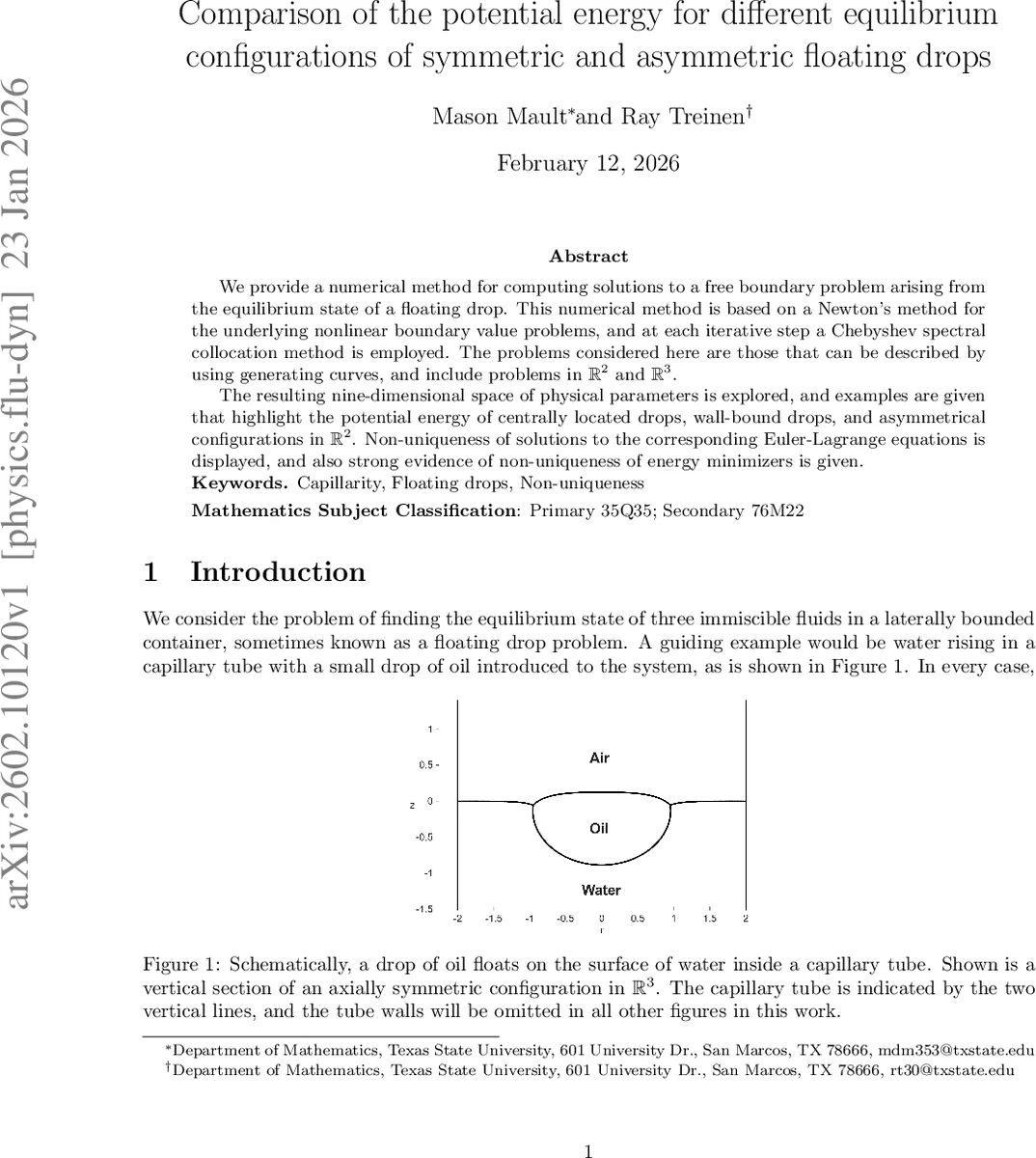
The paper addresses the equilibrium configurations of a floating drop—a volume of fluid with lower density than its surrounding fluids—confined within a laterally bounded container. Three immiscible fluids occupy the domain, and the interfaces between them are governed by surface tensions, contact angles, and gravity. The authors formulate a total energy functional that includes surface‑energy terms (σij |Sij|), gravitational potential energy, and wetting contributions on the container walls. By applying a variational principle, they derive the Young‑Laplace equations for each interface: 2H = κz ± λ/σ, where κ is a capillary constant depending on density differences and surface tension, and λ is a Lagrange multiplier enforcing the prescribed drop volume.
To obtain numerical solutions, the authors eliminate λ through a matching condition at the free boundary Γ, leading to explicit expressions for the physical interfaces u, v, and w that meet at a common radius (or horizontal coordinate) (\bar r). The governing equations are reduced to a system of ordinary differential equations parameterized by arc length s: dr/ds = cos ψ, dU/ds = sin ψ, dψ/ds = κU − sin ψ · r (in 3‑D), and an analogous set in 2‑D. Boundary conditions prescribe the inclination angle ψ at a chosen radius (or at the symmetry axis) and at the container wall.
The numerical algorithm combines a Newton iteration for the nonlinear boundary‑value problem with Chebyshev spectral collocation for the linearized sub‑problems. The Chebyshev points are placed on the interval of total arc length ℓ, typically using n + 1 = 14 points, which yields relative Newton tolerances of 10⁻¹⁴ and linear‑solve tolerances of 10⁻¹⁰. This approach is markedly more robust than earlier shooting methods and can handle inflection points and vertical tangents without loss of convergence. The authors note that extreme parameter regimes may still cause difficulties, but in their extensive testing (millions of solves) the method remained stable.
The physical parameter space is nine‑dimensional: drop volume V, container radius R, densities ρ₁ ≤ ρ₂ (with ρ₀ = 0 for the ambient fluid), three surface tensions σ₀₁, σ₀₂, σ₁₂, and two prescribed wall contact angles γ₁₀ᵖ, γ₂₀ᵖ. By sampling this space, the authors generate families of solutions for both centrally located drops (symmetric about the vertical axis) and wall‑bound drops (annular configurations). For each pair of configurations they compute the total energy and compare.
Key findings include:
-
Non‑uniqueness of solutions – For a given set of parameters, both a symmetric central drop and an asymmetric wall‑bound drop can satisfy the Euler‑Lagrange equations, demonstrating that the underlying free‑boundary problem admits multiple solutions.
-
Energy competition – In many cases the central drop has lower energy, but there are substantial regions of parameter space where the wall‑bound configuration is energetically favored. The authors provide detailed energy curves as the drop volume is varied.
-
Symmetry breaking – Certain parameter combinations produce asymmetric configurations (e.g., left‑right asymmetric drops in 2‑D) that possess lower energy than any symmetric counterpart, indicating that the system can spontaneously break symmetry to minimize energy.
-
Multiplicity of minimizers – Remarkably, for some parameter choices the energies of the central and wall‑bound drops are exactly equal (within numerical precision), implying that the global energy minimizer is not unique. This is the first reported instance of such non‑uniqueness for this class of capillary‑gravity problems.
The authors also propose a heuristic guideline for predicting when the central drop will be the minimizer, based on relative magnitudes of surface tensions and densities. However, a counter‑example in the 2‑D study shows that the heuristic can fail, underscoring the complexity of the parameter interactions.
The paper concludes with a discussion of the implications for both mathematical theory (e.g., existence and uniqueness results for capillary surfaces) and physical applications such as microfluidic devices and oil recovery, where understanding the preferred configuration of immiscible fluids is crucial. All code used for the simulations is made publicly available on GitHub, and the work was partially supported by NSF grant DMS‑2144232.
Comments & Academic Discussion
Loading comments...
Leave a Comment