Acyclic complexes and regular rings
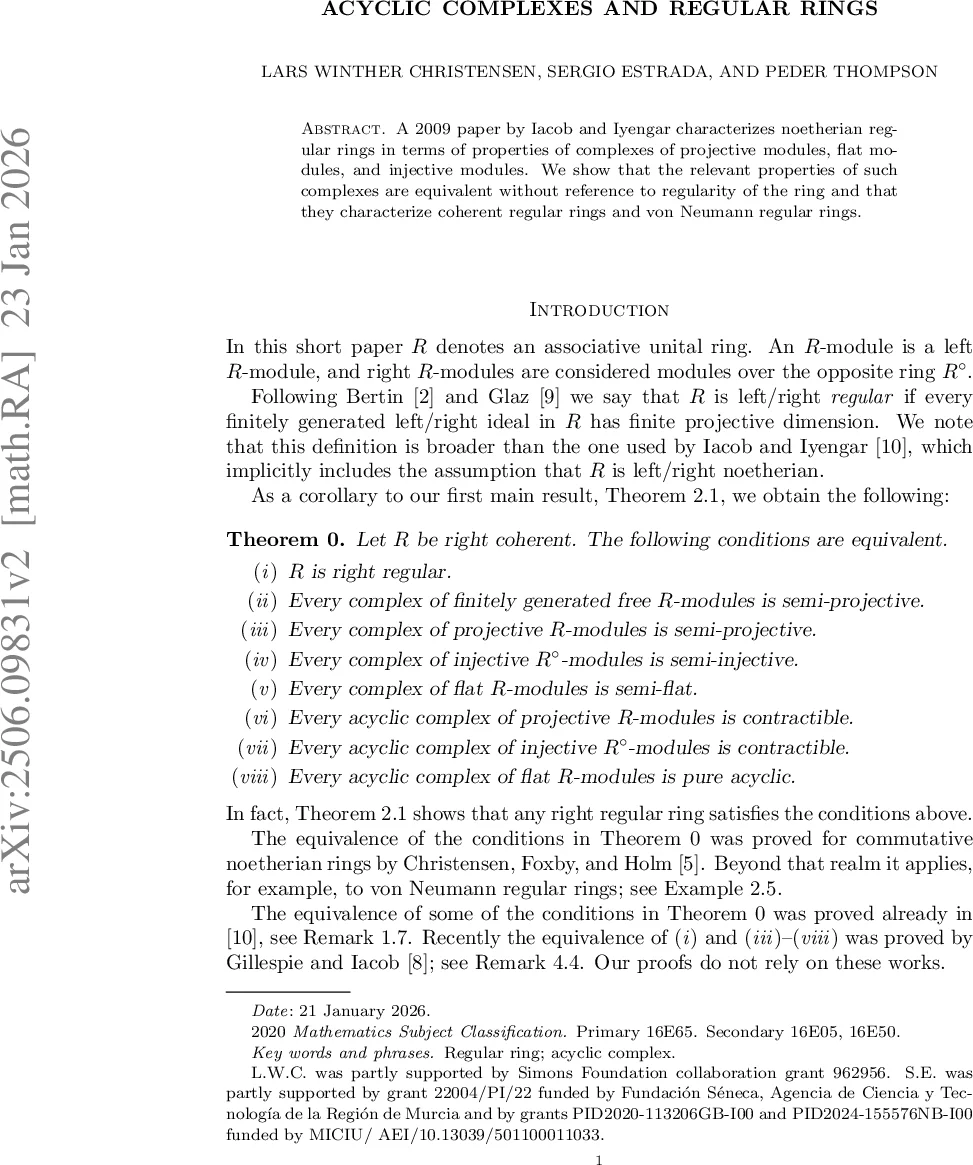
A 2009 paper by Iacob and Iyengar characterizes noetherian regular rings in terms of properties of complexes of projective modules, flat modules, and injective modules. We show that the relevant properties of such complexes are equivalent without reference to regularity of the ring and that they characterize coherent regular rings and von Neumann regular rings.
💡 Research Summary
The paper investigates the relationship between regularity of rings and homological properties of complexes of modules, removing the Noetherian hypothesis that was present in earlier work of Iacob and Iyengar (2009). The authors adopt the broader definition of a right (or left) regular ring: every finitely generated right ideal has finite projective dimension. This definition does not require the ring to be Noetherian.
Section 1 recalls the notions of semi‑projective, semi‑flat, and semi‑injective complexes. A complex (P) of projective modules is semi‑projective iff (\operatorname{Hom}R(P,A)) is acyclic for every acyclic complex (A). Dually, a complex (F) of flat modules is semi‑flat iff (A\otimes_R F) is acyclic for every acyclic complex (A) of right modules, and a complex (I) of injective right modules is semi‑injective iff (\operatorname{Hom}{R^\circ}(A,I)) is acyclic for every acyclic right complex (A). The authors also recall that for an acyclic complex of projectives (resp. injectives, flats) the following are equivalent: being semi‑projective (resp. semi‑injective, semi‑flat), being contractible, and being pure‑acyclic.
Proposition 1.3 establishes the equivalence of a whole family of conditions concerning complexes of finitely generated free modules, all projective modules, and all flat modules. The conditions are denoted (P0)–(P3) and (F1)–(F3). The proof uses a cotorsion pair generated by bounded complexes of finitely generated free modules (Brav‑Gillespie‑Hovey) and Neeman’s result that any complex admits a semi‑flat (hence semi‑projective) resolution. Proposition 1.5 gives the analogous equivalence for injective complexes, denoted (I1)–(I3), and shows that these imply the (P)–(F) conditions.
The central result, Theorem 2.1, lists five statements:
(i) (R) is right regular (in the broader sense).
(ii) Every finitely generated right ideal has finite flat dimension.
(iii) One (hence all) of the injective conditions (I1)–(I3) hold.
(iv) One (hence all) of the projective/flat conditions (P0)–(P3) and (F1)–(F3) hold.
(v) Every right module that admits a degreewise finitely generated projective resolution has finite projective dimension.
The theorem proves the chain of implications (i)⇒(ii)⇒(iii)⇒(iv)⇒(v) and shows that when (R) is right coherent, (v)⇒(i), so all five statements are equivalent. The proof of (iv)⇒(v) is the most delicate: using the semi‑projective resolution of the dual complex (L^\ast=\operatorname{Hom}_{R^\circ}(L,R)), Neeman’s compactness result, and the contractibility of certain acyclic projective complexes (condition (P3)), the authors deduce that the homology of (L^\ast) is bounded, which forces the original module to have finite projective dimension.
Example 2.2 demonstrates that the coherence hypothesis cannot be dropped: a non‑coherent ring can satisfy (v) without being regular. Example 2.5 and Corollary 2.6 treat von Neumann regular rings. For such rings every module is flat, hence every complex of finitely presented modules is semi‑projective, every complex is semi‑flat, and every acyclic complex is pure‑acyclic. Conversely, if every acyclic complex is pure‑acyclic, then every module is flat, so the ring is von Neumann regular.
Sections 3 and 4 (only sketched in the excerpt) develop cotorsion pairs generated by flat‑cotorsion modules and by fp‑injective modules. By invoking Gillespie’s construction of induced cotorsion pairs on complexes, the authors obtain new characterisations of right regularity that no longer reference condition (i). Theorem 4.2 shows that the eight conditions (ii)–(viii) from Theorem 0 are equivalent for any right coherent ring, without assuming regularity. This demonstrates that the homological behaviour of complexes alone suffices to detect regularity.
In summary, the paper provides a clean and robust framework linking regularity of (possibly non‑Noetherian) rings to the homological properties of complexes. It shows that for right coherent rings, the following are all equivalent: right regularity, every complex of projectives being semi‑projective, every complex of flats being semi‑flat, every acyclic complex being pure‑acyclic, and the analogous statements for injective complexes. The results extend earlier work, simplify proofs by avoiding reliance on external theorems, and give a new perspective on von Neumann regular rings via the language of semi‑projective/flat/injective complexes.
Comments & Academic Discussion
Loading comments...
Leave a Comment