Two-Step Regularized HARX to Measure Volatility Spillovers in Multi-Dimensional Systems
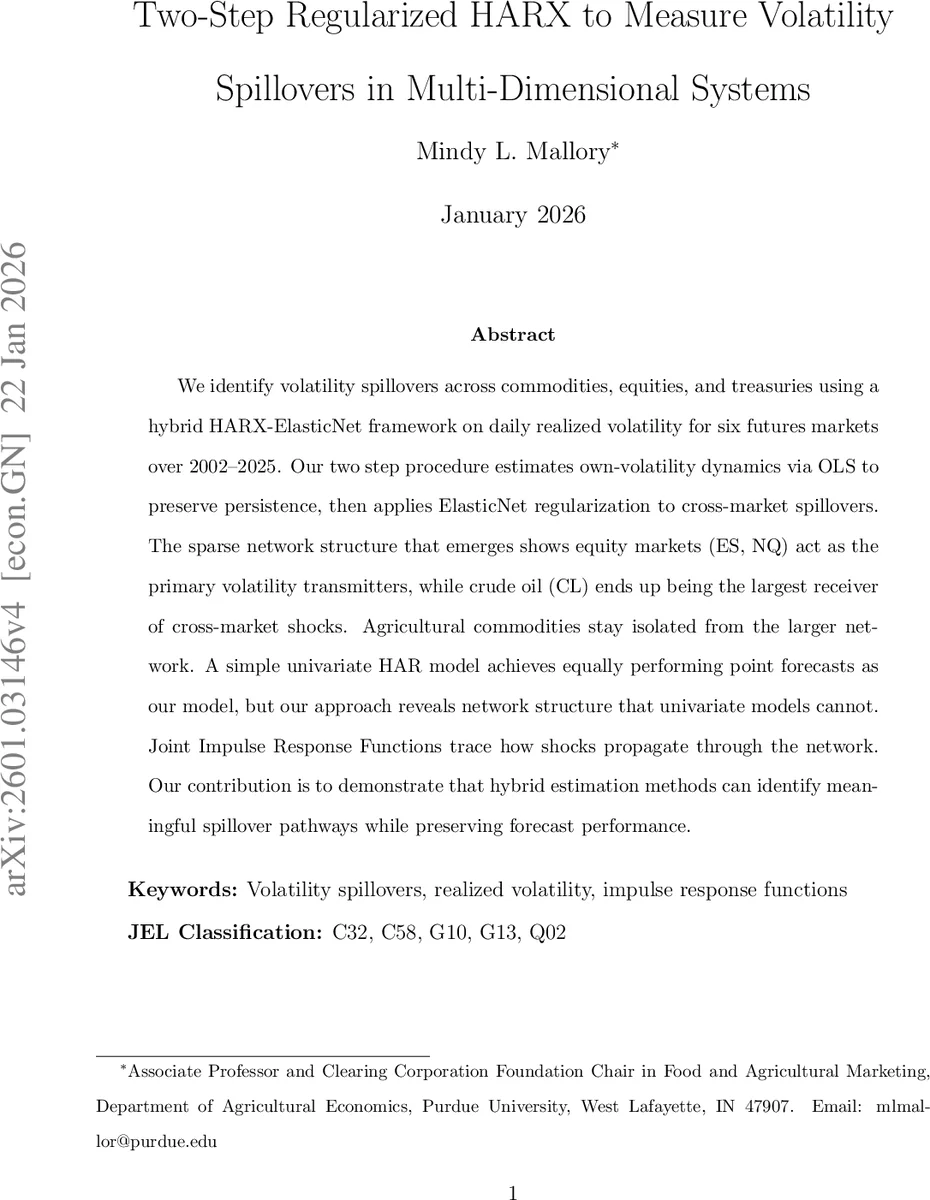
We identify volatility spillovers across commodities, equities, and treasuries using a hybrid HAR-ElasticNet framework on daily realized volatility for six futures markets over 2002–2025. Our two step procedure estimates own-volatility dynamics via OLS to preserve persistence, then applies ElasticNet regularization to cross-market spillovers. The sparse network structure that emerges shows equity markets (ES, NQ) act as the primary volatility transmitters, while crude oil (CL) ends up being the largest receiver of cross-market shocks. Agricultural commodities stay isolated from the larger network. A simple univariate HAR model achieves equally performing point forecasts as our model, but our approach reveals network structure that univariate models cannot. Joint Impulse Response Functions trace how shocks propagate through the network. Our contribution is to demonstrate that hybrid estimation methods can identify meaningful spillover pathways while preserving forecast performance.
💡 Research Summary
**
The paper proposes a novel two‑step hybrid estimation framework—Hybrid HARX‑ElasticNet—to study volatility spillovers among six futures markets (soybeans, crude oil, S&P 500, Nasdaq‑100, 5‑year and 10‑year Treasury futures) using daily realized volatility from May 2002 to January 2025. The authors first estimate a univariate Heterogeneous Autoregressive (HAR) model for each asset by ordinary least squares, preserving the high persistence (β≈0.95‑0.99) that characterises realized volatility. In the second step, they regress the HAR residuals on lagged volatilities of all other assets and apply ElasticNet regularization, which combines L1 (sparsity) and L2 (grouping) penalties. The penalty parameters (λ, α) are chosen via a five‑fold time‑series cross‑validation that respects temporal dependence.
The full system would contain 108 parameters (6 assets × 3 HAR components × 6 cross‑asset effects), but the ElasticNet step shrinks 70‑75 % of the cross‑asset coefficients to zero, leaving only seven non‑zero spillover coefficients (≈8 % of the possible links). The resulting sparse network shows that equity futures (ES, NQ) are the primary transmitters of volatility, while crude oil (CL) is the largest receiver, absorbing small spillovers from equities and Treasuries. Soybean futures (ZS) remain largely isolated, and Treasury futures (ZF, ZN) exhibit no significant bidirectional spillovers.
Forecast performance is evaluated out‑of‑sample using root‑mean‑square error (RMSE). The hybrid model’s RMSE (0.0044) is essentially identical to that of a standard univariate HAR model, indicating that cross‑market information adds little to point‑forecast accuracy over the sample horizon. Nonetheless, the hybrid approach uncovers economically meaningful network structure that a univariate model cannot reveal.
To analyze dynamic propagation, the authors introduce Joint Impulse Response Functions (JIRFs), which trace the reduced‑form response of the entire system to simultaneous shocks in multiple assets. While JIRFs do not identify causal channels, they illustrate how correlated shocks can amplify volatility across the network. For instance, a shock to equity volatility raises crude‑oil volatility from 0.04 to 0.09 over a 20‑day horizon, reflecting historical co‑movement despite the small direct spillover coefficient. Confidence intervals widen over time, highlighting the potential for shock compounding even when direct links are sparse.
Methodologically, the paper contributes by (1) separating the estimation of own‑volatility persistence (OLS‑HAR) from cross‑market spillover selection (ElasticNet), thereby preserving realistic dynamics while achieving sparsity; (2) applying ElasticNet in a multivariate HAR‑X context, a setting where uniform regularization would otherwise over‑shrink persistence terms; and (3) being the first to apply JIRFs to a multivariate volatility model, providing a tool for policymakers and risk managers to visualize systemic volatility transmission.
The authors acknowledge limitations: the asset set is modest, so generalizability to broader markets (e.g., currencies, precious metals) remains to be tested; ElasticNet’s penalty choice may affect results and cannot capture nonlinear spillover mechanisms; and JIRFs lack structural identification, suggesting future work could combine the approach with structural VAR or SVAR frameworks. Potential extensions include expanding the asset universe, exploring alternative regularizers (SCAD, MCP), incorporating nonlinear dynamics, and using the JIRF framework for policy‑scenario analysis.
Overall, the study demonstrates that hybrid regularized HAR models can uncover meaningful volatility spillover pathways without sacrificing forecast performance, offering a valuable addition to the toolbox for financial econometrics, systemic risk monitoring, and portfolio risk management.
Comments & Academic Discussion
Loading comments...
Leave a Comment