A new family of a posteriori error estimates for non-conforming finite element methods leading to stabilization-free error bounds
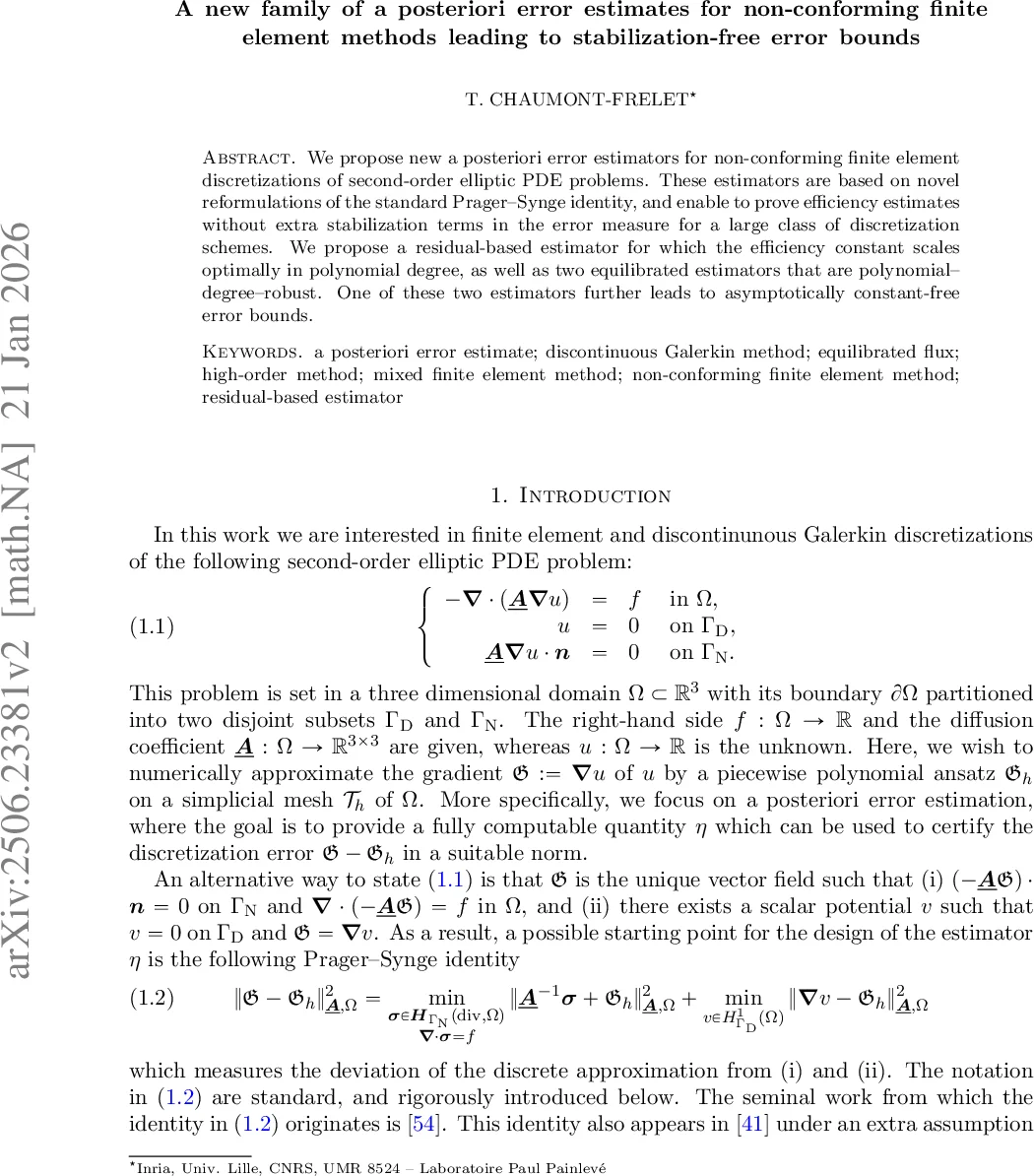
We propose new a posteriori error estimators for non-conforming finite element discretizations of second-order elliptic PDE problems. These estimators are based on novel reformulations of the standard Prager-Synge identity, and enable to prove efficiency estimates without extra stabilization terms in the error measure for a large class of discretization schemes. We propose a residual-based estimator for which the efficiency constant scales optimally in polynomial degree, as well as two equilibrated estimators that are polynomial-degree-robust. One of the two estimators further leads to asymptotically constant-free error bounds.
💡 Research Summary
The paper addresses a posteriori error estimation for non‑conforming and mixed finite‑element discretizations of second‑order elliptic boundary‑value problems in three dimensions, possibly with mixed Dirichlet–Neumann boundary conditions. Classical a posteriori analysis relies on the Prager–Synge identity, which splits the error into two minimization problems: one measuring the deviation of a discrete flux from the exact flux, the other measuring the deviation of a discrete gradient from a potential gradient. For conforming methods the second term vanishes, but for non‑conforming or mixed methods it remains and is difficult to control because the discrete vector field G_h is not necessarily a gradient.
The authors reformulate the Prager–Synge identity into two equivalent expressions (Equation 1.5). The first replaces the minimizer by a curl‑free field ϕ, the second by a scalar potential θ satisfying the appropriate boundary conditions. These reformulations are valid for any L²(Ω) vector field and only depend on mesh shape regularity. Consequently, the non‑conformity term can be bounded by quantities that are either (i) a locally reconstructed curl‑free field ϕ_h obtained from solving small Nédélec problems on vertex patches, or (ii) a reconstructed potential θ_h obtained from a global H¹‑minimization.
Based on these identities three families of error estimators are constructed:
-
Residual‑based estimator (Equation 1.6). It consists of an interior term involving the broken gradient of G_h scaled by h_K p² and a boundary term involving the normal jump of G_h scaled by h_K p⁻¹. This scaling yields an efficiency constant that grows only like O(p²), which is optimal with respect to the polynomial degree. The estimator is fully computable from G_h alone and does not require any post‑processing of a potential.
-
Fully equilibrated estimator. The curl‑free field ϕ_h is built by solving local mixed Nédélec problems on vertex patches. The estimator η_eq1 = ‖G_h − ϕ_h‖_{A,Ω} is shown to be polynomial‑degree‑robust: its efficiency constant is bounded independently of p and depends only on the mesh shape regularity. This provides a true equilibrated flux without the need for a scalar potential.
-
Alternative equilibrated estimator. By solving a global H¹‑minimization for θ_h, the authors obtain η_eq2 = ‖G_h − ∇θ_h‖_{A,Ω}. Remarkably, the efficiency constant of this estimator tends to one as the mesh is refined, i.e., the bound becomes asymptotically constant‑free. This is the first result of its kind for non‑conforming discretizations.
The paper demonstrates the applicability of these estimators to three representative schemes:
- Crouzeix–Raviart non‑conforming elements: When the average jump across faces vanishes, the new residual estimator improves the classical p³ scaling to the optimal p²·p⁻¹ scaling, and the equilibrated estimator provides degree‑robust bounds without extra stabilization.
- Raviart–Thomas mixed elements: Here G_h = A⁻¹σ_h, with σ_h the mixed flux. The proposed estimators can be applied directly to σ_h, avoiding the usual post‑processing to a potential. The residual estimator retains optimal hp‑scaling, while the equilibrated estimator yields degree‑robust efficiency.
- Interior Penalty Discontinuous Galerkin (IPDG): Traditional DG error estimators require an enlarged penalty parameter to achieve efficiency. The new residual estimator works without any additional stabilization, delivering efficient bounds in the natural energy norm.
The authors also compare their work with recent literature. Prior approaches (e.g.,
Comments & Academic Discussion
Loading comments...
Leave a Comment