engGNN: A Dual-Graph Neural Network for Omics-Based Disease Classification and Feature Selection
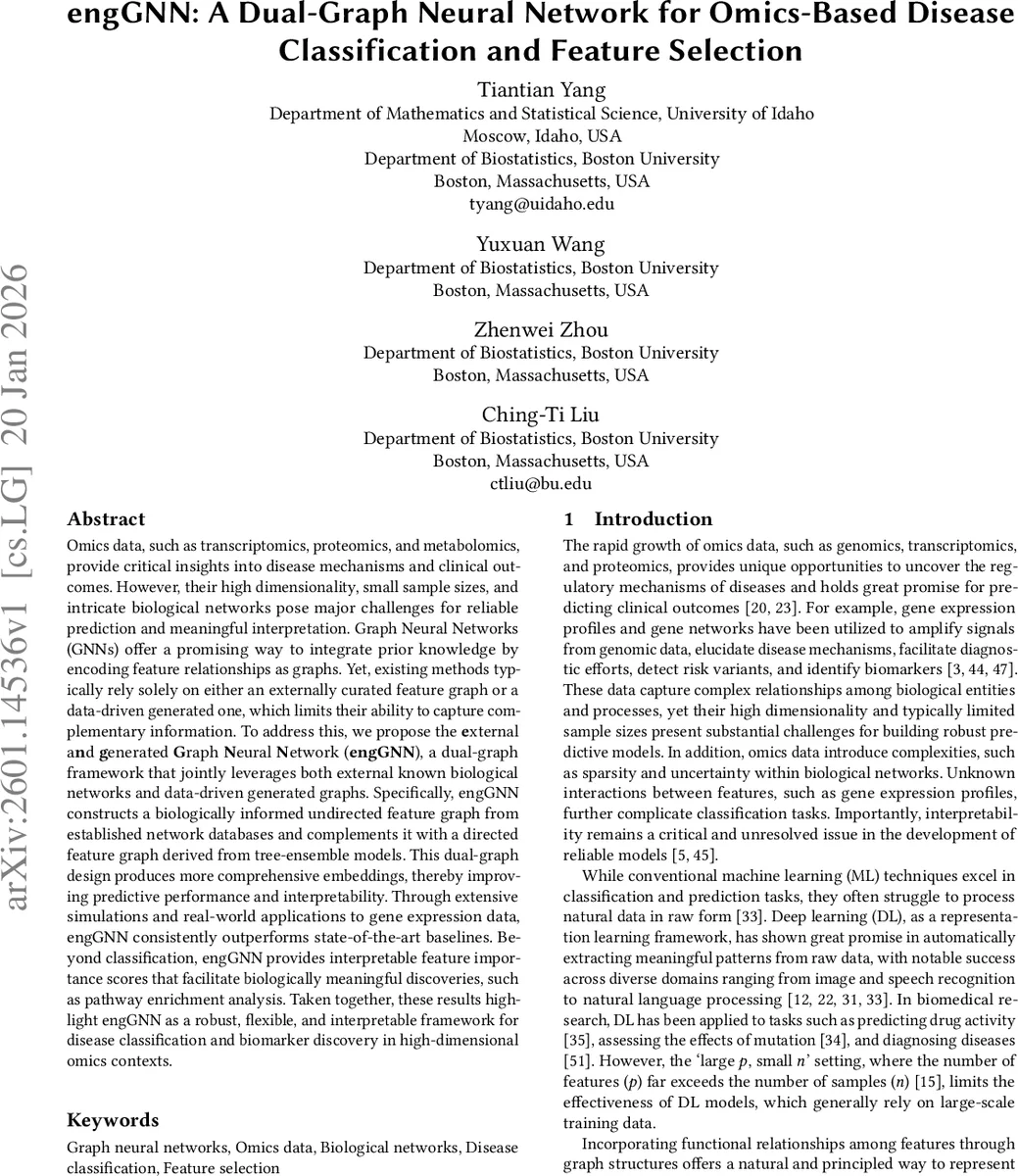
Omics data, such as transcriptomics, proteomics, and metabolomics, provide critical insights into disease mechanisms and clinical outcomes. However, their high dimensionality, small sample sizes, and intricate biological networks pose major challenges for reliable prediction and meaningful interpretation. Graph Neural Networks (GNNs) offer a promising way to integrate prior knowledge by encoding feature relationships as graphs. Yet, existing methods typically rely solely on either an externally curated feature graph or a data-driven generated one, which limits their ability to capture complementary information. To address this, we propose the external and generated Graph Neural Network (engGNN), a dual-graph framework that jointly leverages both external known biological networks and data-driven generated graphs. Specifically, engGNN constructs a biologically informed undirected feature graph from established network databases and complements it with a directed feature graph derived from tree-ensemble models. This dual-graph design produces more comprehensive embeddings, thereby improving predictive performance and interpretability. Through extensive simulations and real-world applications to gene expression data, engGNN consistently outperforms state-of-the-art baselines. Beyond classification, engGNN provides interpretable feature importance scores that facilitate biologically meaningful discoveries, such as pathway enrichment analysis. Taken together, these results highlight engGNN as a robust, flexible, and interpretable framework for disease classification and biomarker discovery in high-dimensional omics contexts.
💡 Research Summary
The paper introduces engGNN, a novel dual‑graph neural network designed for disease classification and feature selection in high‑dimensional omics datasets. The authors identify two major challenges in omics analysis: (1) the “large‑p, small‑n” problem, where the number of molecular features far exceeds the number of samples, leading to over‑fitting in conventional deep learning models; and (2) the difficulty of integrating prior biological knowledge while still capturing data‑specific interactions. Existing graph‑based approaches typically rely on a single source of graph information—either an externally curated biological network (e.g., protein‑protein interaction) or a data‑driven similarity graph—thereby missing complementary information.
engGNN addresses this gap by simultaneously employing (i) an undirected external graph (G_e) built from public databases such as STRING, BioGRID, and KEGG, which encodes known functional relationships among genes, and (ii) a directed, data‑driven graph (G_g) derived from an XGBoost ensemble. In the XGBoost‑based graph, each decision tree contributes a directed edge from a parent split node to its child, reflecting the hierarchical order in which features influence the prediction. All trees are merged into a single directed adjacency matrix, and self‑loops are added.
Both graphs are processed by separate instances of a Graph‑Embedded Deep Feedforward Network (GEDFN). GEDFN modifies the first linear layer by element‑wise multiplying the trainable weight matrix with the (self‑loop‑augmented) adjacency matrix, thus restricting connections to graph‑adjacent features while preserving the ability to learn feature‑specific transformations. Subsequent layers are fully connected, allowing the network to capture higher‑order patterns. The two resulting embeddings, H_Ge and H_Gg, are concatenated into a combined representation H_C =
Comments & Academic Discussion
Loading comments...
Leave a Comment