Improved Lower Bounds for QAC0
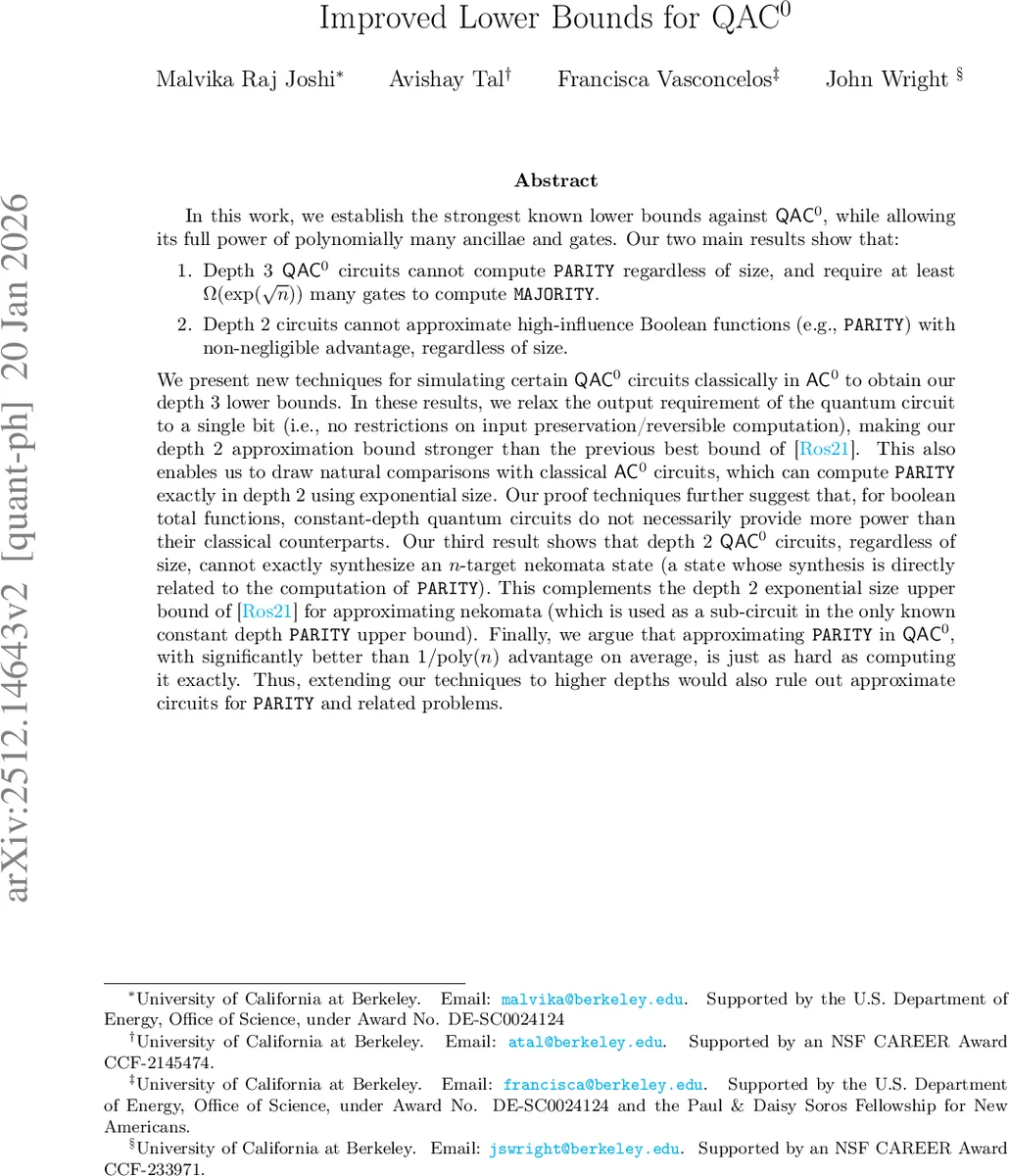
In this work, we prove the strongest known lower bounds for QAC$^0$, allowing polynomially many gates and ancillae. Our main results show that: (1) Depth-3 QAC$^0$ circuits cannot compute PARITY, and require $Ω(\exp(\sqrt{n}))$ gates to compute MAJORITY. (2) Depth-2 circuits cannot approximate high-influence Boolean functions (e.g., PARITY) with non-negligible advantage, regardless of size. We develop new classical simulation techniques for QAC$^0$ to obtain our depth-3 bounds. In these results, we relax the output requirement of the quantum circuit to a single bit, making our depth $2$ approximation bound stronger than the previous best bound of Rosenthal (2021). This also enables us to draw natural comparisons with classical AC$^0$ circuits, which can compute PARITY exactly in depth $2$ (exp size). Our techniques further suggest that, for boolean total functions, constant-depth quantum circuits do not necessarily provide more power than their classical counterparts. Our third result shows that depth $2$ QAC$^0$ circuits, regardless of size, cannot exactly synthesize an $n$-target nekomata state (a state whose synthesis is directly related to the computation of PARITY). This complements the depth $2$ exponential size upper bound of Rosenthal (2021) for approximating nekomatas (which is used as a sub-circuit in the only known constant depth PARITY upper bound). Finally, we argue that approximating PARITY in QAC0, with significantly better than 1/poly(n) advantage on average, is just as hard as computing it exactly. Thus, extending our techniques to higher depths would also rule out approximate circuits for PARITY and related problems
💡 Research Summary
This paper establishes the strongest known lower bounds for the quantum circuit class QAC⁰ when unrestricted polynomial‑size ancillae are allowed. QAC⁰ consists of constant‑depth quantum circuits built from arbitrary single‑qubit gates and generalized Toffoli gates with unbounded fan‑in. The authors focus on depths three and two, proving three main results.
First, they show that any depth‑3 QAC⁰ circuit cannot compute the PARITY function, regardless of its size, and that computing MAJORITY requires at least Ω(exp(√n)) gates. The proof introduces a “Clean‑Up Lemma” that normalizes the projectors appearing after the first layer, then uses a block‑diagonalization of gates to transform the circuit into a form amenable to classical simulation. By simulating the resulting circuit in AC⁰, they invoke the classical switching lemma and Fourier‑tail arguments to demonstrate that an AC⁰ circuit would need exponential size to implement PARITY or MAJORITY, thereby establishing the quantum lower bounds.
Second, for depth‑2 QAC⁰ circuits the paper proves a total‑influence bound: any such circuit that outputs a single bit has total influence O(log n). Consequently, high‑influence Boolean functions such as PARITY cannot be approximated with non‑negligible advantage by any depth‑2 QAC⁰ circuit, irrespective of its size. This result strengthens the previous depth‑2 approximation lower bound of Rosenthal (2021), which applied only to input‑preserving circuits, by removing the input‑preservation requirement. The authors achieve this by analyzing the effect of each gate on the influence of input bits and showing that the influence cannot accumulate beyond a logarithmic factor in constant depth.
Third, the authors consider the preparation of “nekomata” states, a generalization of GHZ states defined as |Nek⟩ = (|0ⁿ⟩|ψₐ⟩ + |1ⁿ⟩|ψ_b⟩)/√2. They prove that no depth‑2 QAC⁰ circuit, regardless of size, can exactly synthesize an n‑target nekomata. The proof reduces exact nekomata preparation to exact PARITY computation, leveraging the known reduction between PARITY (or FAN‑OUT) and GHZ‑type states. Since depth‑2 circuits cannot compute PARITY, they also cannot prepare the corresponding nekomata. This complements Rosenthal’s exponential‑size upper bound for approximating nekomata and shows a clear separation between exact and approximate state synthesis in constant depth.
Finally, the paper presents an exact‑to‑approximate reduction for PARITY: achieving an average‑case advantage better than 1/poly(n) in approximating PARITY is as hard as computing PARITY exactly. This reduction implies that any technique capable of ruling out exact PARITY in constant depth automatically rules out any non‑trivial approximation, and it suggests a pathway to extend the depth‑3 lower bounds to higher depths.
Overall, the work introduces new classical‑simulation techniques for shallow quantum circuits, a block‑diagonal gate analysis, a quantum analogue of restriction arguments, and an influence‑based method. These tools collectively demonstrate that constant‑depth QAC⁰ does not surpass classical AC⁰ for total Boolean functions such as PARITY and MAJORITY, and that exact preparation of certain entangled states also requires depth beyond two. The results narrow the gap between known upper and lower bounds for QAC⁰ and provide a foundation for future investigations into depth‑vs‑ancilla trade‑offs in quantum circuit complexity.
Comments & Academic Discussion
Loading comments...
Leave a Comment