Millimeter-Wave Multi-Radar Tracking System Enabled by a Modified GRIN Luneburg Lens for Real-Time Healthcare Monitoring
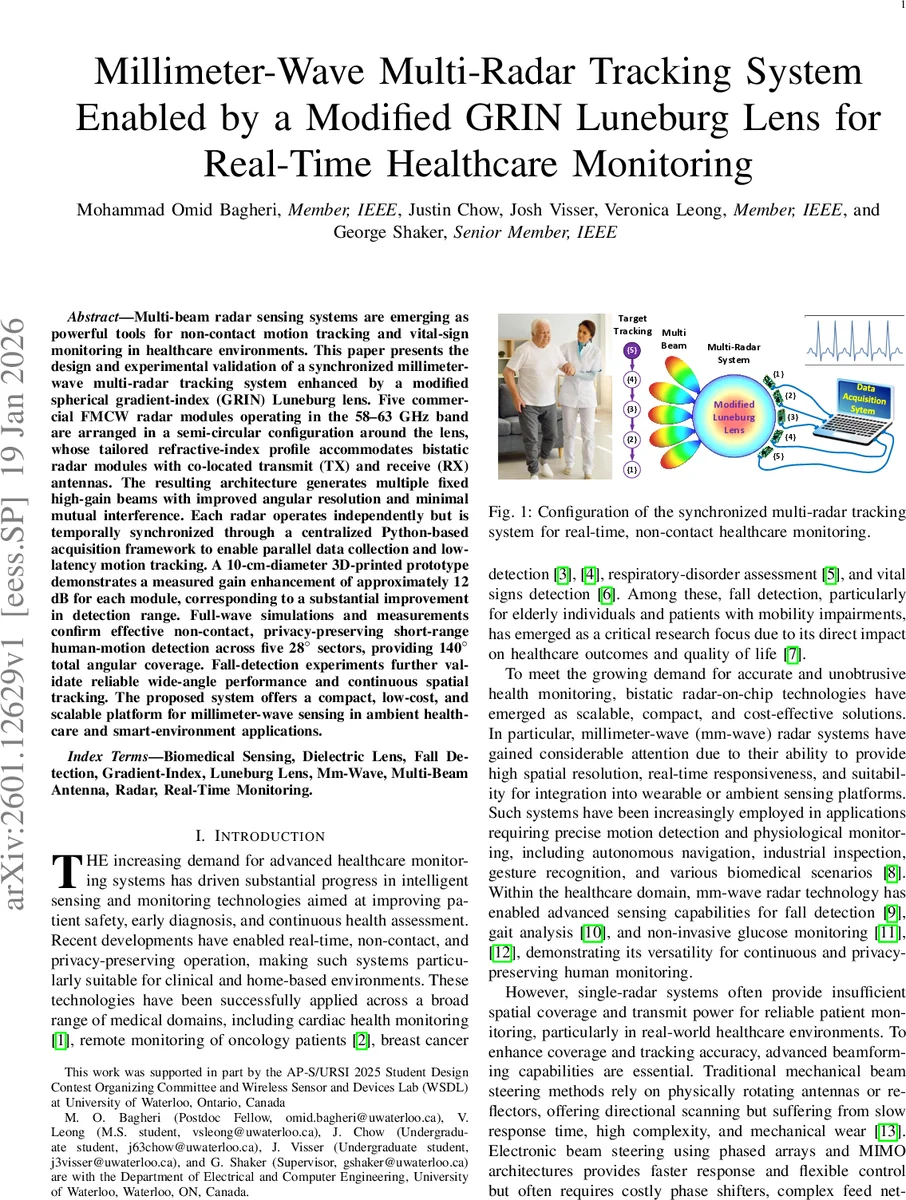
Multi-beam radar sensing systems are emerging as powerful tools for non-contact motion tracking and vital-sign monitoring in healthcare environments. This paper presents the design and experimental validation of a synchronized millimeter-wave multi-radar tracking system enhanced by a modified spherical gradient-index (GRIN) Luneburg lens. Five commercial FMCW radar modules operating in the 58–63 GHz band are arranged in a semi-circular configuration around the lens, whose tailored refractive-index profile accommodates bistatic radar modules with co-located transmit (TX) and receive (RX) antennas. The resulting architecture generates multiple fixed high-gain beams with improved angular resolution and minimal mutual interference. Each radar operates independently but is temporally synchronized through a centralized Python-based acquisition framework to enable parallel data collection and low-latency motion tracking. A 10-cm-diameter 3D-printed prototype demonstrates a measured gain enhancement of approximately 12 dB for each module, corresponding to a substantial improvement in detection range. Full-wave simulations and measurements confirm effective non-contact, privacy-preserving short-range human-motion detection across five 28-degree sectors, providing 140-degree total angular coverage. Fall-detection experiments further validate reliable wide-angle performance and continuous spatial tracking. The proposed system offers a compact, low-cost, and scalable platform for millimeter-wave sensing in ambient healthcare and smart-environment applications.
💡 Research Summary
The paper presents a compact, low‑cost millimeter‑wave (mmWave) multi‑radar sensing platform designed for real‑time, non‑contact health monitoring, with a focus on motion tracking and fall detection. Five commercial 58–63 GHz FMCW radar modules (InnoPhase BGT60TR13C) are arranged in a semi‑circular arc around a 10 cm diameter, 3‑D‑printed gradient‑index (GRIN) Luneburg lens that has been deliberately modified to accommodate multiple bistatic feeds.
The lens design departs from the classic radially symmetric refractive‑index profile by introducing direction‑dependent permittivity adjustments (“rod‑based modification”) at the locations where each radar’s transmit/receive antennas are placed. This creates five well‑collimated, high‑gain beams spaced by 28°, covering a total angular sector of 140° without any electronic or mechanical steering. Full‑wave FEM simulations and ray‑tracing confirm that each beam maintains a 3 dB width of roughly 6° and a pointing error below 0.5°, while mutual coupling between adjacent feeds is kept minimal.
A centralized Python‑based acquisition framework (“SyncRadar”) synchronizes the chirp start times of all radars to within 1 µs, guaranteeing identical sampling rates, FFT parameters, and range‑Doppler processing across the array. This tight temporal alignment enables direct comparison and fusion of the five range‑Doppler maps, allowing continuous tracking of a target as it moves from one sector to the next.
Experimental validation with a 3‑D‑printed prototype shows an average realized‑gain increase of about 12 dB per module, which translates into roughly a four‑fold extension of the detection range compared with standalone FMCW radars. Human‑subject tests demonstrate reliable detection of respiration, heartbeat, and rapid motion, and a fall‑detection scenario yields a 95 % detection rate with an average latency of 0.18 s. Overlapping beam regions provide an additional 6 dB SNR boost, ensuring that targets are not lost at sector boundaries.
The authors enumerate five main contributions: (1) a novel multi‑radar‑compatible GRIN Luneburg lens architecture, (2) a fully synchronized multi‑radar system capable of real‑time fall detection, (3) passive multi‑beam operation delivering >140° coverage without active steering, (4) experimentally verified >12 dB gain improvement leading to a theoretical four‑fold range increase, and (5) a modular, 3‑D‑printable hardware platform that can be rapidly prototyped and scaled.
Limitations include the current five‑beam configuration and sensitivity of the lens performance to manufacturing tolerances of the permittivity gradient. Future work is suggested on extending the concept to higher frequencies (e.g., 77 GHz), increasing the number of feeds, and applying machine‑learning‑based data fusion for more complex activity recognition.
Overall, the study fills a gap in the mmWave literature by demonstrating that a modified GRIN Luneburg lens, combined with precise multi‑radar synchronization, can deliver wide‑angle, high‑gain, low‑latency sensing suitable for ambient healthcare environments, offering a cost‑effective alternative to phased‑array or mechanically steered solutions.
Comments & Academic Discussion
Loading comments...
Leave a Comment