Cohen-Macaulay representations of Artin-Schelter Gorenstein algebras of dimension one
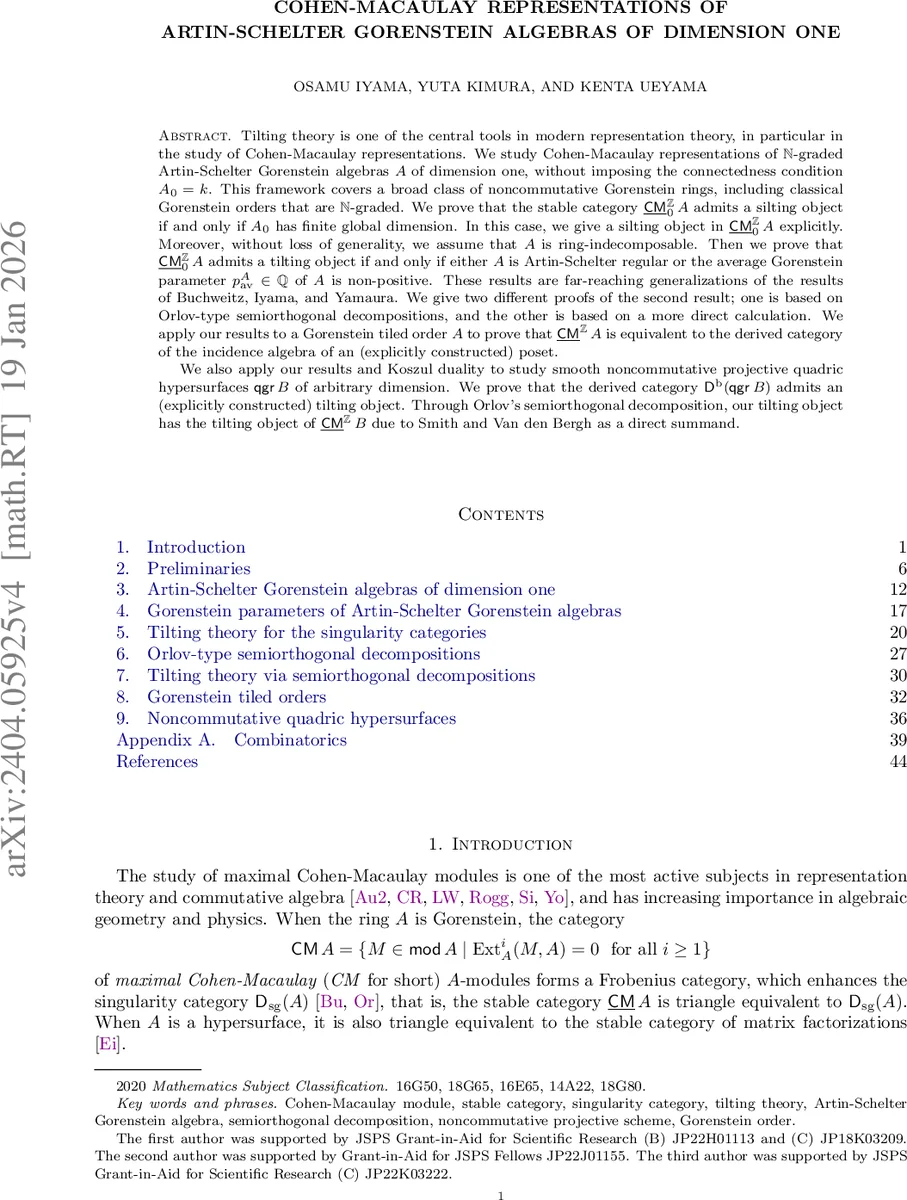
Tilting theory is one of the central tools in modern representation theory, in particular in the study of Cohen-Macaulay representations. We study Cohen-Macaulay representations of $\mathbb N$-graded Artin-Schelter Gorenstein algebras $A$ of dimension one, without assuming the connectedness condition. This framework covers a broad class of noncommutative Gorenstein rings, including classical $\mathbb N$-graded Gorenstein orders. We prove that the stable category $\underline{\mathsf{CM}}_0^{\mathbb Z}A$ admits a silting object if and only if $A_0$ has finite global dimension. In this case we give such a silting object explicitly. Assuming that $A$ is ring-indecomposable, we further show that $\underline{\mathsf{CM}}_0^{\mathbb Z}A$ admits a tilting object if and only if either $A$ is Artin-Schelter regular or the average Gorenstein parameter of $A$ is non-positive. These results generalize those of Buchweitz, Iyama, and Yamaura. We give two proofs of the second result: one via Orlov-type semiorthogonal decompositions, and the other via a direct calculation. As an application, we show that for a Gorenstein tiled order $A$, the category $\underline{\mathsf{CM}}^{\mathbb Z}A$ is equivalent to the derived category of the incidence algebra of an explicitly constructed poset. We also apply our results and Koszul duality to study smooth noncommutative projective quadric hypersurfaces $\mathsf{qgr},B$ of arbitrary dimension. We prove that $\mathsf{D}^{\mathrm b}(\mathsf{qgr},B)$ admits an explicitly constructed tilting object, which contains the tilting object of $\underline{\mathsf{CM}}^{\mathbb Z}B$ due to Smith and Van den Bergh as a direct summand via Orlov’s semiorthogonal decomposition.
💡 Research Summary
The paper investigates Cohen‑Macaulay (CM) representations of ℕ‑graded Artin‑Schelter (AS) Gorenstein algebras A of dimension one, without imposing the usual connectedness hypothesis A₀ = k. This broader setting encompasses many non‑commutative Gorenstein rings, notably classical Gorenstein orders that are ℕ‑graded.
The authors focus on the graded singularity category D_{sg}^{ℤ}(A) and its Frobenius subcategory CM_{0}^{ℤ} A, consisting of graded CM modules whose tensor product with the graded total quotient ring Q becomes a graded projective Q‑module. This subcategory enjoys Auslander‑Reiten–Serre duality and thus has almost split sequences.
The first main result characterises when CM_{0}^{ℤ} A admits a silting object. They prove that a silting object exists if and only if the degree‑zero part A₀ has finite global dimension. When this condition holds, they construct an explicit silting object
V = ⊕{i∈I_A} ⊕{j=0}^{-p_i+q} e_{ν(i)}A(j)
where (p_i)_{i∈I_A} are the Gorenstein parameters, ν is the Nakayama permutation, and q is a positive integer such that Q(q) ≅ Q. Conversely, if gldim A₀ is infinite, no silting object can exist.
The second main theorem addresses tilting objects. Introducing the average Gorenstein parameter p_A^{av}= (1/|I_A|)∑{i}p_i, they show that CM{0}^{ℤ} A admits a tilting object precisely when either p_A^{av} ≤ 0 or A is AS‑regular. In both cases the same V above becomes a tilting object. Its endomorphism algebra Γ = End_{ℤ A}(V) is shown to be Iwanaga‑Gorenstein, and there is a triangle equivalence
CM_{0}^{ℤ} A ≃ per Γ.
Moreover, when the quiver of A₀ is acyclic, the indecomposable direct summands of V can be ordered to form a full strong exceptional collection.
Two independent proofs of the tilting statement are supplied. The first uses explicit syzygy calculations together with the Auslander‑Reiten–Serre duality. The second exploits Orlov‑type semi‑orthogonal decompositions (SODs) of D_{sg}^{ℤ}(A) and D^{b}(qgr A). In the latter approach, the generator P = ⊕{i=1}^{A(i)} of qgr A yields a tilting object in per(qgr A), and the SOD links per(qgr A) with CM{0}^{ℤ} A, giving the desired tilting object.
A crucial auxiliary result is that the average Gorenstein parameter is invariant under graded Morita equivalence. Using this, the authors construct a graded‑Morita equivalent algebra B with |p_i^{B} − p_A^{av}| < 1 for each i, which in particular forces all p_i^{B} ≤ 0 when p_A^{av} ≤ 0.
Applications:
-
Gorenstein tiled orders. For a basic ℕ‑graded Gorenstein tiled order A with p_i ≤ 0 for all i, the object
V = ⊕{i∈I_A} ⊕{j=1}^{1−p_i} e_iA(j)
is a tilting object in CM^{ℤ} A. Its endomorphism algebra is Morita equivalent to the incidence algebra k Vo_A of an explicitly constructed poset. Consequently,
CM^{ℤ} A ≃ D^{b}(mod k Vo_A). -
Non‑commutative quadric hypersurfaces. Let B be a non‑commutative quadric hypersurface of dimension d−1 (d ≥ 2) with qgr B of finite global dimension. Its Koszul dual A^{op} is a Koszul AS‑Gorenstein algebra of dimension one with Gorenstein parameter 2−d. There is a duality
F : D^{b}(qgr B) → CM^{ℤ} A.
The object
L = ⊕_{i=1}^{d−1} A(i)
is a tilting object in CM^{ℤ} A, and its image under F gives a tilting object in D^{b}(qgr B) consisting of the shifted Koszul syzygies Ω_i k(i). The endomorphism algebra Λ of this tilting object is described explicitly as a block matrix algebra involving the graded components of A and the total quotient ring Q. Hence
D^{b}(qgr B) ≃ D^{b}(mod Λ).
These results generalise the classical theorem that the derived category of a smooth projective quadric admits a tilting bundle (Kapranov) to the non‑commutative setting. Moreover, via the Orlov SOD, the tilting objects constructed by Smith–Van den Bergh for CM^{ℤ} B appear as direct summands of the larger tilting objects for D^{b}(qgr B).
In summary, the paper provides a complete description of when silting and tilting objects exist in the graded CM singularity category of one‑dimensional AS‑Gorenstein algebras, supplies explicit constructions, and demonstrates powerful applications to Gorenstein tiled orders and non‑commutative quadric hypersurfaces, thereby unifying and extending several recent developments in tilting theory, singularity categories, and non‑commutative algebraic geometry.
Comments & Academic Discussion
Loading comments...
Leave a Comment