Preservation under Reduced Products in Continuous Logic
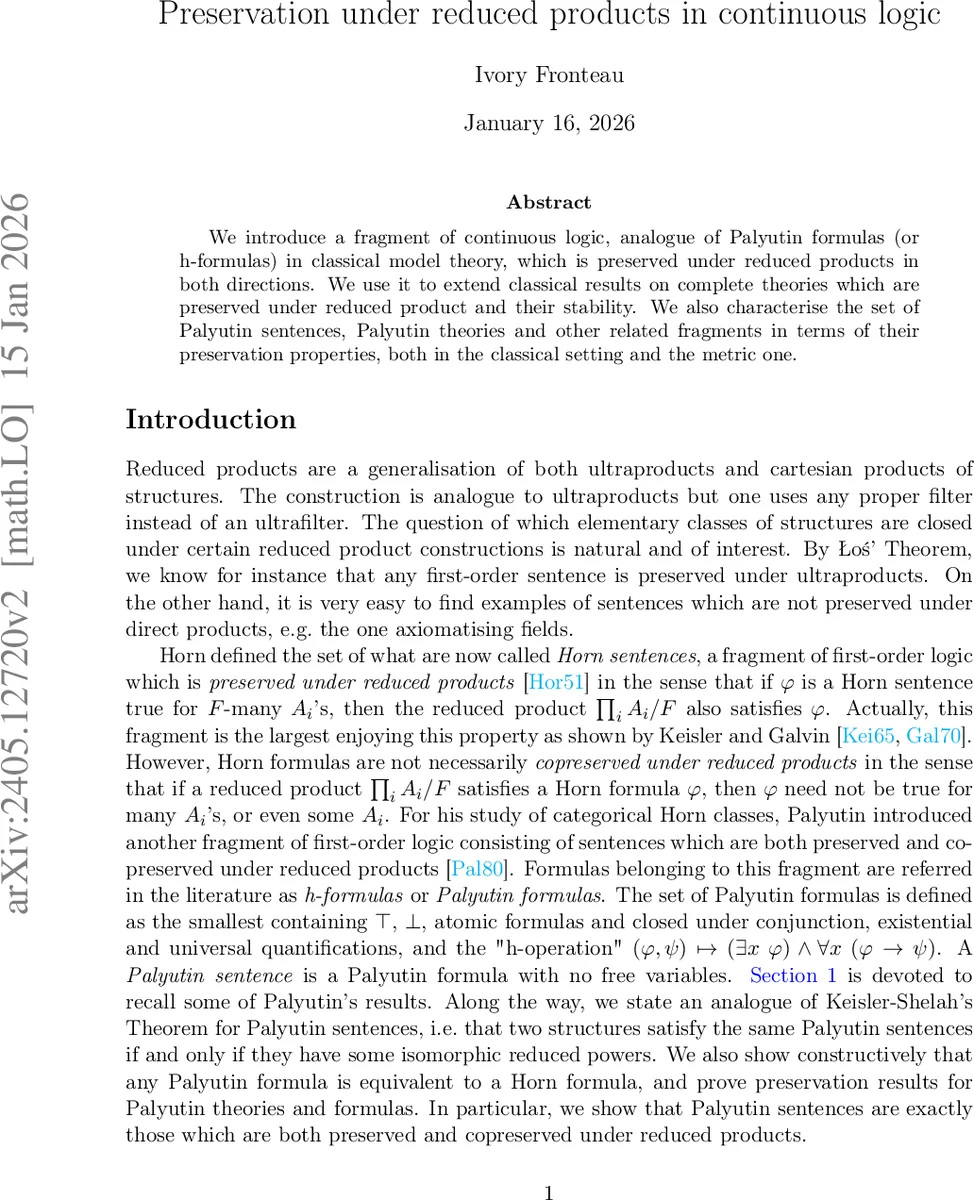
We introduce a fragment of continuous first-order logic, analogue of Palyutin formulas (or h-formulas) in classical model theory, which is preserved under reduced products in both directions. We use it to extend classical results on complete theories which are preserved under reduced product and their stability. We also characterize the set of Palyutin sentences, Palyutin theories and other related fragments in terms of their preservation properties, both in the classical setting and the metric one.
💡 Research Summary
This paper develops a continuous‑logic analogue of the classical Palyutin (or h‑) formulas, showing that these formulas are preserved both forward and backward under reduced products. The authors begin by recalling the classical setting: reduced products generalize ultraproducts by using an arbitrary filter instead of an ultrafilter, and Horn formulas are known to be exactly those first‑order sentences preserved under reduced products (Keisler‑Galvin). However, Horn formulas are not co‑preserved, which motivated Palyutin to isolate a fragment that is bipreserved.
In the first section the authors formalize the classical notions, define reduced products M_F, and present the standard results: Horn sentences characterize reduced‑product‑preservation, and Palyutin formulas are the smallest class containing atomic formulas, closed under ∧, ∃, ∀, and the “h‑operation” (∃x φ) ∧ ∀x(φ → ψ). They prove that every Palyutin formula is equivalent to a Horn formula, and that Palyutin sentences are exactly those bipreserved under reduced products.
The paper then moves to continuous logic, following the framework of Ben Yaacov, Berenstein, Henson, and Usvyatsov (BBHU08). Structures are complete bounded metric spaces; relations are uniformly continuous real‑valued functions. Formulas are built from atomic formulas using continuous connectives ℝ→ℝ and the sup/inf quantifiers. Ultraproducts are defined via limits along ultrafilters; reduced products replace the limit by lim sup along a filter. Goldbring and Keisler introduced continuous Horn (conditional) sentences and proved they are precisely the sentences preserved under reduced products.
Section 3 introduces continuous Palyutin formulas. The key novelty is that whenever a non‑increasing unary connective D is used, a fixed point Δ must be supplied to guarantee the desired preservation properties. The inductive clauses are: (i) if φ is Palyutin and U is a non‑decreasing unary connective, then Uφ is Palyutin; (ii) if φ, ψ are Palyutin then max(φ,ψ) is Palyutin; (iii) if φ, ψ are Palyutin, D is non‑increasing with fixed point Δ, and x a variable, then
max( infₓ φ , supₓ min(Dφ, Δ, ψ) )
is Palyutin. This construction mirrors the classical h‑operation but adapts it to the metric setting. The authors prove constructively that every continuous Palyutin formula is equivalent to a continuous Horn formula, extending the classical equivalence.
The authors define a theory SCP (Simple C‑property) consisting of sentences of the form
sup_y inf_x max(φ, n·max_j D_j ψ_j) − n·max_j inf_x max(φ, D_j ψ_j) ≤ 0
for any Palyutin formulas φ, ψ₁,…,ψₙ and non‑increasing connectives D₁,…,Dₙ. They show: (i) SCP is preserved under reduced products; (ii) any reduced product by the Fréchet filter (co‑finite filter on ω) is a model of SCP; (iii) a complete theory T satisfies SCP iff T is preserved under all reduced products, equivalently iff T is preserved under Fréchet‑filter reduced powers. This yields a continuous‑logic version of the Keisler‑Shelah theorem: two structures satisfy the same Palyutin sentences iff their Fréchet‑filter reduced powers are elementarily equivalent (or isomorphic after further ultraproducts).
A major stability result follows: if a complete theory T is preserved under reduced products (i.e., T ⊨ SCP), then the following are equivalent: (1) T is stable; (2) for every non‑negative Palyutin formula φ(x,y) we have
sup_{y,z} ( sup_x |φ(x,y)−φ(x,z)| − inf_x max(φ(x,y), φ(x,z)) ) ≤ 0
in T; (3) T is NIP. Thus, in the continuous setting, NIP together with reduced‑product preservation forces stability, exactly as in the classical case.
Section 4 establishes further preservation theorems. The authors prove that any sentence φ such that for every reduced product Q_i A_i /F we have φ(Q_i A_i /F) = lim sup_F φ(A_i) can be approximated arbitrarily closely by Palyutin formulas. Consequently, the class of sentences that are “continuous‑product‑continuous” coincides with the closure of Palyutin formulas under uniform limits. This gives a full characterization of the sentences preserved under reduced products in metric logic.
Overall, the paper achieves a comprehensive transfer of the classical Palyutin‑Horn dichotomy to continuous logic, introduces the SCP theory as the natural axiomatization of reduced‑product‑preserved theories, and connects preservation, NIP, and stability in the metric context. The results open avenues for applying reduced‑product techniques to metric structures such as Banach spaces, probability algebras, and C*‑algebras, where continuous logic is the standard model‑theoretic language.
Comments & Academic Discussion
Loading comments...
Leave a Comment