A Cold Tracer in a Hot Bath: In and Out of Equilibrium
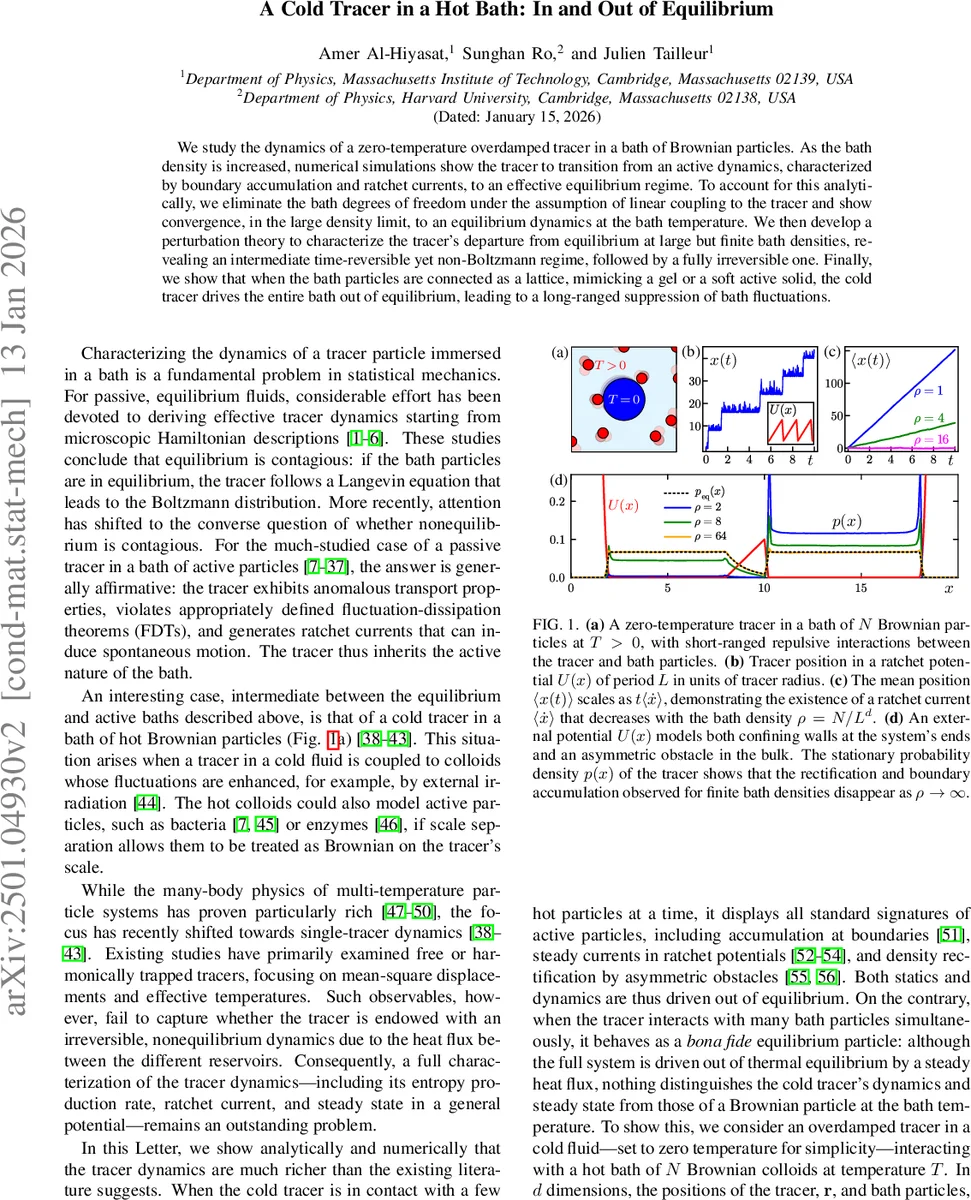
We study the dynamics of a zero-temperature overdamped tracer in a bath of Brownian particles. As the bath density is increased, numerical simulations show the tracer to transition from an active dynamics, characterized by boundary accumulation and ratchet currents, to an effective equilibrium regime. To account for this analytically, we eliminate the bath degrees of freedom under the assumption of linear coupling to the tracer and show convergence, in the large density limit, to an equilibrium dynamics at the bath temperature. We then develop a perturbation theory to characterize the tracer’s departure from equilibrium at large but finite bath densities, revealing an intermediate time-reversible yet non-Boltzmann regime, followed by a fully irreversible one. Finally, we show that when the bath particles are connected as a lattice, mimicking a gel or a soft active solid, the cold tracer drives the entire bath out of equilibrium, leading to a long-ranged suppression of bath fluctuations.
💡 Research Summary
The paper investigates the dynamics of a zero‑temperature overdamped tracer immersed in a bath of Brownian particles at temperature T > 0. The central question is whether the tracer inherits the non‑equilibrium character of the hot bath or whether it can behave as an equilibrium particle despite the temperature mismatch. Two complementary models are studied. First, direct numerical simulations of a short‑ranged repulsive interaction model (Fig. 1) show that at low bath density the tracer displays classic active‑matter signatures: accumulation at walls, a steady ratchet current in an asymmetric potential, and density rectification by obstacles. As the density ρ = N/L^d is increased, these signatures fade and the tracer’s stationary distribution approaches the Boltzmann weight at temperature T.
To obtain analytical insight, the authors introduce a fully‑connected harmonic model in which the tracer is linearly coupled to all N bath particles (Eq. 2). By defining the tracer‑bath centre‑of‑mass displacement q = r − (1/N)∑_i r_i, the coupled Langevin equations reduce to a closed set for r and q (Eqs. 4a‑4b). Integrating out q yields a non‑Markovian equation for r (Eq. 5) with a persistent Gaussian noise ξ(t) whose correlation decays exponentially (Eq. 6). In the limit N → ∞ the noise becomes white, ξ → √(2T/N) η, and the tracer obeys a simple overdamped Langevin equation at temperature T (Eq. 7). Thus, in the large‑N limit the hot bath dominates the friction and noise, restoring an effective fluctuation‑dissipation theorem (FDT) and equilibrium dynamics.
For finite but large N the authors develop a systematic 1/N perturbation theory. By introducing the tracer velocity p = ṙ, the joint probability density Ψ(r,p) satisfies a Fokker‑Planck operator L (Eq. 9). The steady state is written as Ψ ∝ exp(−H/T) with an effective Hamiltonian expanded in powers of 1/N (Eq. 10). To leading order the Hamiltonian contains non‑trivial couplings between position and velocity (Eq. 11), leading to a non‑Boltzmann stationary distribution for the position, P(r) ∝ exp
Comments & Academic Discussion
Loading comments...
Leave a Comment