Digital self-Efficacy as a foundation for a generative AI usage framework in faculty's professional practices
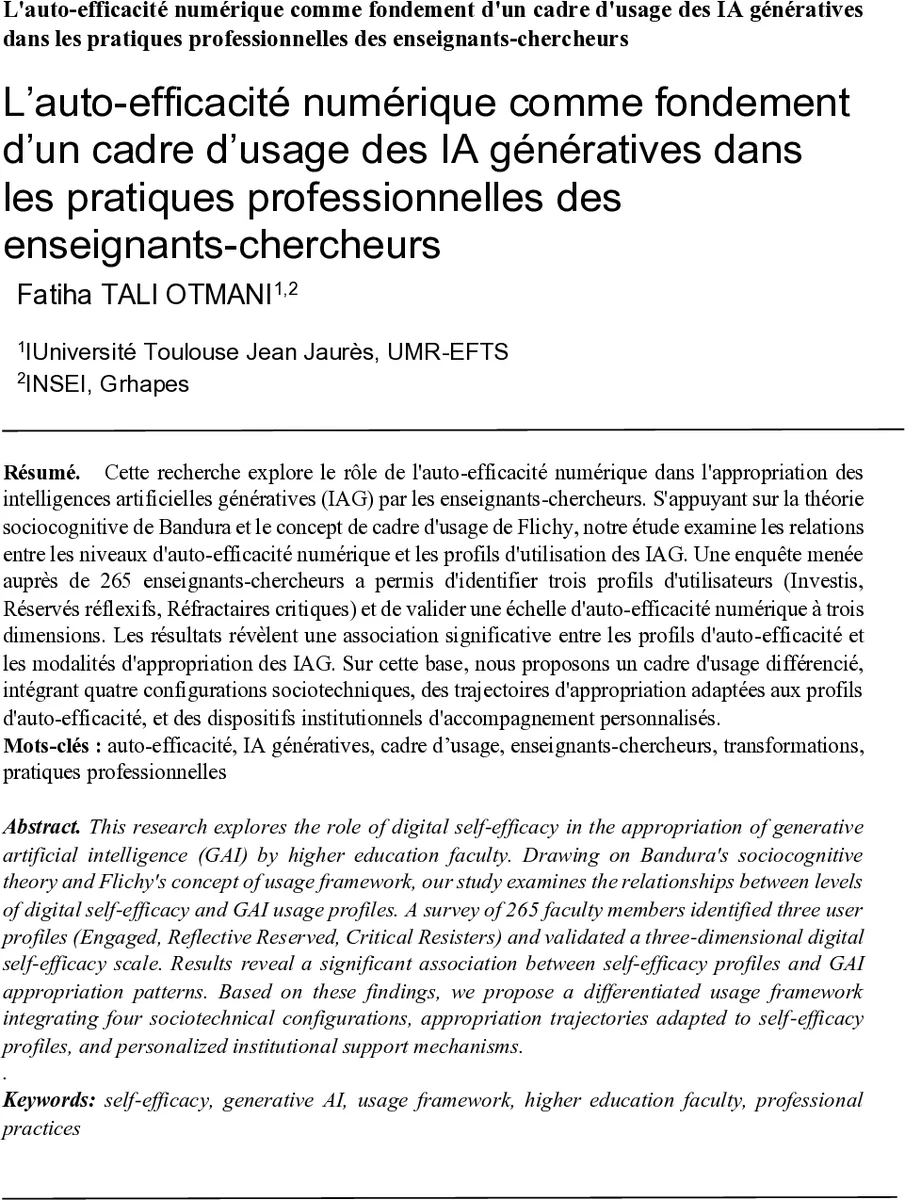
This research explores the role of digital self-efficacy in the appropriation of generative artificial intelligence (GAI) by higher education faculty. Drawing on Bandura’s sociocognitive theory and Flichy’s concept of usage framework, our study examines the relationships between levels of digital self-efficacy and GAI usage profiles. A survey of 265 faculty members identified three user profiles (Engaged, Reflective Reserved, Critical Resisters) and validated a three-dimensional digital self-efficacy scale. Results reveal a significant association between self-efficacy profiles and GAI appropriation patterns. Based on these findings, we propose a differentiated usage framework integrating four sociotechnical configurations, appropriation trajectories adapted to self-efficacy profiles, and personalized institutional support mechanisms.
💡 Research Summary
This paper investigates how digital self‑efficacy influences university faculty members’ appropriation of generative artificial intelligence (GAI) tools. Drawing on Bandura’s sociocognitive theory and Flichy’s “usage framework,” the authors posit that faculty members’ belief in their ability to use digital technologies shapes their attitudes, intentions, and actual practices with GAI.
A cross‑sectional survey was administered to 265 faculty across multiple disciplines and institutions in France and Canada. The questionnaire comprised three parts: (1) a newly developed three‑dimensional digital self‑efficacy scale (technical task confidence, problem‑solving competence, and learning transfer ability); (2) a set of items measuring GAI usage across teaching, research, and administrative contexts; and (3) demographic and organizational variables. Exploratory and confirmatory factor analyses confirmed the reliability and construct validity of the self‑efficacy scale.
Cluster analysis (k‑means) identified three distinct user profiles:
- Engaged – high self‑efficacy, frequent and proactive use of GAI for syllabus creation, research idea generation, and draft writing;
- Reflective Reserved – moderate self‑efficacy, cautious adoption, primarily using GAI as a supplemental aid while emphasizing ethical and legal safeguards;
- Critical Resisters – low self‑efficacy, strong risk‑aversion, minimal or no use of GAI, citing concerns about academic integrity and professional identity.
Multivariate logistic regression showed that self‑efficacy dimensions significantly predict profile membership (p < .01). A structural equation model further revealed a sequential mediation pathway: digital self‑efficacy → cognitive attitude → behavioral intention → actual GAI usage. Organizational culture and policy support acted as moderators, strengthening the link for Engaged faculty and weakening it for Resisters.
Based on these findings, the authors propose a differentiated usage framework consisting of four sociotechnical configurations (collaborative, assistive, monitoring, protective) and a four‑stage adoption trajectory (awareness, pilot, scale‑up, sustainability). Each configuration aligns with a specific user profile and prescribes tailored institutional support mechanisms:
- Workshops to boost digital self‑efficacy (hands‑on tool training, problem‑solving scenarios).
- Ethics and legal guidance (AI Act compliance, data protection, academic integrity policies).
- Mentoring and peer‑networking (communities of practice linking Engaged and Reserved faculty).
- Technical infrastructure and data governance (transparent model documentation, bias audits, secure access).
The framework emphasizes that technology adoption should not be a one‑size‑fits‑all rollout but a nuanced, profile‑driven process that respects faculty diversity, promotes responsible AI use, and integrates institutional values. The paper contributes empirically by linking digital self‑efficacy to concrete GAI usage patterns and theoretically by extending Flichy’s usage framework with a sociocognitive lens. It offers higher‑education leaders a practical roadmap for fostering sustainable, ethical, and effective integration of generative AI into academic practice.
Comments & Academic Discussion
Loading comments...
Leave a Comment