Community by Design
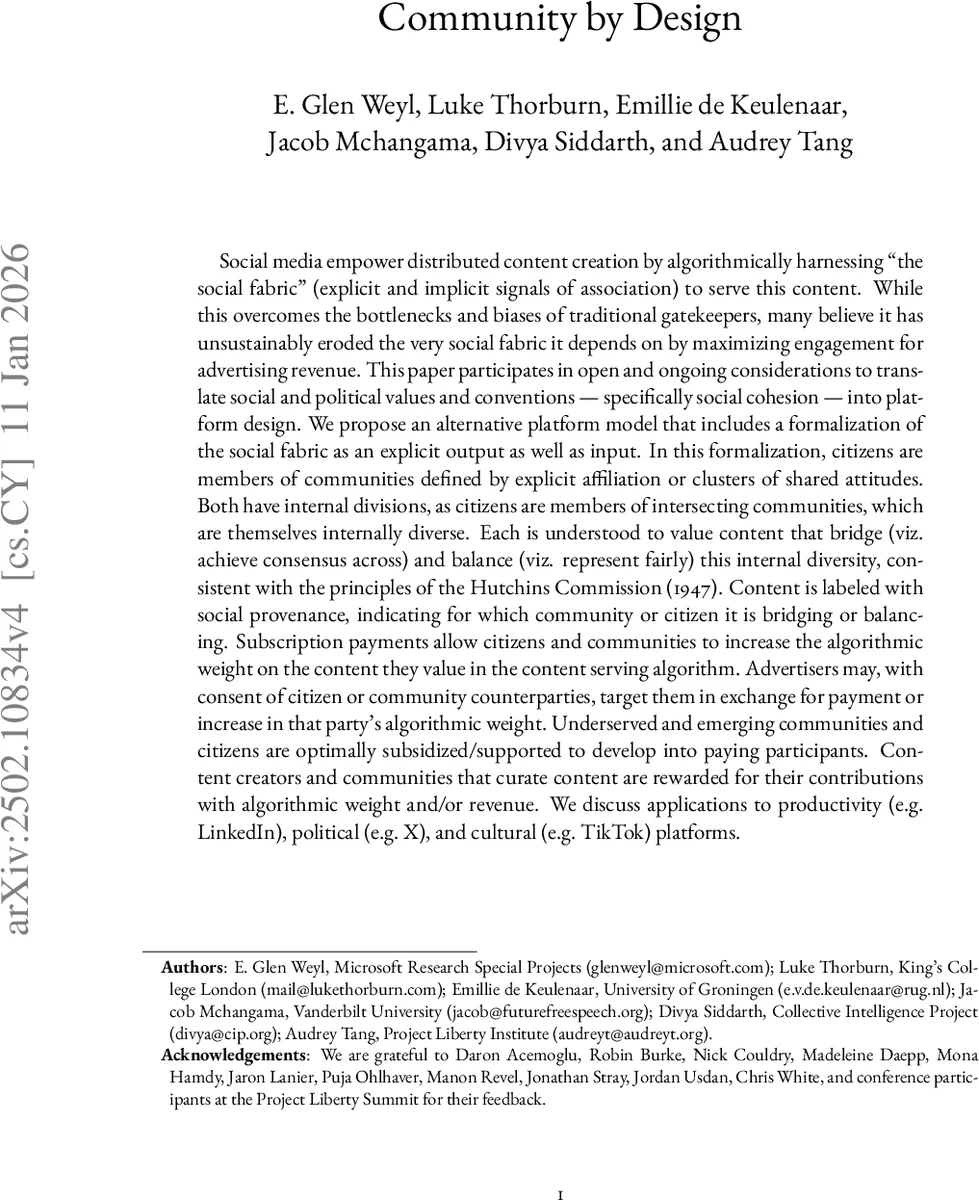
Social media empower distributed content creation by algorithmically harnessing “the social fabric” (explicit and implicit signals of association) to serve this content. While this overcomes the bottlenecks and biases of traditional gatekeepers, many believe it has unsustainably eroded the very social fabric it depends on by maximizing engagement for advertising revenue. This paper participates in open and ongoing considerations to translate social and political values and conventions, specifically social cohesion, into platform design. We propose an alternative platform model that includes the social fabric an explicit output as well as input. Citizens are members of communities defined by explicit affiliation or clusters of shared attitudes. Both have internal divisions, as citizens are members of intersecting communities, which are themselves internally diverse. Each is understood to value content that bridge (viz. achieve consensus across) and balance (viz. represent fairly) this internal diversity, consistent with the principles of the Hutchins Commission (1947). Content is labeled with social provenance, indicating for which community or citizen it is bridging or balancing. Subscription payments allow citizens and communities to increase the algorithmic weight on the content they value in the content serving algorithm. Advertisers may, with consent of citizen or community counterparties, target them in exchange for payment or increase in that party’s algorithmic weight. Underserved and emerging communities and citizens are optimally subsidized/supported to develop into paying participants. Content creators and communities that curate content are rewarded for their contributions with algorithmic weight and/or revenue. We discuss applications to productivity (e.g. LinkedIn), political (e.g. X), and cultural (e.g. TikTok) platforms.
💡 Research Summary
**
The paper “Community by Design” addresses the paradox that today’s social media platforms both rely on and erode the “social fabric” – the network of explicit and implicit signals of association among users – in order to maximize advertising revenue. Existing remedies, such as top‑down moderation or algorithmic tweaks, are criticized for being either too centralized, insufficiently systemic, or for exacerbating bias against marginalized groups. To overcome this dilemma, the authors propose a fundamentally new platform architecture that treats the social fabric as an explicit input and output of the system.
Core Model
-
Citizens and Communities: Users (citizens) belong to communities defined either by explicit affiliation (e.g., organization, geography) or by clusters of shared attitudes and values. A citizen can belong to many overlapping communities, forming a hyper‑graph where nodes are citizens and hyper‑edges are communities.
-
Internal Diversity Metrics: Each community values two complementary dimensions of content:
- Bridge – content that creates consensus across divergent sub‑groups within the community.
- Balance – content that fairly represents the perspectives of all sub‑groups.
These dimensions revive the Hutchins Commission’s 1947 principles (distinguish news from opinion, bridge diverse society, balance divisive opinion).
-
Social Provenance Labels: Every piece of content is tagged with a provenance label indicating for which community (or citizen) it serves as a bridge or a balance. The label makes the hidden social context visible, counteracting the “false consensus effect” that arises when users assume viral content reflects broad agreement.
Algorithmic Weighting Mechanisms
- Subscription Payments – Citizens or communities can pay a recurring fee to increase the algorithmic weight of the bridge/balance content they prefer.
- Advertiser Consent – Advertisers may target a citizen or community only after explicit consent; in exchange they can boost the community’s weight, creating a market for “social‑impact” advertising.
- Subsidies for Emerging Communities – The platform allocates financial support and initial algorithmic weight to under‑served or nascent communities, helping them become paying participants over time.
Reward Structure
- Content Creators earn both algorithmic prominence and direct revenue when their material is labeled as high‑quality bridge or balance content.
- Community Curators receive weight boosts and platform subsidies for successfully curating and promoting such content within their groups.
Design Interventions
- Social Context Annotation – By displaying provenance labels, users can see which communities endorse or contest a post, fostering meta‑consensus.
- Fair Ranking – The feed ranking algorithm is altered to (i) surface common interests across relevant communities and (ii) guarantee each community a fair share of attention. This draws on multi‑fairness frameworks (e.g., Faridani et al., 2010; Small et al., 2021).
- Cross‑Cutting Community Formation – The platform can automatically generate “cross‑cutting” communities that bridge disparate groups, providing them with initial weight and financial incentives to encourage collaboration across divides.
Applications
- Productivity (LinkedIn‑style): Professional communities can surface career‑building content that bridges skill gaps while balancing diverse industry viewpoints.
- Political (X/Twitter‑style): Political sub‑communities receive balanced exposure, reducing echo‑chamber amplification and mitigating misinformation spread.
- Cultural (TikTok‑style): Creative content is labeled to show cultural bridges, helping creators reach audiences beyond their immediate niche while preserving representation of minority cultures.
Critical Reflections
The paper offers a compelling normative vision but leaves several implementation challenges open:
- Metric Operationalization – Defining and measuring “bridge” versus “balance” in real‑time, scalable ways is non‑trivial and may require sophisticated sentiment and network analysis.
- Privacy Concerns – Tagging content with community provenance could expose sensitive affiliation data; safeguards must reconcile transparency with data minimization.
- Economic Equity – Subscription‑driven weight boosts risk reinforcing wealth disparities unless subsidies are sufficiently robust and transparent.
- Algorithmic Complexity & Explainability – Adding hyper‑graph structures and multi‑objective weighting may reduce system interpretability, complicating regulatory compliance.
Conclusion
“Community by Design” reframes the social media problem as a design issue: rather than treating the social fabric as a hidden resource to be mined, the authors embed it as a visible, manipulable component of the platform. By formalizing communities as hyper‑graph edges, introducing bridge/balance metrics, and coupling provenance labeling with market‑based weight adjustments and subsidies, the proposal aims to regenerate the social cohesion that current platforms erode. Future work must empirically validate the proposed metrics, develop privacy‑preserving provenance mechanisms, and devise sustainable economic models that prevent the re‑concentration of influence. The paper thus opens a promising research agenda for socially responsible platform architecture.
Comments & Academic Discussion
Loading comments...
Leave a Comment