Condensation mechanism of high-$T_c$ cuprates: the key role of pairon excitations
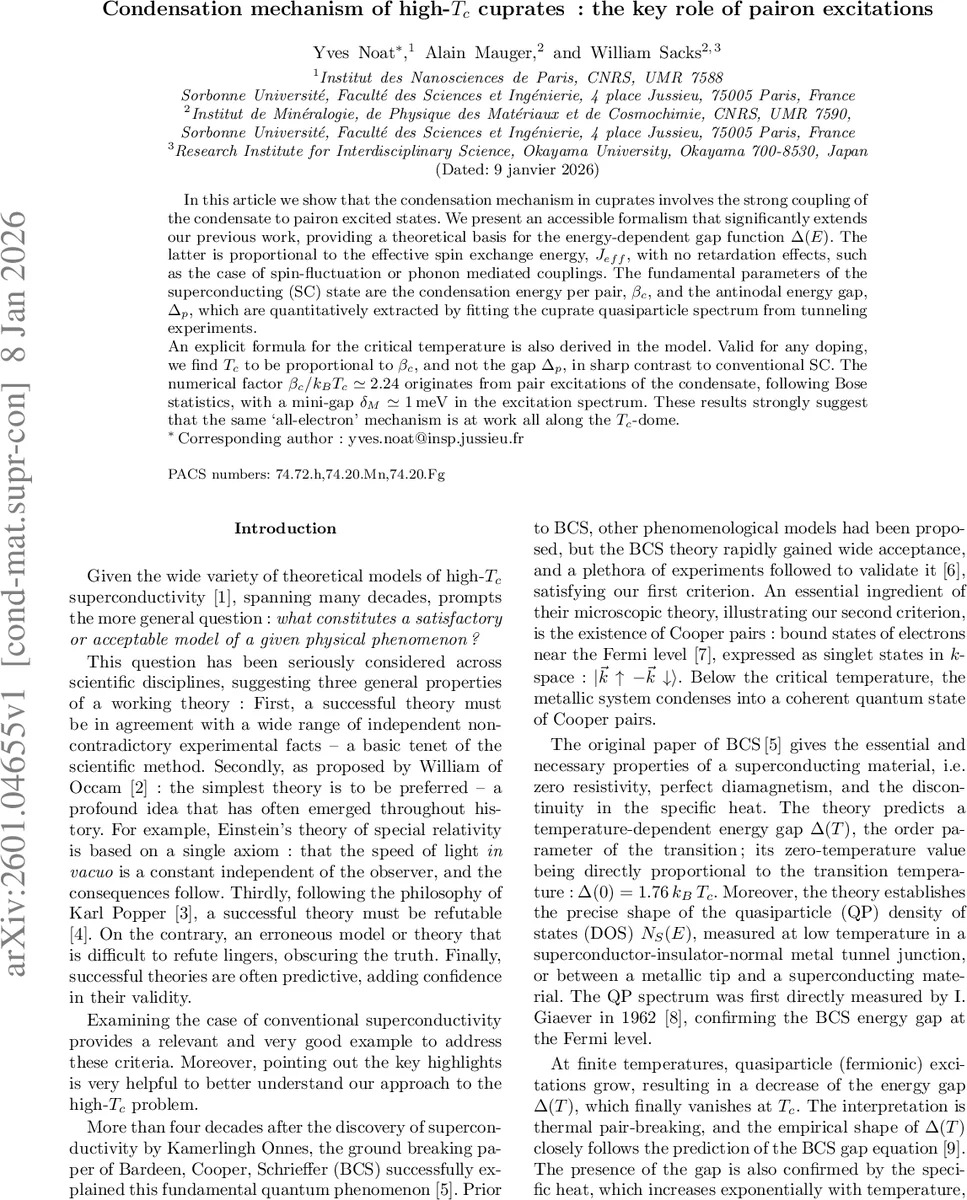
In this article we show that the condensation mechanism in cuprates involves the strong coupling of the condensate to pairon excited states. We present an accessible formalism that significantly extends our previous work, providing a theoretical basis for the energy-dependent gap function $Δ(E)$. The latter is proportional to the effective spin exchange energy, $J_{eff}$, with no retardation effects, such as the case of spin-fluctuation or phonon mediated couplings. The fundamental parameters of the superconducting (SC) state are the condensation energy per pair, $β_c$, and the antinodal energy gap, $Δ_p$, which are quantitatively extracted by fitting the cuprate quasiparticle spectrum from tunneling experiments. An explicit formula for the critical temperature is also derived in the model. Valid for any doping, we find $T_c$ to be proportional to $β_c$, and not the gap $Δ_p$, in sharp contrast to conventional SC. The numerical factor $β_c/k_BT_c\simeq 2.24$ originates from pair excitations of the condensate, following Bose statistics, with a mini-gap $δ_M \simeq 1,$meV in the excitation spectrum. These results strongly suggest that the same `all-electron’ mechanism is at work all along the $T_c$-dome.
💡 Research Summary
The paper proposes a novel condensation mechanism for high‑temperature cuprate superconductors that departs fundamentally from the conventional Bardeen‑Cooper‑Schrieffer (BCS) picture. The authors introduce the concept of “pairons” – bound hole pairs that form on adjacent copper sites within the antiferromagnetic (AF) background of the CuO₂ planes. Unlike Cooper pairs, which are described in momentum space, pairons are real‑space objects whose binding energy Δₚ (the antinodal gap) is directly proportional to the effective spin‑exchange energy J_eff. This establishes a non‑retarded, instantaneous interaction, in contrast to the retarded phonon‑ or spin‑fluctuation mechanisms traditionally invoked for cuprates.
A second key energy scale, the condensation energy per pair β_c, quantifies the interaction among pairons that drives the superconducting transition. While Δₚ follows the pseudogap temperature T* and decreases linearly with hole doping, β_c tracks the critical temperature T_c across the entire dome. The authors find a universal ratio β_c / (k_B T_c) ≈ 2.24, which they attribute to the statistical properties of pairon excitations. These excitations obey Bose statistics and possess a small “mini‑gap” δ_M ≈ 1 meV, giving rise to a characteristic dip in tunneling spectra.
The theoretical framework is built on a simple Hamiltonian that couples a non‑interacting condensate state |p⟩ (energy Δ₀) to a continuum of excited pair states |ex_i⟩ (energies E_i) via a coupling constant λ. Using Dyson’s equation, the authors derive an exact Green’s function for the coupled system:
G_pp(E) = 1 /
Comments & Academic Discussion
Loading comments...
Leave a Comment