Alignment-Dependent Gapless Chiral Split Magnons in Altermagnetic Domain Walls
Altermagnets, an emerging class of magnetic materials, exhibit exotic chiral split magnons that are of great interest for both fundamental physics and spintronic applications. However, detecting and manipulating these magnons is challenging due to their THz frequency response. Here, we report the discovery of gapless chiral split magnons confined within altermagnetic domain walls. Unlike in conventional ferromagnets or antiferromagnets, their spectrum is highly sensitive to the domain wall orientation relative to the crystal axis. These magnons inherit the chiral splitting of their bulk counterparts and are detectable in the microwave regime, offering a distinctive signature for identifying altermagnets. We further show that the interfacial Dzyaloshinskii-Moriya interaction drives hybridization of magnons with opposite chiralities, enabling unidirectional strong magnon-magnon coupling. Moreover, we demonstrate that spin-orbit torque can control the domain wall orientation, providing a practical means to manipulate these chiral magnons. Our findings open pathways for novel magnonic nanocircuitry based on altermagnetic domain walls.
💡 Research Summary
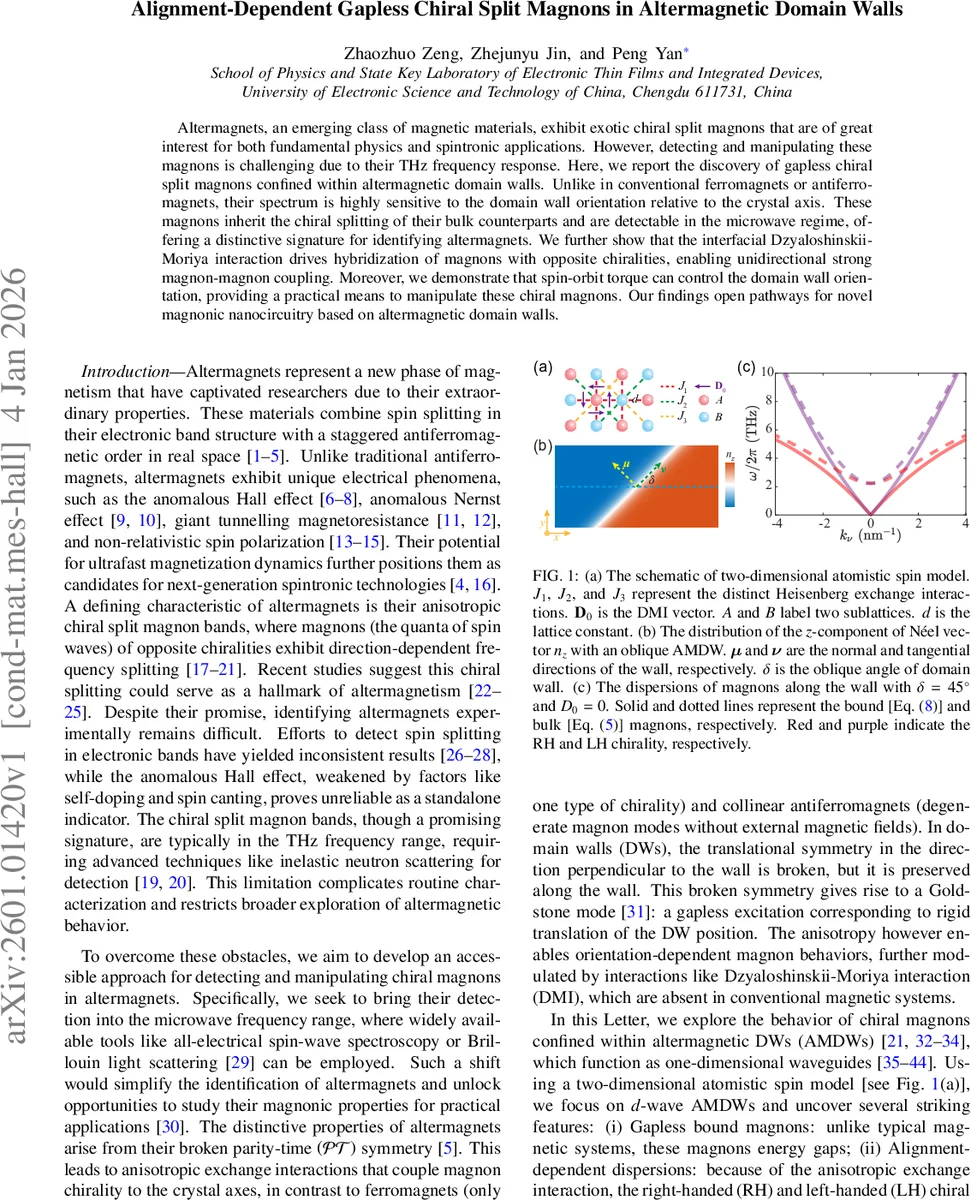
The authors investigate a previously unexplored class of excitations—gapless chiral split magnons that are confined to domain walls in altermagnetic materials (AMDWs). Altermagnets are a newly identified magnetic phase that combines staggered antiferromagnetic order with spin‑splitting in the electronic band structure, breaking parity‑time (PT) symmetry and giving rise to anisotropic exchange interactions. These interactions produce right‑handed (RH) and left‑handed (LH) magnon branches whose frequencies differ depending on the propagation direction relative to the crystal axes, a phenomenon known as chiral splitting. In bulk altermagnets this splitting lies in the terahertz range, making experimental detection difficult.
Using a two‑dimensional atomistic spin model that includes nearest‑neighbor antiferromagnetic exchange (J₁), next‑nearest‑neighbor ferromagnetic exchanges (J₂, J₃), easy‑axis anisotropy (K), and an interfacial Dzyaloshinskii‑Moriya interaction (D₀), the authors derive a continuum Hamiltonian for the Néel vector n and the net magnetization m. From this they obtain the equations of motion and analytically solve for a static domain‑wall profile characterized by a width w = √(A₁/K) and an oblique angle δ that measures the wall’s orientation with respect to the crystal axes. Small fluctuations (n₁, n₂) around this background lead to a coupled 2×2 dynamical matrix whose eigenvalues give the magnon dispersions.
In the absence of DMI (D₀ = 0) the bound magnon modes are shown to be gapless (ω = 0 at kν = 0) for any δ, but their dispersion acquires a δ‑dependent chiral splitting: ω± = q
Comments & Academic Discussion
Loading comments...
Leave a Comment