Convective Flows in Sheared Packings of Spherical Particles
Understanding how granular materials respond to shear stress remains a central challenge in soft matter physics. We report direct observations of persistent granular convection in the bulk shear zones of spherical particle packings – a phenomenon previously associated primarily with particle shape anisotropy or boundary effects. By employing various bead-coloring techniques in a split-bottom geometry, we reveal internal flow fields within sheared granular packings. We find robust convection rolls, strikingly governed by system geometry: at low filling heights, two counter-rotating convection rolls emerge, while at higher filling heights, a single dominant convection roll forms, featuring radially outward flow at the surface. This transition is driven by the height-dependent broadening of the shear zone, which introduces shear rate asymmetry across its flanks. Notably, the transition occurs entirely within the open shear band regime. These findings underscore the pivotal role of system geometry in shaping secondary flow formation in dense packings of frictional particles, suggesting possible broader relevance to geophysical flow dynamics and industrial applications.
💡 Research Summary
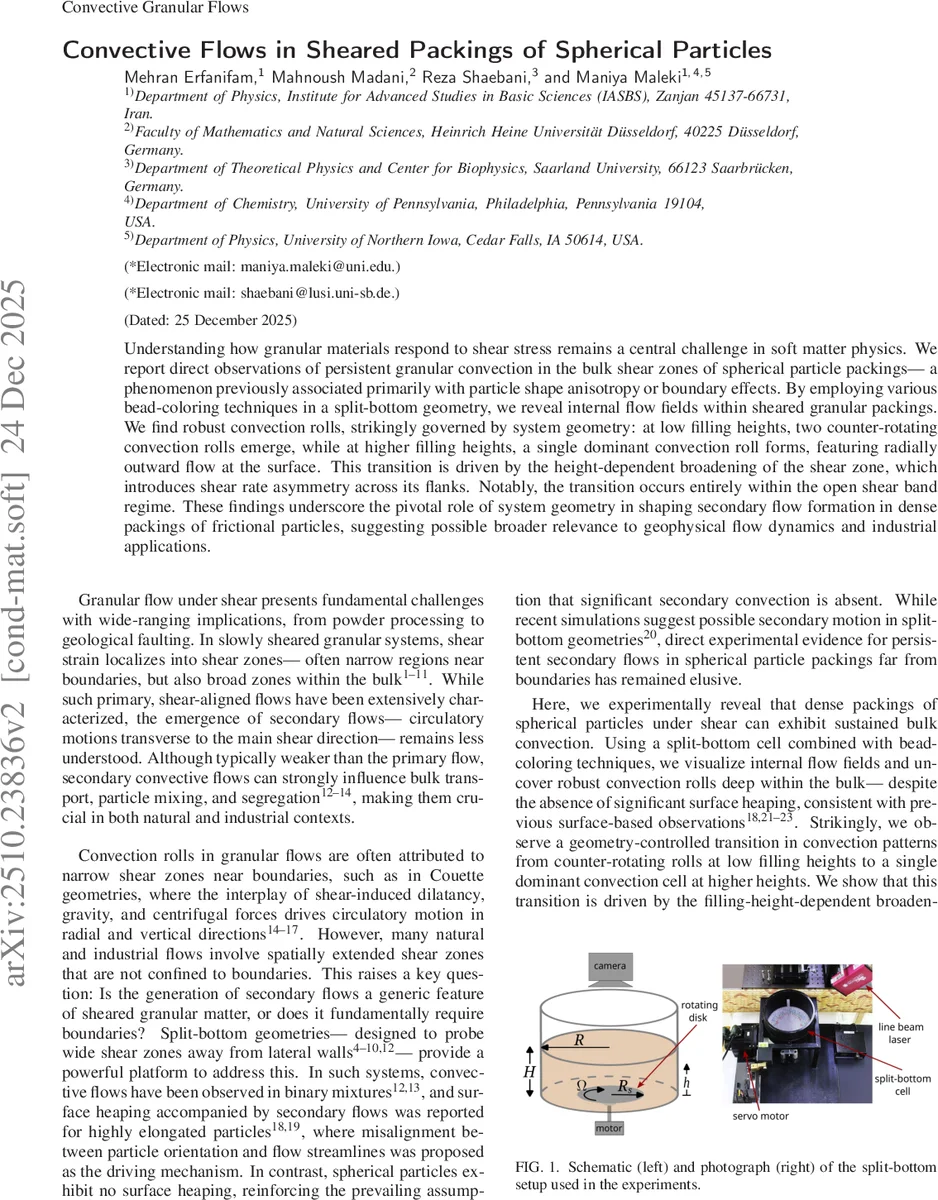
This paper presents the first direct experimental evidence that dense packings of spherical particles can sustain persistent bulk convection when sheared, even in the absence of particle shape anisotropy or explicit boundary confinement. The authors employ a split‑bottom shear cell consisting of a rotating disk (radius 7.5 cm) flush with a fixed outer ring (radius 10 cm). The disk rotates at a low angular speed (Ω = 0.127 rad s⁻¹) to ensure quasistatic conditions where the primary shear flow is essentially rate‑independent. The granular medium is made of 2 mm glass beads with a modest 15 % polydispersity; a small amount of pigment coating adds only a few micrometres to the bead diameter, leaving mechanical properties unchanged.
To visualize internal flow, the authors embed coloured tracer beads in controlled patterns (vertical planes, radial bands, and horizontal layers) before shearing. After a prescribed shear duration, the top layers are carefully removed and the positions of the tracers are imaged, yielding a three‑dimensional reconstruction of particle trajectories. Primary shear profiles are obtained by tracking the deformation of a vertical black‑tracer sheet. The angular velocity ω(r) at each depth h follows an error‑function form ω = ω₀ · ½
Comments & Academic Discussion
Loading comments...
Leave a Comment