SO(3) real algebra method for SU(3) QCD at finite baryon-number densities
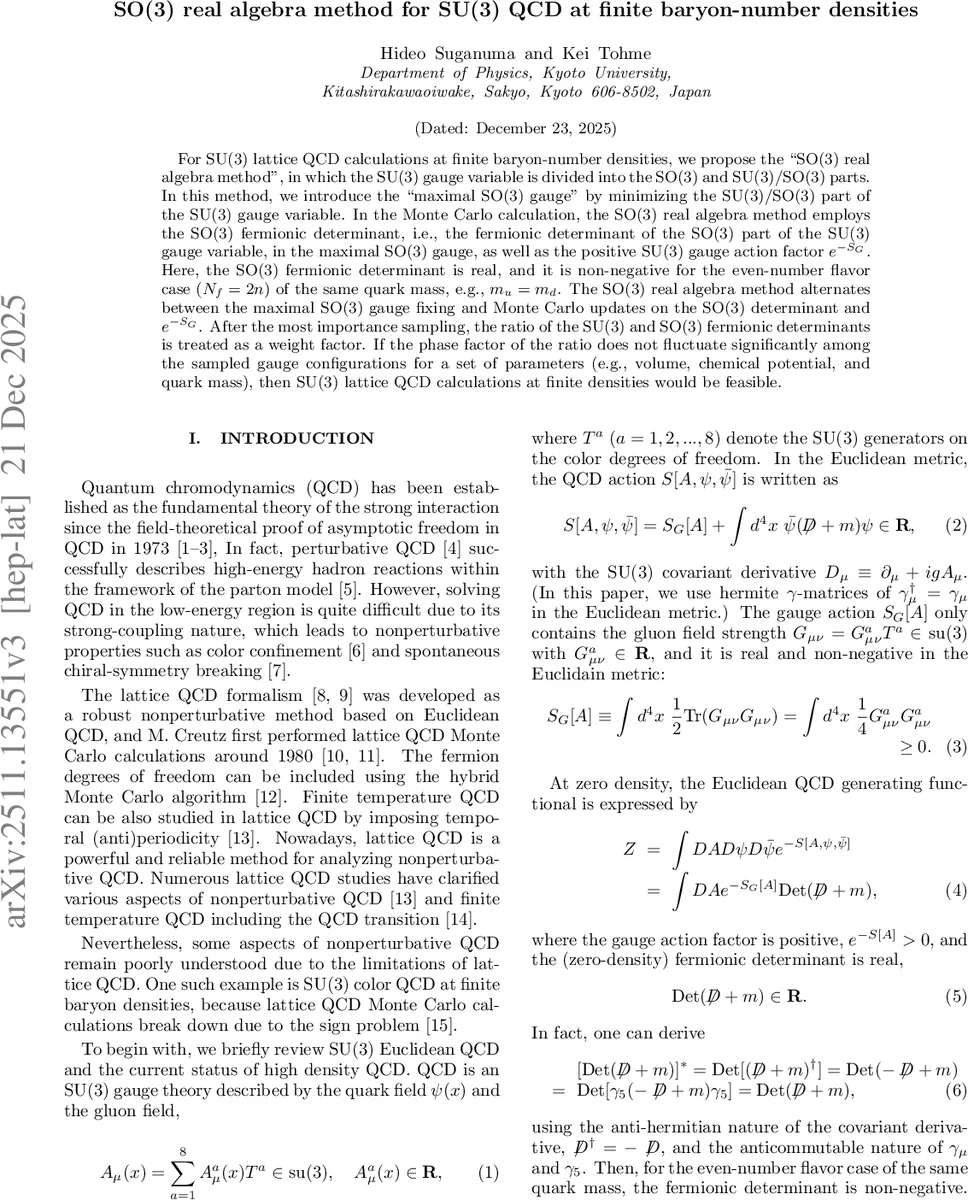
For SU(3) lattice QCD calculations at finite baryon-number densities, we propose the SO(3) real algebra method'', in which the SU(3) gauge variable is divided into the SO(3) and SU(3)/SO(3) parts. In this method, we introduce the maximal SO(3) gauge’’ by minimizing the SU(3)/SO(3) part of the SU(3) gauge variable. In the Monte Carlo calculation, the SO(3) real algebra method employs the SO(3) fermionic determinant, i.e., the fermionic determinant of the SO(3) part of the SU(3) gauge variable, in the maximal SO(3) gauge, as well as the positive SU(3) gauge action factor $e^{-S_G}$. Here, the SO(3) fermionic determinant is real, and it is non-negative for the even-number flavor case ($N_f=2n$) of the same quark mass, e.g., $m_u=m_d$. The SO(3) real algebra method alternates between the maximal SO(3) gauge fixing and Monte Carlo updates on the SO(3) determinant and $e^{-S_G}$. After the most importance sampling, the ratio of the SU(3) and SO(3) fermionic determinants is treated as a weight factor. If the phase factor of the ratio does not fluctuate significantly among the sampled gauge configurations for a set of parameters (e.g., volume, chemical potential, and quark mass), then SU(3) lattice QCD calculations at finite densities would be feasible.
💡 Research Summary
The paper tackles the notorious sign problem that plagues lattice QCD simulations at finite baryon density. When a real quark chemical potential μ is introduced, the fermionic determinant Det(D + m + μγ₄) becomes complex, destroying the probabilistic interpretation of the Boltzmann weight e⁻ˢ and rendering standard Monte‑Carlo methods ineffective. The authors propose a novel algebraic strategy called the “SO(3) real algebra method” that exploits a decomposition of the SU(3) gauge field into an SO(3) subgroup and its complementary coset SU(3)/SO(3).
First, the SU(3) Lie algebra is split by selecting three anti‑Hermitian generators (T₂, T₅, T₇) that close under commutation and form an SO(3) subalgebra. The remaining five generators (T₁, T₃, T₄, T₆, T₈) span the coset space and are symmetric under transposition. Crucially, the structure constants involving mixed indices vanish (f¯iij = 0) and those purely in the coset also vanish (f¯i¯j¯k = 0), guaranteeing orthogonality between the two sectors.
Using this algebraic split, any SU(3) link variable U can be factorized as U = u M (or M u), where u ∈ SO(3) is a real orthogonal matrix and M ∈ SU(3)/SO(3) is a symmetric matrix. The authors define the “maximal SO(3) gauge” as the gauge transformation that minimizes the norm of the coset part M, equivalently imposing Tr(M T_i) = 0 for i = 2, 5, 7. This gauge fixing forces the gauge configuration to be as close as possible to a pure SO(3) element, thereby reducing the contribution of the complex coset sector.
In the maximal SO(3) gauge the fermionic determinant built from the SO(3) part alone, Det_SO(3)
Comments & Academic Discussion
Loading comments...
Leave a Comment