Generalized Harmonic Numbers: Identities and Properties
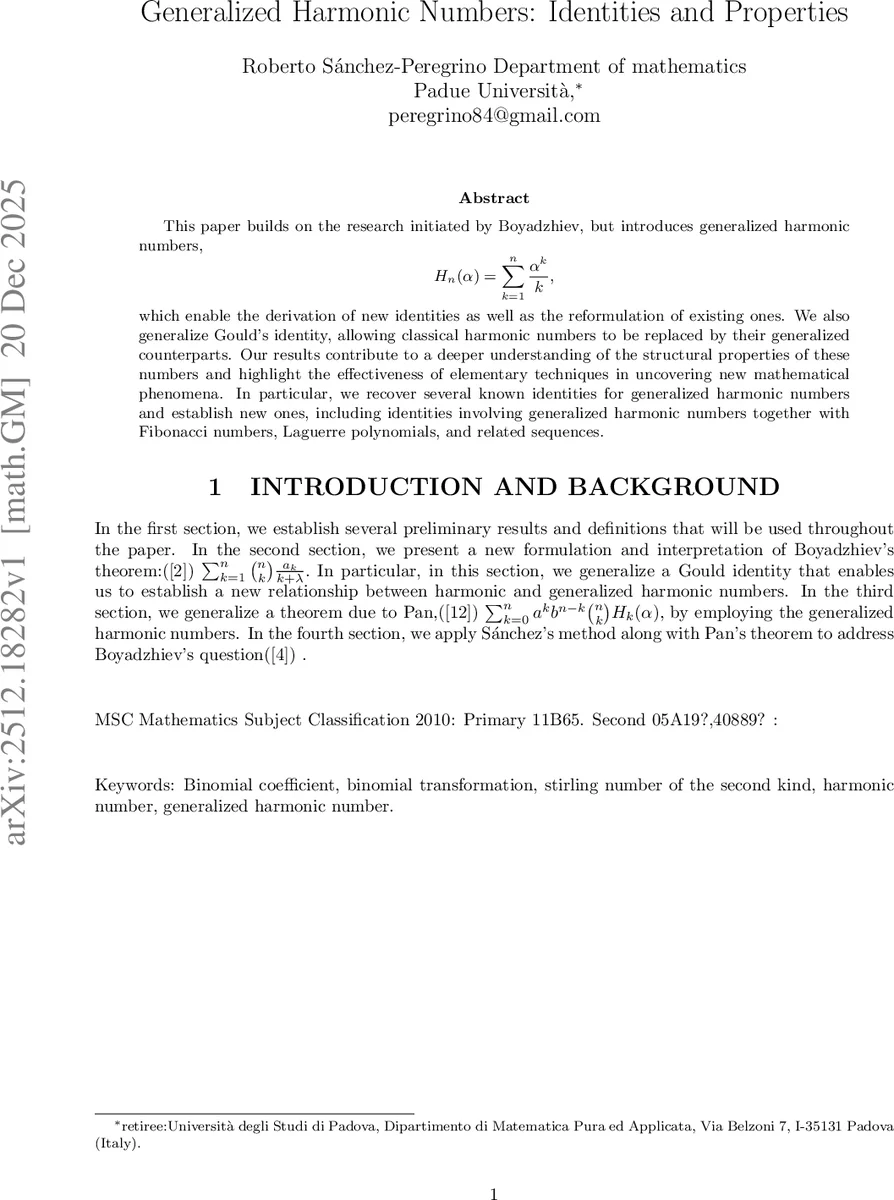
This paper builds on the research initiated by Boyadzhiev, but introduces generalized harmonic numbers, [ H_n(α)= \sum_{k=1}^n \frac{α^{k}}{k}, ] which enable the derivation of new identities as well as the reformulation of existing ones. We also generalize Gould’s identity, allowing classical harmonic numbers to be replaced by their generalized counterparts. Our results contribute to a deeper understanding of the structural properties of these numbers and highlight the effectiveness of elementary techniques in uncovering new mathematical phenomena. In particular, we recover several known identities for generalized harmonic numbers and establish new ones, including identities involving generalized harmonic numbers together with Fibonacci numbers, Laguerre polynomials, and related sequences.
💡 Research Summary
The paper introduces the generalized harmonic numbers (H_n(\alpha)=\sum_{k=1}^{n}\frac{\alpha^{k}}{k}) and systematically develops a collection of identities that extend classical results of Boyadzhiev, Gould, and Pan. After a brief motivation, the author defines the basic objects, including the binomial transform (b_n=\sum_{k=0}^{n}\binom{n}{k}a_k), Stirling numbers of the second kind, and an integral representation of (H_n(\alpha)) that makes the dependence on the parameter (\alpha) analytically tractable.
The core of the work is a reformulation of Boyadzhiev’s theorem. Using Lemmas 3.1 and 3.2 the author shows that for any complex (\lambda) not equal to a negative integer,
\
Comments & Academic Discussion
Loading comments...
Leave a Comment