Altermagnetic polarons: the fate of alter magnetic band splittings at strong coupling
While a spin-dependent band splitting is one of the characteristic features of altermagnets, the conventional band picture itself breaks down in the many altermagnets that are correlated Mott materials. We employ two numerical many-body methods, the self-consistent Born approximation and variational cluster approach, to explore this strongly correlated regime and investigate hole motion in Mott altermagnets. Our results reveal that spin-dependent spectral-weight transfer is the dominant signature of Mott altermagnetism. This pronounced spin-momentum locking of the quasiparticle spectral weight arises from the formation of altermagnetic polarons, whose dynamics are governed by the interplay between free hole motion and the coupling of the hole to magnon excitations in the altermagnet. We demonstrate this effect by calculating ARPES spectra for three canonical altermagnetic systems: the checkerboard $J$-$J’$ model, a variant describing the transition-metal–ion sites of the inverse Lieb lattice, and the Kugel-Khomskii spin-orbital altermagnet based on cubic vanadates RVO$_3$ (R=La, Pr, Nd, Y).
💡 Research Summary
The paper addresses a fundamental question: what happens to the characteristic spin‑dependent band splitting of altermagnets when the material is a strongly correlated Mott insulator? While weak‑coupling altermagnets display anisotropic, spin‑split iso‑energy surfaces, many experimentally relevant altermagnets are actually Mott insulators where the Hubbard interaction dominates the electronic structure. In this regime the conventional single‑particle band picture breaks down, and the motion of a doped hole must be treated as a many‑body problem.
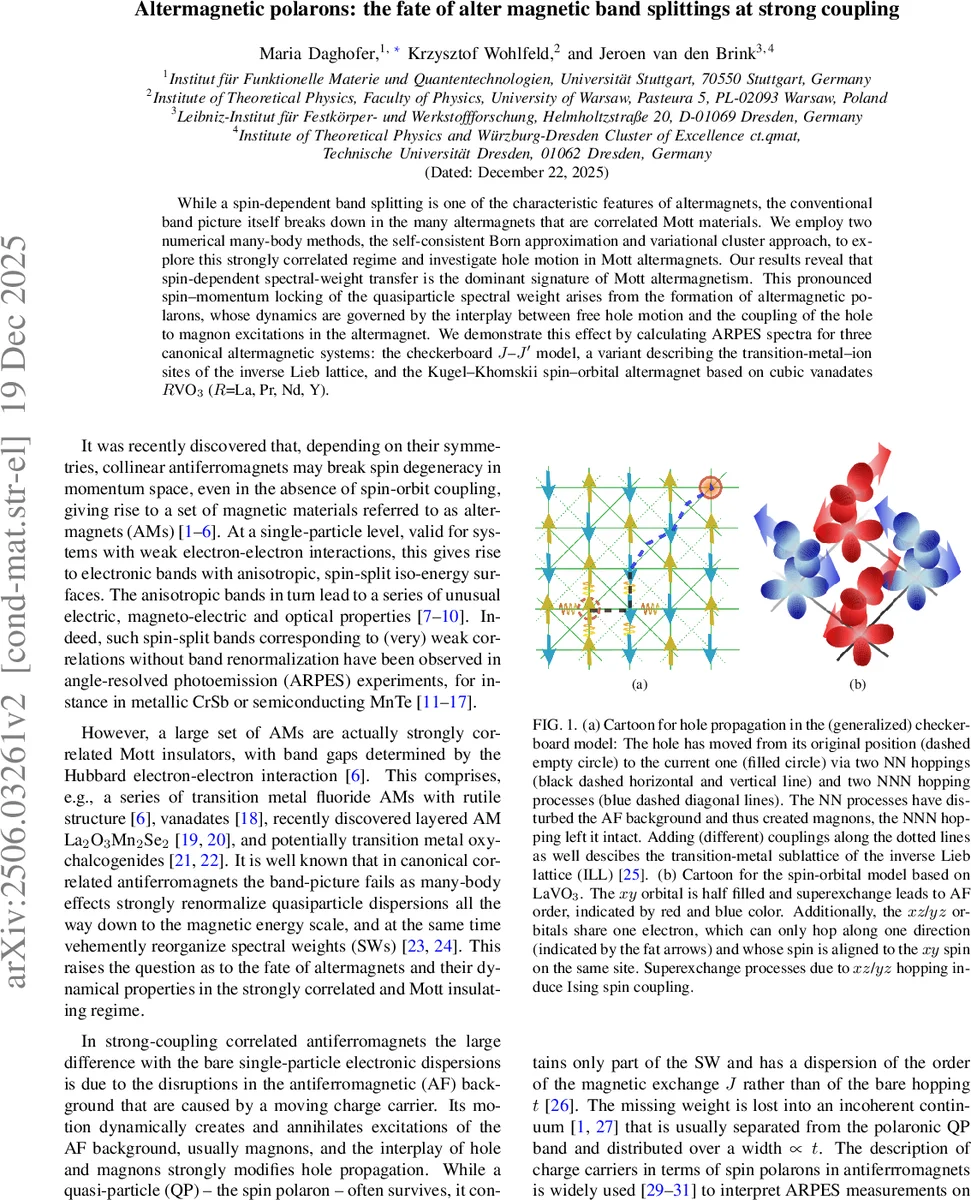
To explore this, the authors study three prototypical altermagnetic systems using two complementary many‑body techniques: the self‑consistent Born approximation (SCBA), which captures the non‑crossing hole‑magnon coupling to high accuracy, and the variational cluster approximation (VCA), which treats the full Hubbard interaction on a finite cluster. The three models are: (i) a checkerboard t‑J model with nearest‑neighbor (NN) hopping t, next‑nearest‑neighbor (NNN) hopping t′, NN exchange J and NNN exchange J′; (ii) a generalized checkerboard lattice that mimics the transition‑metal sublattice of the inverse Lieb lattice (ILL) by adding diagonal hoppings t′_b and exchange J′_b; and (iii) a three‑orbital t₂g Kugel‑Khomskii model appropriate for cubic vanadates RVO₃ (R = La, Pr, Nd, Y), which exhibits simultaneous antiferromagnetic (AF) spin order and antiferro‑orbital (AO) order, thereby realizing an altermagnetic state on a single plane.
The SCBA analysis of the pure checkerboard model (J′ = 0.15 t, t′ = –0.5 t) reveals that the expected two spin‑split quasiparticle (QP) bands are replaced by a single coherent QP whose spectral weight is strongly spin‑dependent. The opposite‑spin component is pushed into an incoherent continuum, losing its QP character. This “spin‑momentum locking” of the spectral weight is the dominant signature of altermagnetic Mott physics. Varying t′ and J′ shows a clear trend: larger sublattice‑conserving hopping t′ reduces the hole‑magnon coupling, allowing two spin‑polarized QPs to reappear, whereas dominant NN hopping (small t′) enforces strong coupling and a single spin‑polarized QP.
In the ILL‑type lattice, the authors consider two orbital channels. For the xy orbital, the diagonal hopping t′_b is much smaller than t′, reproducing the strong spin‑momentum locking seen in the checkerboard case. For the 3z²−r² orbital, t′ ≈ t′_b ≈ 3 t, so sublattice‑conserving processes dominate; the hole essentially decouples from the spin background, and two spin‑split bands survive with appreciable weight. These results illustrate how the microscopic hopping anisotropy controls the balance between coherent polaron motion and incoherent background scattering.
The VCA calculations on the Hubbard version of the checkerboard model (U = 10 t) confirm the SCBA findings: even with full on‑site repulsion the QP retains a momentum‑dependent spin polarization, and the incoherent background carries the opposite spin weight.
For the Kugel‑Khomskii t₂g model, VCA yields a spectrum with a series of “ladder” bands that reflect three‑site hopping processes constrained by the AF/AO order. The hole inserted into a specific orbital (xy, xz, or yz) inherits a definite spin orientation, leading to spin‑dependent dispersion. Notably, at the altermagnetic high‑symmetry momenta (π,0) and (0,π) the spectral weight is almost fully spin‑polarized, especially in the combined xz/yz sector. The opposite‑spin weight is transferred not to a low‑energy incoherent background but to the upper Hubbard band, indicating a different redistribution mechanism compared with the checkerboard case.
Overall, the study establishes that in strongly correlated altermagnets the hallmark of altermagnetism is not a rigid spin‑split band structure but a spin‑dependent redistribution of spectral weight—a phenomenon the authors term “altermagnetic polarons.” The polaron’s dynamics are governed by the competition between free hole hopping (which preserves the altermagnetic background) and magnon‑mediated scattering (which disrupts it). The balance of these processes is set by the details of NN versus NNN hopping and exchange, as well as by orbital symmetry in spin‑orbital coupled systems.
The authors propose concrete experimental signatures: spin‑resolved ARPES on thin films or surface layers of LaVO₃, or on La₂O₃Mn₂Se₂, should reveal a single coherent QP with spin‑dependent intensity or, depending on the orbital channel, two spin‑split QPs with markedly different weights. The presence of ladder‑like replica bands in the vanadate case would further confirm the polaronic nature.
In conclusion, the work extends the concept of altermagnetism into the strong‑coupling regime, showing that altermagnetic polarons exhibit spin‑momentum locking through spectral‑weight transfer rather than simple band splitting. This insight bridges the fields of altermagnetism, Mott physics, and polaron theory, and opens new avenues for exploiting spin‑polarized quasiparticles in spintronic and possibly unconventional superconducting devices.
Comments & Academic Discussion
Loading comments...
Leave a Comment