SpikeDet: Better Firing Patterns for Accurate and Energy-Efficient Object Detection with Spiking Neural Networks
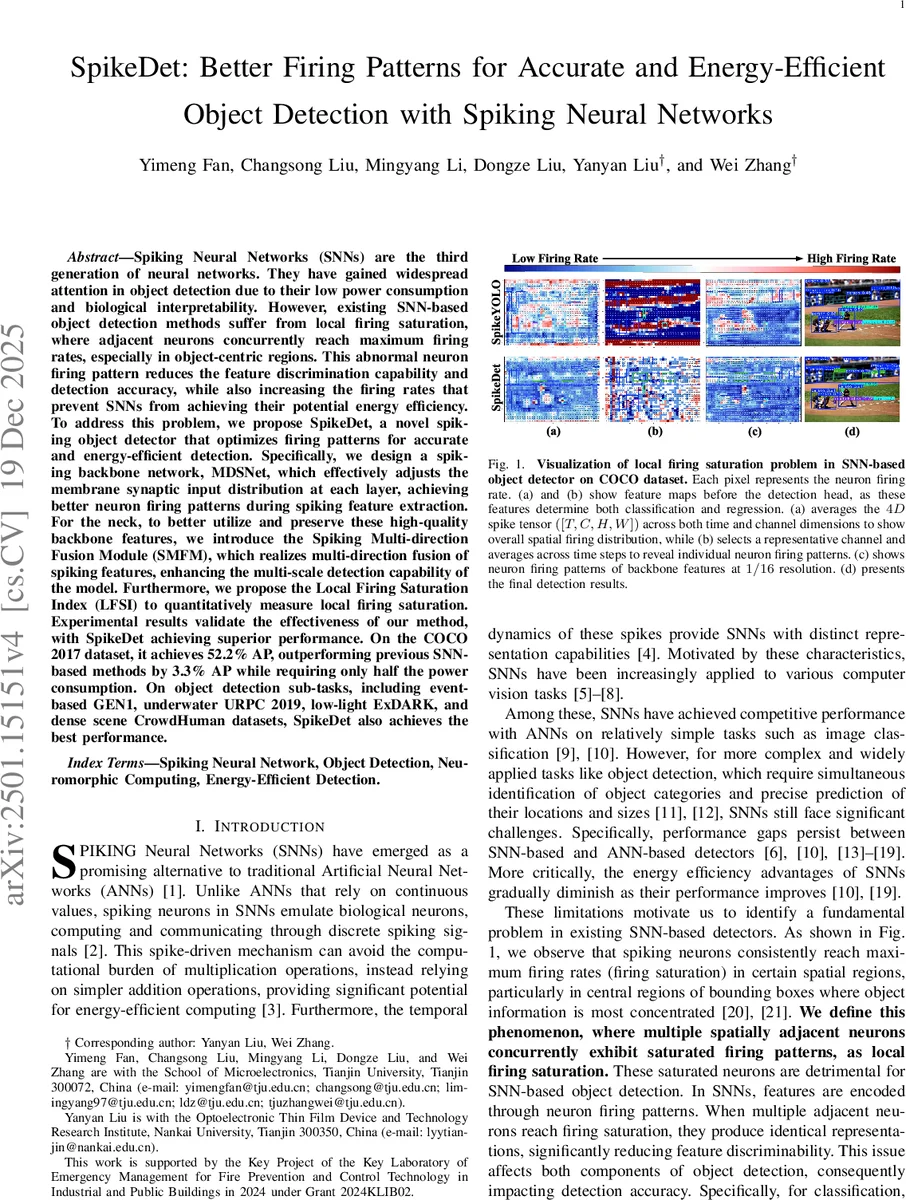
Spiking Neural Networks (SNNs) are the third generation of neural networks. They have gained widespread attention in object detection due to their low power consumption and biological interpretability. However, existing SNN-based object detection methods suffer from local firing saturation, where adjacent neurons concurrently reach maximum firing rates, especially in object-centric regions. This abnormal neuron firing pattern reduces the feature discrimination capability and detection accuracy, while also increasing the firing rates that prevent SNNs from achieving their potential energy efficiency. To address this problem, we propose SpikeDet, a novel spiking object detector that optimizes firing patterns for accurate and energy-efficient detection. Specifically, we design a spiking backbone network, MDSNet, which effectively adjusts the membrane synaptic input distribution at each layer, achieving better neuron firing patterns during spiking feature extraction. For the neck, to better utilize and preserve these high-quality backbone features, we introduce the Spiking Multi-direction Fusion Module (SMFM), which realizes multi-direction fusion of spiking features, enhancing the multi-scale detection capability of the model. Furthermore, we propose the Local Firing Saturation Index (LFSI) to quantitatively measure local firing saturation. Experimental results validate the effectiveness of our method, with SpikeDet achieving superior performance. On the COCO 2017 dataset, it achieves 52.2% AP, outperforming previous SNN-based methods by 3.3% AP while requiring only half the power consumption. On object detection sub-tasks, including event-based GEN1, underwater URPC 2019, low-light ExDARK, and dense scene CrowdHuman datasets, SpikeDet also achieves the best performance.
💡 Research Summary
SpikeDet addresses a fundamental limitation of spiking neural network (SNN) based object detectors: local firing saturation, where clusters of adjacent neurons simultaneously reach their maximum firing rates, especially in object‑centric regions. This phenomenon reduces feature discriminability, harms both classification confidence and bounding‑box regression, and inflates power consumption. The authors first identify that the common use of membrane‑based shortcut residual connections in SNN backbones causes the variance of membrane synaptic inputs to accumulate across layers, dramatically increasing the likelihood of saturation.
To mitigate this, they propose a new backbone, MDSNet, built around a Membrane‑based Deformed Shortcut (MDS). Unlike the standard shortcut that directly adds the residual path to the identity path, MDS inserts a learned scaling/normalization that stabilizes the output distribution of the identity branch. This prevents variance amplification, thereby reducing the probability that neurons receive excessively large inputs and enter saturation. MDSNet comprises five stages with two types of blocks: MDS‑Block1 (no down‑sampling) and MDS‑Block2 (with down‑sampling). The architecture preserves multi‑scale feature extraction while keeping firing patterns stable at each stage.
For the neck, the authors introduce the Spiking Multi‑direction Fusion Module (SMFM). Conventional spiking fusion modules propagate information in a single direction or through limited pathways, which can cause redundant activation of multi‑scale features and exacerbate local saturation. SMFM creates bidirectional and cross‑scale pathways, allowing shallow, detail‑rich features and deep, semantic‑rich features to repeatedly refine each other. This multi‑directional flow both enhances multi‑scale detection capability and further suppresses local firing saturation.
To quantitatively assess saturation, they define the Local Firing Saturation Index (LFSI), which averages the proportion of saturated neurons in the neighborhood of each neuron across all layers. Lower LFSI values indicate fewer saturated clusters. Experiments show that SpikeDet reduces LFSI by over 40 % compared with prior SNN detectors, confirming that the proposed architectural changes effectively regularize firing patterns.
Empirically, SpikeDet achieves 52.2 % AP on COCO 2017, surpassing the previous best SNN detector by 3.3 % AP while consuming roughly half the power under the same hardware conditions. The model also attains state‑of‑the‑art results on several specialized benchmarks: event‑based GEN1, underwater URPC 2019, low‑light ExDARK, and dense‑crowd CrowdHuman. Ablation studies demonstrate that removing MDS leads to a steep rise in LFSI and a drop of ~2 % AP, while omitting SMFM harms small‑object AP, confirming the complementary roles of backbone stabilization and multi‑directional fusion.
Implementation details include the use of Integer Leaky‑Integrate‑and‑Fire (I‑LIF) neurons with a clipping function to bound integer spikes, surrogate gradient training with a piecewise linear surrogate, and an 8‑step temporal encoding (T = 8) for both static images and event streams. The detection head reuses the SpikeYOLO head, as firing‑pattern stability is less critical at this stage.
In summary, SpikeDet introduces two novel architectural components—MDS for variance‑controlled residual connections and SMFM for comprehensive multi‑scale fusion—together with a quantitative saturation metric (LFSI). These contributions enable SNN‑based object detectors to close the performance gap with ANN counterparts while preserving the intrinsic energy‑efficiency advantage of spiking computation. Future work is suggested on hardware‑level optimization (ASIC/FPGA), longer temporal horizons for event data, and further parameter reduction to make the approach even more lightweight.
Comments & Academic Discussion
Loading comments...
Leave a Comment