Agnosticism About Artificial Consciousness
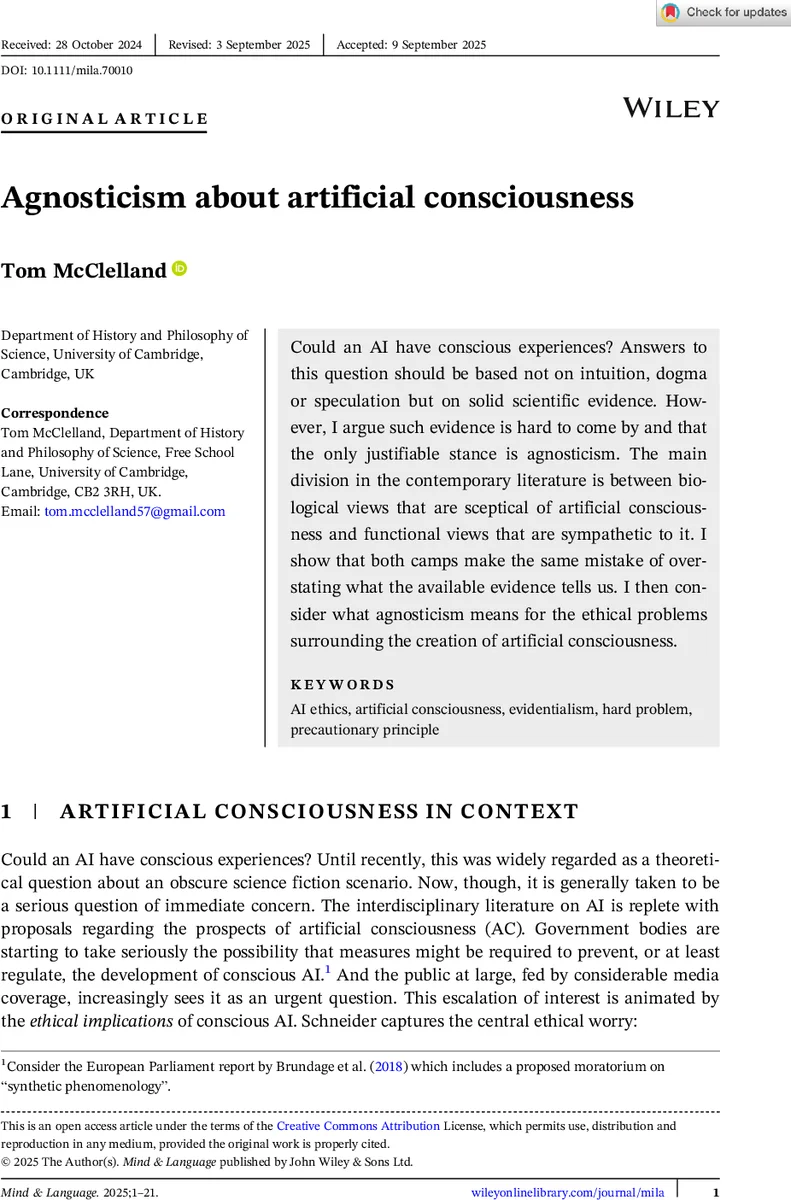
Could an AI have conscious experiences? Any answer to this question should conform to Evidentialism - that is, it should be based not on intuition, dogma or speculation but on solid scientific evidence. I argue that such evidence is hard to come by and that the only justifiable stance on the prospects of artificial consciousness is agnosticism. In the current debate, the main division is between biological views that are sceptical of artificial consciousness and functional views that are sympathetic to it. I argue that both camps make the same mistake of over-estimating what the evidence tells us. Scientific insights into consciousness have been achieved through the study of conscious organisms. Although this has enabled cautious assessments of consciousness in various creatures, extending this to AI faces serious obstacles. AI thus presents consciousness researchers with a dilemma: either reach a verdict on artificial consciousness but violate Evidentialism; or respect Evidentialism but offer no verdict on the prospects of artificial consciousness. The dominant trend in the literature has been to take the first option while purporting to follow the scientific evidence. I argue that if we truly follow the evidence, we must take the second option and adopt agnosticism.
💡 Research Summary
Tom McClelland’s paper “Agnosticism About Artificial Consciousness” argues that the question of whether an artificial intelligence (AI) could have conscious experiences must be answered on the basis of evidentialism – that is, only on the basis of solid scientific evidence, not on intuition, speculation, or dogma. The author observes that the contemporary debate is split between biological skeptics, who think consciousness is tied to organic life, and functionalists, who think certain functional architectures could generate consciousness. Both camps, however, over‑state what the current evidence actually tells us.
The core of the argument is three‑premised: (1) we lack a “deep explanation” of consciousness – a theory that explains why a given physical or functional state is accompanied by subjective experience rather than being a zombie state; (2) without such a deep explanation we cannot justifiably decide whether a hypothetical “challenger‑AI” (an AI that exhibits every marker that would count as strong evidence of consciousness in a biological organism) is conscious; (3) therefore we cannot justify any verdict about AI consciousness. The “hard problem” (Chalmers, 1995) is invoked to show that all existing theories – Global Workspace Theory, Recurrent Processing Theory, Higher‑Order Thought theories, Predictive Processing, Attention Schema, etc. – provide only shallow mechanistic accounts. They explain how a state becomes globally available or metacognitively monitored, but they do not explain why those states should feel like something. Because this explanatory gap persists, the author claims the first premise is plausible.
McClelland then critiques two dominant methodological approaches. The “theory‑heavy” approach tries to transplant theories built on human or animal neurobiology directly onto AI, assuming the same functional signatures have the same ontological status. The “theory‑light” approach relies on behavioral or physiological markers (global broadcasting, self‑monitoring, etc.) as proxies for consciousness, but treats the equivalence of those markers with consciousness as a leap of faith. Both violate evidentialism because they assume that evidence gathered in the biological domain is automatically transferable to non‑organic systems.
The paper also addresses the possibility that future advances in consciousness science might resolve the epistemic impasse. McClelland argues that even if a deep explanation were discovered, it would still need independent validation for artificial substrates; thus the problem is not merely temporary.
Ethically, the author shifts focus from consciousness per se to sentience – the capacity for valenced experience (pain, pleasure). Sentience can be inferred from observable avoidance, stress responses, or other behavioral correlates, providing a more tractable evidential basis for policy. Consequently, a precautionary principle can be applied: if there is credible reason to think an AI might be sentient, development and deployment should be regulated, even while we remain agnostic about full conscious experience.
In sum, McClelland concludes that the scientific evidence available today is insufficient to make a definitive claim about artificial consciousness. The only rational stance, respecting evidentialism, is agnosticism. This stance does not preclude ethical action; rather, it redirects moral concern toward sentience and recommends precautionary regulation until (and unless) a deep, empirically validated explanation of consciousness that applies to artificial substrates emerges.
Comments & Academic Discussion
Loading comments...
Leave a Comment