Hyperbolic Simplices of Maximal Inradius
For $n\in \mathbb{N}$, consider a hyperbolic $n$-dimensional simplex $Δ$, defined by $1+n$ points in the compactified hyperbolic space $\mathbf{H}^n \sqcup \partial \mathbf{H}^n$. For each integer $m\le n$, denote $δ^n_m(Δ)\in [0,+\infty]$ the Hausdorff distance between its skeleta of dimensions $n$ and $m$. In particular, $δ^n_{n-1}(Δ)$ is its inradius. The maximum of $δ^n_m(Δ)$ over $Δ\in (\mathbf{H}^n \sqcup \partial \mathbf{H}^n)^{1+n}$ is denoted $μ^n_m\in [0,+\infty]$. We first show that $Δ$ has maximal inradius $δ^n_{n-1}(Δ)=μ^n_m$ if and only if its is (total) ideal and regular; for which the inradius is given by $\tanh μ^n_{n-1} = 1/n$. We deduce that $Δ$ has maximal $δ^n_{n-1}(Δ)=μ^n_m$ if and only if it is (total) ideal and regular. We compute that the maximal distance to the $1$-skeleton $μ^n_1$ is given by $\left(\tanh μ^n_1\right)^2 = (n-1)/(2n)$ and deduce that those are uniformly bounded by $\lim_{n} μ^n_1 = \log(1+\sqrt{2})$.
💡 Research Summary
The paper investigates the extremal geometry of hyperbolic simplices in dimension n. A hyperbolic n‑simplex Δ is defined by n + 1 points in the compactified hyperbolic space Hⁿ∪∂Hⁿ. For each integer m with 0 ≤ m ≤ n, the authors introduce the Hausdorff distance δⁿ_m(Δ) between the full simplex Δ⁽ⁿ⁾ and its m‑skeleton Δ⁽ᵐ⁾; when m = n‑1 this distance coincides with the inradius. Because the map Δ↦δⁿ_m(Δ) is continuous on the compact space (Hⁿ∪∂Hⁿ)^{n+1}, a maximum μⁿ_m exists.
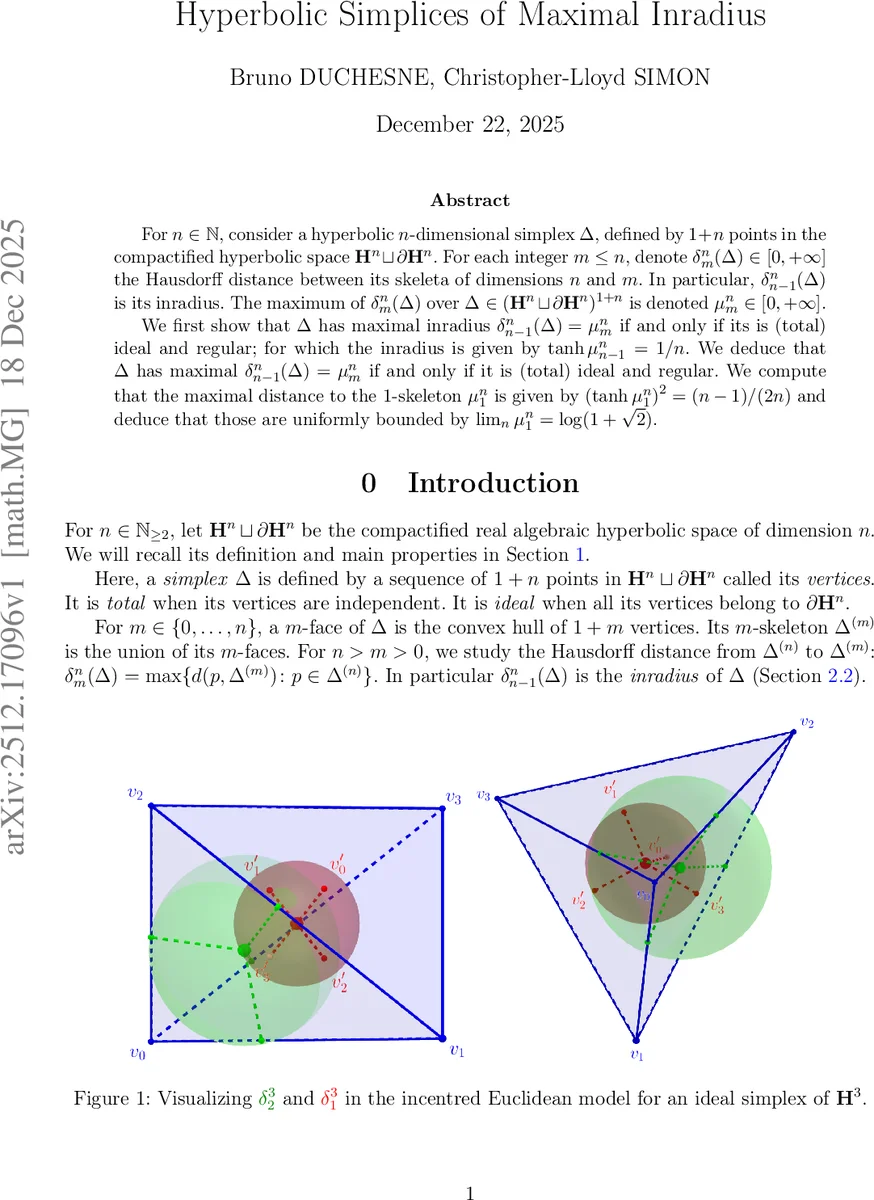
The authors first recall three standard models of hyperbolic geometry: the Minkowski model, the Cayley‑Klein projective model, and the Euclidean ball model. The Euclidean ball model is particularly convenient for studying simplices because it provides an “incentred” Euclidean picture: an ideal hyperbolic simplex corresponds to a Euclidean simplex inscribed in the unit sphere with its incenter at the origin. This correspondence is equivariant under the isometry groups and allows the authors to translate hyperbolic problems into Euclidean ones.
A simplex is called total if its vertices are affinely independent, ideal if all vertices lie on the boundary ∂Hⁿ, and regular if its stabiliser in Isom(Hⁿ) is isomorphic to the full symmetric group S_{n+1}. There is a unique (up to isometry) total, ideal, regular simplex in each dimension.
Theorem 0.1 (maximal inradius). For any total simplex Δ one has
δⁿ_{n‑1}(Δ) ≤ tanh⁻¹(1/n),
with equality if and only if Δ is ideal and regular. The proof works in the incentred Euclidean model, uses barycentric coordinates to show that a simplex with maximal inradius must have its orthocenter coincide with its incenter, and then invokes a known regularity result (EHM05b, Thm 4.3).
Theorem 0.4 (maximal distance to the m‑skeleton). For any integers n > m > 0, a simplex attains the maximal Hausdorff distance μⁿ_m if and only if it is total, ideal, and regular. In the special case m = 1 one obtains an explicit formula
(tanh μⁿ_1)² = (n‑1)/(2n).
Consequently μⁿ_1 grows with n and converges to the finite limit
μ^∞_1 = tanh⁻¹(1/√2) = log(1 + √2).
The argument proceeds by iteratively projecting a point of the (n‑c)-skeleton onto the nearest (n‑c‑1)-face, applying the hyperbolic Pythagorean theorem, and using the inequality from Theorem 0.1 at each step; equality forces regularity at every stage.
The paper also revisits the finiteness of μⁿ_1, previously cited in Bes88 and Bon86, and supplies a concise, self‑contained proof. This boundedness is crucial for recent work on Gromov‑Hausdorff convergence of group actions on hyperbolic spaces, allowing the authors to extend results to sequences of dimensions possibly tending to infinity.
Finally, the authors pose Problem 0.6, asking how many distinct local/global maximizers of δⁿ_m(Δ) can exist and where they are located. They describe a construction: for a given collection of (n+1) m‑faces, consider the decreasing family of convex sets C_t(F) consisting of points at distance at least t from each chosen face. Maximizers correspond to points where these sets first become empty. The problem invites a combinatorial–geometric classification of such maximizers and their symmetry orbits, a question more subtle than merely counting orbits under the simplex stabiliser.
The paper concludes with additional results on the enumeration of maximizers (Theorem 2.11) and a study of disphenoids (Theorem 2.12).
Overall, the work provides a clear and elegant characterization of hyperbolic simplices that maximise inradius or distance to lower‑dimensional skeleta, showing that the extremal objects are precisely the ideal regular simplices. The explicit formulas, the uniform bound on μⁿ_1, and the connection to Gromov‑Hausdorff convergence make the results both theoretically satisfying and practically useful for further research in hyperbolic geometry, geometric group theory, and high‑dimensional topology.
Comments & Academic Discussion
Loading comments...
Leave a Comment