Null-LoRA: Low-Rank Adaptation on Null Space
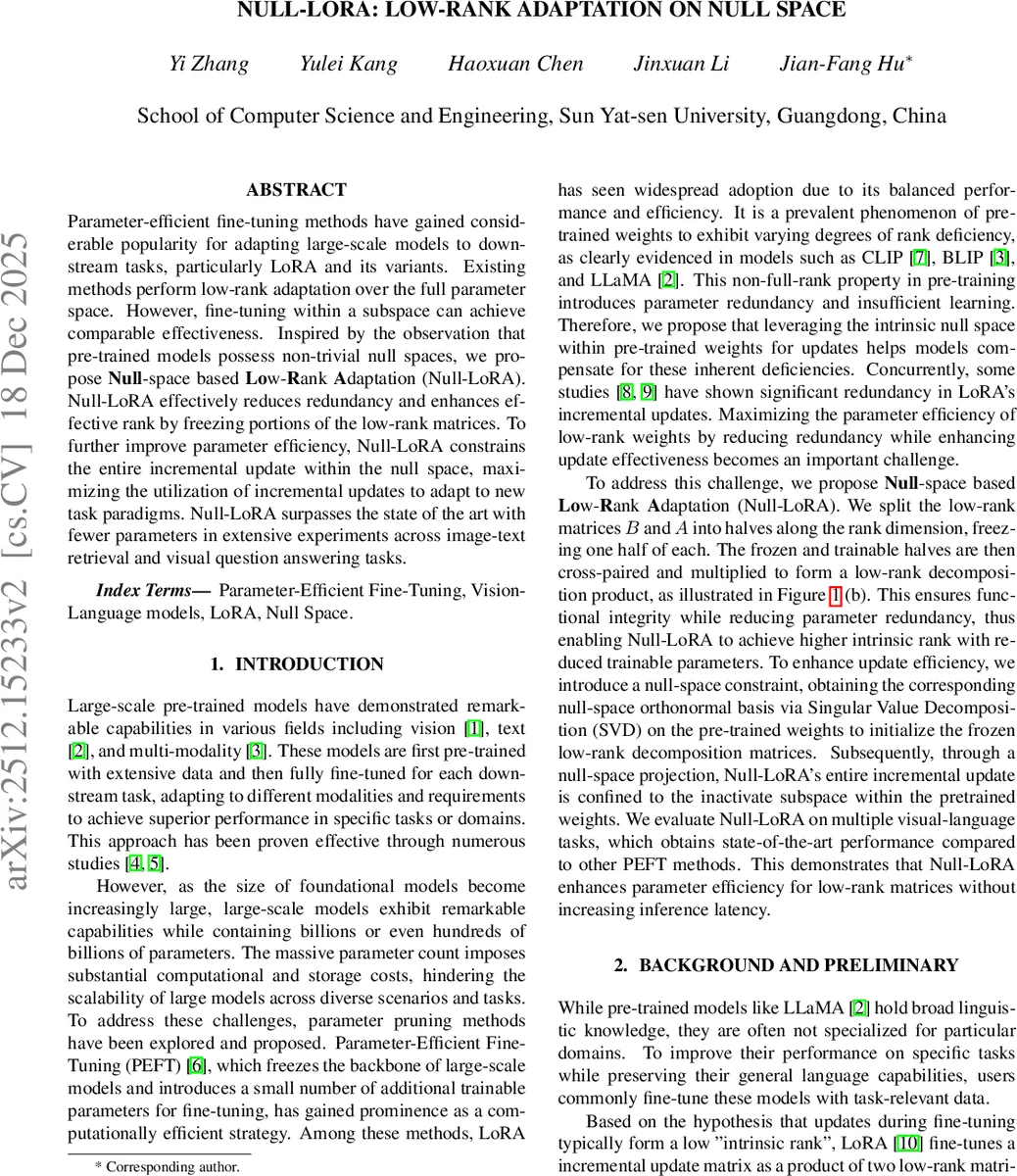
Parameter-efficient fine-tuning methods have gained considerable popularity for adapting large-scale models to downstream tasks, particularly LoRA and its variants. Existing methods perform low-rank adaptation over the full parameter space. However, fine-tuning within a subspace can achieve comparable effectiveness. Inspired by the observation that pre-trained models possess non-trivial null spaces, we propose Null-space based Low-Rank Adaptation (Null-LoRA). Null-LoRA effectively reduces redundancy and enhances effective rank by freezing portions of the low-rank matrices. To further improve parameter efficiency, Null-LoRA constrains the entire incremental update within the null space, maximizing the utilization of incremental updates to adapt to new task paradigms. Null-LoRA surpasses the state of the art with fewer parameters in extensive experiments across image-text retrieval and visual question answering tasks.
💡 Research Summary
The paper introduces Null‑LoRA, a novel parameter‑efficient fine‑tuning (PEFT) technique that leverages the null space of pretrained weights to improve both the effectiveness and efficiency of low‑rank adaptation. Traditional LoRA approximates a weight update ΔW as a product of two low‑rank matrices B (d_out × r) and A (r × d_in), inserting a small number of trainable parameters while keeping the backbone frozen. However, LoRA’s performance scales with the rank r, and increasing r inevitably raises the number of trainable parameters and computational cost. Moreover, empirical studies have shown that LoRA’s updates often contain redundant directions, limiting the effective rank of the adaptation.
Key contributions of Null‑LoRA are fourfold:
-
Cross‑Freezing of Projection Matrices – B and A are each split into two halves along the rank dimension (r/2). The first halves (B_f, A_f) are frozen, while the second halves (B, A) remain trainable. The update is formed by cross‑pairing the frozen and trainable halves: ΔW = B A_f + B_f A. This design preserves the full rank r (the two cross‑terms together span an r‑dimensional subspace) but reduces the number of trainable parameters by 50 %. The frozen halves act as a pre‑computed basis that guides the trainable part, mitigating redundancy.
-
Dynamic Norm Scaling – Because frozen matrices (often orthogonal) and trainable matrices (unconstrained) can have mismatched norms, a scaling vector s is introduced. A diagonal matrix S built from s is inserted into each cross‑term, yielding ΔW = B S₁ A_f + B_f S₂ A. This equalizes the magnitude of the two halves, stabilizing gradients and improving generalization.
-
Null‑Space Initialization and Projection – Most large vision‑language models (e.g., CLIP, BLIP, LLaMA) are not full‑rank; they possess a non‑trivial right null space. By performing SVD on the pretrained weight W₀, the authors extract orthonormal bases \hat U (left null space) and \hat V (right null space) corresponding to zero singular values. These bases are used to initialize the frozen halves B_f = \hat U and A_f = \hat V, guaranteeing W₀ᵀ B_f = 0 and W₀ A_f = 0. To ensure the trainable part also stays within the null space, a projection matrix P = \hat U \hat Uᵀ is applied: ΔW = P B S₁ A_f + B_f S₂ A. Consequently, the entire update satisfies W₀ᵀ ΔW = 0, meaning the fine‑tuned update is orthogonal to the pretrained direction. This orthogonal constraint preserves the knowledge encoded in W₀ while allowing the model to explore a completely new subspace, reducing catastrophic forgetting.
-
Rank Self‑Adaptation – The nullity (dimension of the null space) of each layer’s weight matrix is measured, and the rank r for that layer is set to twice its nullity. Layers with larger rank deficiencies receive a higher r, gaining expressive power where it is most needed, while layers that are already near full rank receive a smaller r, saving parameters. This automatic per‑layer rank allocation yields a balanced trade‑off between performance and efficiency.
Experimental validation is performed on three cross‑modal benchmarks using BLIP‑base as the frozen backbone: (i) image‑text retrieval on MS‑COCO and Flickr30K, and (ii) visual question answering (VQA v2). Baselines include full fine‑tuning, LoRA (r = 32, 10.6 M trainable parameters), DoRA (similar size), UniAdapter (r = 512, 19.5 M), and Aurora (r = 64, 0.6 M).
- On retrieval, Null‑LoRA with only 6 M trainable parameters achieves R@1 of 80.7 % (COCO I→T) and 62.7 % (Flickr30K I→T), surpassing LoRA and DoRA despite using roughly half the parameters. It matches or exceeds the performance of larger PEFT methods such as UniAdapter while being 30 % more parameter‑efficient.
- On VQA, Null‑LoRA with 9.5 M parameters reaches 77.48 % accuracy on both test‑dev and test‑std, outperforming LoRA (75.10 %) and DoRA (75.89 %) and matching the best frozen‑backbone method (UniAdapter) with less than half the trainable parameters.
- An ablation where the frozen matrices are randomly initialized (i.e., without null‑space initialization) shows a consistent drop of ~0.4 % in accuracy, confirming that constraining updates to the true null space yields measurable gains.
The authors also analyze the intrinsic rank of the adapted weights, showing that cross‑freezing indeed raises the effective rank while keeping the total rank low, and that the projection matrix P remains nearly full‑rank, indicating that the trainable component successfully spans the intended subspace.
Implications and future directions: Null‑LoRA demonstrates that careful exploitation of the algebraic structure of pretrained weights—specifically their null spaces—can dramatically improve the parameter efficiency of low‑rank adaptation. By freezing a principled basis and only learning complementary directions, the method reduces redundancy, stabilizes training, and preserves pretrained knowledge. The approach is model‑agnostic and could be extended to pure language models, multimodal transformers, or even diffusion models. Moreover, the idea of orthogonal updates may inspire new regularization schemes for continual learning, where preserving prior knowledge is critical.
In summary, Null‑LoRA offers a theoretically grounded and empirically validated framework that pushes the frontier of PEFT: it achieves state‑of‑the‑art performance on challenging vision‑language tasks while using a fraction of the trainable parameters required by existing methods, thereby opening a promising path toward scalable, efficient fine‑tuning of ever‑larger foundation models.
Comments & Academic Discussion
Loading comments...
Leave a Comment