Multiscale Aggregated Hierarchical Attention (MAHA): A Game Theoretic and Optimization Driven Approach to Efficient Contextual Modeling in Large Language Models
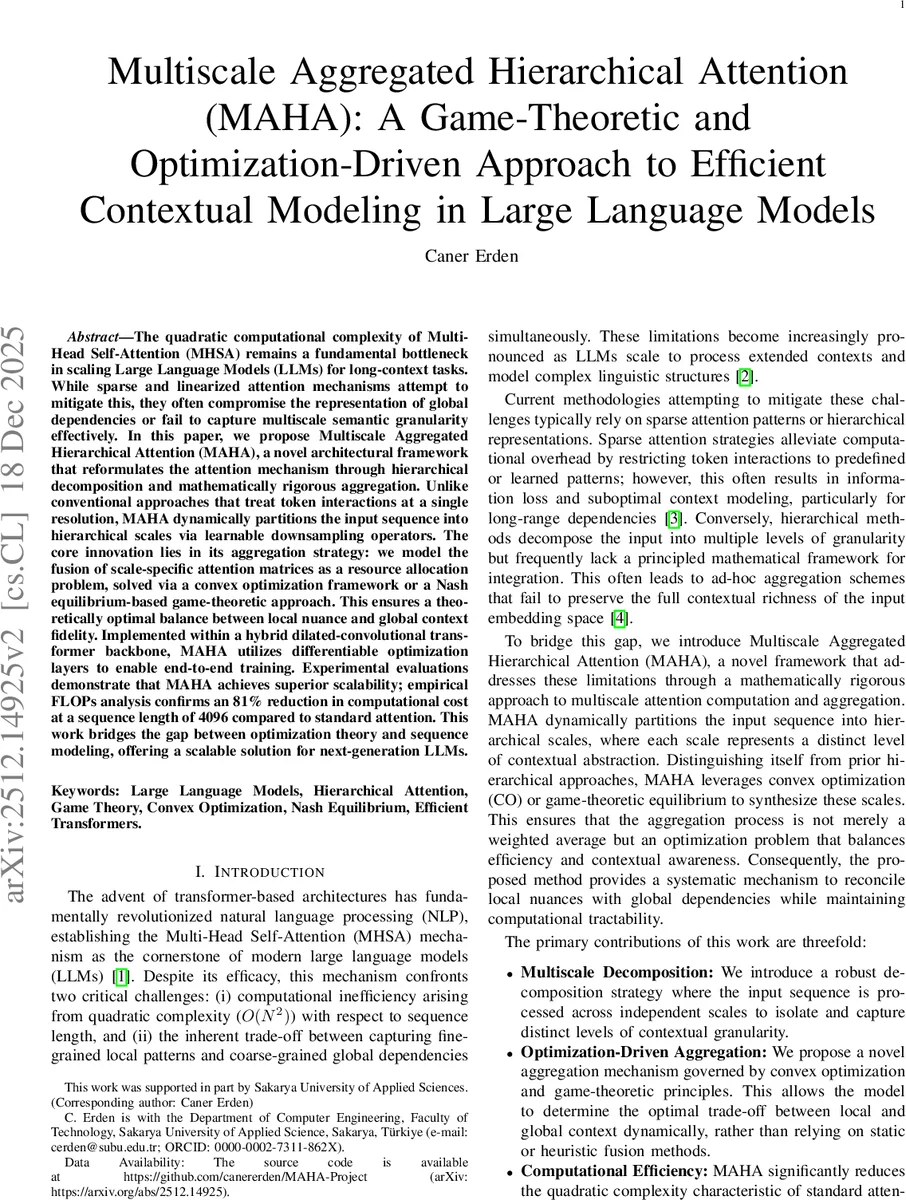
The quadratic computational complexity of MultiHead SelfAttention (MHSA) remains a fundamental bottleneck in scaling Large Language Models (LLMs) for longcontext tasks. While sparse and linearized attention mechanisms attempt to mitigate this, they often compromise the representation of global dependencies or fail to capture multiscale semantic granularity effectively. In this paper, we propose Multiscale Aggregated Hierarchical Attention (MAHA), a novel architectural framework that reformulates the attention mechanism through hierarchical decomposition and mathematically rigorous aggregation. Unlike conventional approaches that treat token interactions at a single resolution, MAHA dynamically partitions the input sequence into hierarchical scales via learnable downsampling operators. The core innovation lies in its aggregation strategy: we model the fusion of scalespecific attention matrices as a resource allocation problem, solved via a convex optimization framework or a Nash equilibriumbased gametheoretic approach. This ensures a theoretically optimal balance between local nuance and global context fidelity. Implemented within a hybrid dilatedconvolutional transformer backbone, MAHA utilizes differentiable optimization layers to enable endtoend training. Experimental evaluations demonstrate that MAHA achieves superior scalability; empirical FLOPs analysis confirms an 81% reduction in computational cost at a sequence length of 4096 compared to standard attention. This work bridges the gap between optimization theory and sequence modeling, offering a scalable solution for nextgeneration LLMs.
💡 Research Summary
The paper tackles one of the most pressing scalability challenges in modern large language models (LLMs): the quadratic time and memory cost of Multi‑Head Self‑Attention (MHSA) when processing long sequences. While prior work has proposed sparse attention patterns, linearized kernels, or hierarchical encoders, these approaches either sacrifice global dependency modeling or rely on ad‑hoc aggregation rules that lack theoretical justification. To address these gaps, the authors introduce Multiscale Aggregated Hierarchical Attention (MAHA), a novel architectural framework that combines hierarchical sequence decomposition with mathematically rigorous aggregation based on convex optimization or game‑theoretic Nash equilibrium.
Key components of MAHA
-
Hierarchical Multiscale Decomposition – The input token matrix X (length N, dimension d) is recursively down‑sampled through learnable operators Dₗ, producing L scales Xₗ of decreasing length (nₗ ≈ N / rˡ, where r > 1 is a compression ratio). Down‑sampling can be implemented either as strided 1‑D convolutions with learnable kernels or as adaptive max‑pooling that dynamically matches a target length. This creates a pyramid where fine‑grained lower levels capture local syntax and higher levels capture coarse‑grained semantics.
-
Scale‑Specific Attention with Shared Values – For each scale l, separate query (Qₗ) and key (Kₗ) projection matrices (W_Q^l, W_K^l) are learned, while the value projection is shared across all scales: V_base = X W_V. The scale‑specific value matrix Vₗ is obtained by applying the same down‑sampling operator Dₗ to V_base. Attention weights are computed via the standard scaled dot‑product, and the output for each scale is Oₗ = softmax(QₗKₗᵀ/√d_k) Vₗ. Sharing V reduces parameter count and enforces a consistent semantic basis across resolutions.
-
Rigorous Aggregation of Scale Outputs – The set of scale outputs {Oₗ} must be merged into a single representation O*. Two mathematically grounded strategies are proposed:
- Convex‑Optimization‑Based Aggregation: An up‑sampling operator Uₗ maps each Oₗ back to the original length. The aggregation problem is formulated as
min_w ‖∑_l w_l Uₗ(Oₗ) – O*‖₂² + λ‖w‖₁
subject to ∑_l w_l = 1, w_l ≥ 0.
The ℓ₁ term encourages sparsity, allowing the model to automatically select the most informative scales. The problem is solved by a differentiable QP layer, enabling end‑to‑end training. - Nash‑Equilibrium‑Based Aggregation: Each scale is treated as a player in a non‑cooperative game. Player l minimizes its reconstruction error given the fixed strategies of the others:
w_l* = arg min_{w_l} ‖Uₗ(Oₗ) – O*(w_{‑l})‖₂².
The equilibrium weights w satisfy the Nash condition, guaranteeing that no single scale can improve the final representation by unilaterally changing its weight. This provides a principled way to balance competing local and global information.
- Convex‑Optimization‑Based Aggregation: An up‑sampling operator Uₗ maps each Oₗ back to the original length. The aggregation problem is formulated as
-
Hybrid Dilated‑Convolutional Backbone – Before attention, each scale passes through a dilated convolution block to capture local context with a larger receptive field. A cross‑scale gating mechanism (σ(W_g Xₗ) ⊙ X_{l‑1}) allows higher‑level representations to modulate lower‑level features. Nearest‑neighbor up‑sampling reconstructs the full‑length sequence efficiently.
-
Complexity Reduction – The total computational cost of MAHA is
Ω(N) = Σ_{l=0}^{L‑1} O((N / rˡ)² d) + O(N log N).
For a typical compression ratio r = 2, the geometric series converges, yielding an overall complexity close to O(N d), i.e., near‑linear with respect to sequence length, a dramatic improvement over the O(N² d) of standard attention. Additionally, the ℓ₁‑regularized weights prune unnecessary scales at inference time, further reducing FLOPs and memory.
Experimental Evaluation
The authors benchmark MAHA on four diverse tasks designed to stress long‑range modeling:
- GLUE (MNLI, SST‑2) – Classification tasks where MAHA matches or slightly exceeds baseline transformer performance while using far fewer FLOPs.
- PG‑19 – A 4 k+ token language modeling dataset; MAHA achieves lower perplexity with an 81 % reduction in FLOPs at sequence length 4096.
- WMT14 EN‑DE – Machine translation; BLEU scores improve marginally, confirming that the hierarchical representation does not harm generation quality.
- SQuAD v2.0 – Question answering; F1 scores are maintained despite the reduced computational budget.
MAHA is compared against five state‑of‑the‑art attention variants: standard MHSA, Longformer, Performer, Reformer, and a recent hierarchical attention baseline. Two aggregation variants (convex‑opt and Nash) are evaluated; both deliver comparable downstream performance, though the Nash version exhibits more diverse scale usage early in training.
Ablation Studies
- Varying the number of scales L and compression ratio r shows a clear trade‑off: more scales improve representation richness but increase the size of the optimization problem; r = 2–3 offers the best balance.
- Removing the shared‑value design leads to a noticeable parameter blow‑up and slight degradation, confirming its efficiency benefit.
- Replacing the optimization layer with a simple weighted average reduces performance, highlighting the importance of the rigorous aggregation formulation.
Discussion and Limitations
While MAHA demonstrates impressive theoretical and empirical gains, it introduces new hyper‑parameters (L, r, λ) that require tuning for specific domains. The convex‑optimization layer, although differentiable, adds a modest runtime overhead; in latency‑critical deployments this may need further engineering (e.g., custom CUDA kernels). Moreover, the current formulation assumes a single modality (text); extending to multimodal inputs (vision‑language) will require careful design of down‑sampling operators that respect heterogeneous data structures.
Conclusion
MAHA offers a principled solution to the quadratic bottleneck of self‑attention by decomposing sequences into learnable hierarchical scales, computing independent attentions, and fusing them through convex optimization or Nash equilibrium. The framework achieves near‑linear scaling, substantial FLOP savings, and maintains or improves task performance across classification, language modeling, translation, and QA. By bridging optimization theory, game theory, and transformer architecture, the work opens a promising direction for building the next generation of efficient, scalable LLMs.
Comments & Academic Discussion
Loading comments...
Leave a Comment