SN 2024aecx: a fast-evolving Type IIb supernova with a prominent shock-cooling peak
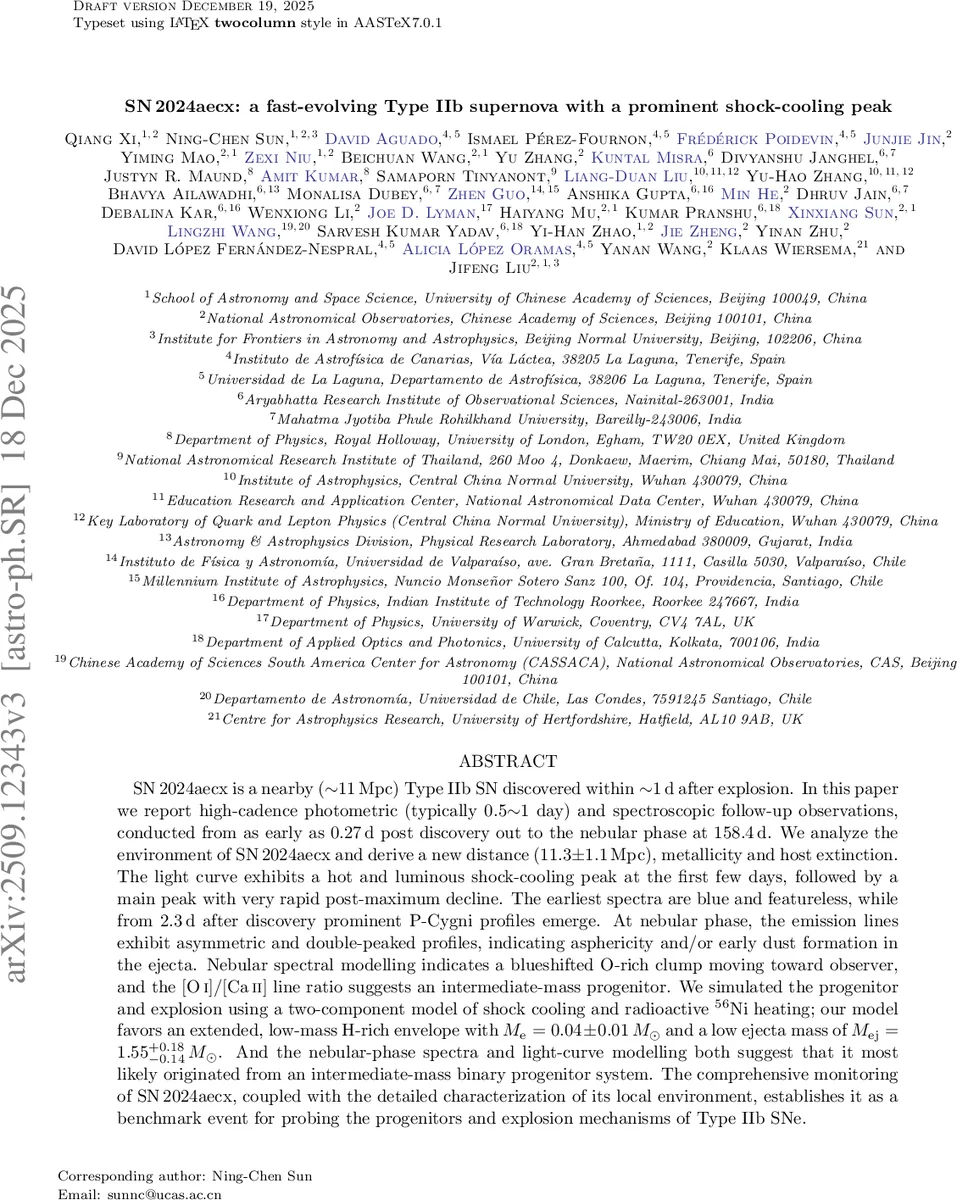
SN 2024aecx is a nearby ($\sim$11 Mpc) Type IIb SN discovered within $\sim$1 d after explosion. In this paper we report high-cadence photometric (typically 0.5$\sim$1 day) and spectroscopic follow-up observations, conducted from as early as 0.27 d post discovery out to the nebular phase at 158.4 d. We analyze the environment of SN 2024aecx and derive a new distance (11.3$\pm$1.1 Mpc), metallicity and host extinction. The light curve exhibits a hot and luminous shock-cooling peak at the first few days, followed by a main peak with very rapid post-maximum decline. The earliest spectra are blue and featureless, while from 2.3 d after discovery prominent P-Cygni profiles emerge. At nebular phase, the emission lines exhibit asymmetric and double-peaked profiles, indicating asphericity and/or early dust formation in the ejecta. Nebular spectral modelling indicates a blueshifted O-rich clump moving toward observer, and the $[\text{OI}]/[\text{CaII}]$ line ratio suggests an intermediate-mass progenitor. We simulated the progenitor and explosion using a two-component model of shock cooling and radioactive $^{56}$Ni heating; our model favors an extended, low-mass H-rich envelope with $M_{\mathrm{e}} = 0.04\pm{0.01} M_{\odot}$ and a low ejecta mass of$M_{\mathrm{ej}} = 1.55^{+0.18}{-0.14} M{\odot}$. And the nebular-phase spectra and light-curve modelling both suggest that it most likely originated from an intermediate-mass binary progenitor system. The comprehensive monitoring of SN 2024aecx, coupled with the detailed characterization of its local environment, establishes it as a benchmark event for probing the progenitors and explosion mechanisms of Type IIb SNe.
💡 Research Summary
SN 2024aecx was discovered in the nearby spiral galaxy NGC 3521 at a distance of roughly 11 Mpc, and it was identified as a Type IIb supernova within about one day of explosion. The authors carried out an intensive follow‑up campaign that began only 0.27 days after discovery and continued until 158.4 days, providing a densely sampled multi‑band photometric series (typical cadence 0.5–1 day) and a time‑series of optical spectra from 0.3 days to the nebular phase.
Host galaxy characterization
Using HST/ACS imaging, the tip‑of‑the‑red‑giant‑branch (TRGB) method yielded a precise distance of 11.3 ± 1.1 Mpc, improving upon the widely scattered Tully‑Fisher estimates (4–16 Mpc). Integral‑field spectroscopy from VLT/MUSE gave an oxygen abundance of 12 + log(O/H) = 8.55 ± 0.05 at the SN site, indicating a moderately sub‑solar metallicity. Host extinction was measured as E(B–V) ≈ 0.07 mag, which together with the Galactic foreground (E(B–V) ≈ 0.02 mag) was applied to all photometric and spectroscopic data.
Early light‑curve behavior
The first three days show a luminous, hot shock‑cooling peak with a temperature of ~15,000 K and a bolometric luminosity of ~10⁴³ erg s⁻¹. Modeling this peak with the analytic frameworks of Rabinak & Waxman (2011) and Piro (2015) indicates an extended, low‑mass hydrogen envelope (M_H ≈ 0.04 M⊙) with a radius of ~150 R⊙ and an explosion energy of ≈1.2 × 10⁵¹ erg. After the shock‑cooling phase, the main peak is powered by the decay of ⁵⁶Ni. The peak absolute magnitude is M_V ≈ ‑17.2 mag, the post‑maximum decline is rapid (Δm₁₅(g) ≈ 1.8 mag), and the inferred ⁵⁶Ni mass is ≈0.06 M⊙. A bolometric light‑curve fit yields an ejecta mass of 1.55 +0.18/‑0.14 M⊙.
Spectroscopic evolution
The earliest spectra (0.3–2 days) are essentially featureless and very blue. From 2.3 days onward, classic Type IIb features appear: a transient H α line that fades by ~30 days, He I λ5876 that strengthens with time, and a forest of Fe II lines. This evolution confirms the presence of a thin hydrogen layer that quickly becomes optically thin, effecting the transition from IIb to Ib.
In the nebular phase (≥70 days), the forbidden lines
Comments & Academic Discussion
Loading comments...
Leave a Comment