On the significance of parameters and the projective level in the Choice and Comprehension axioms
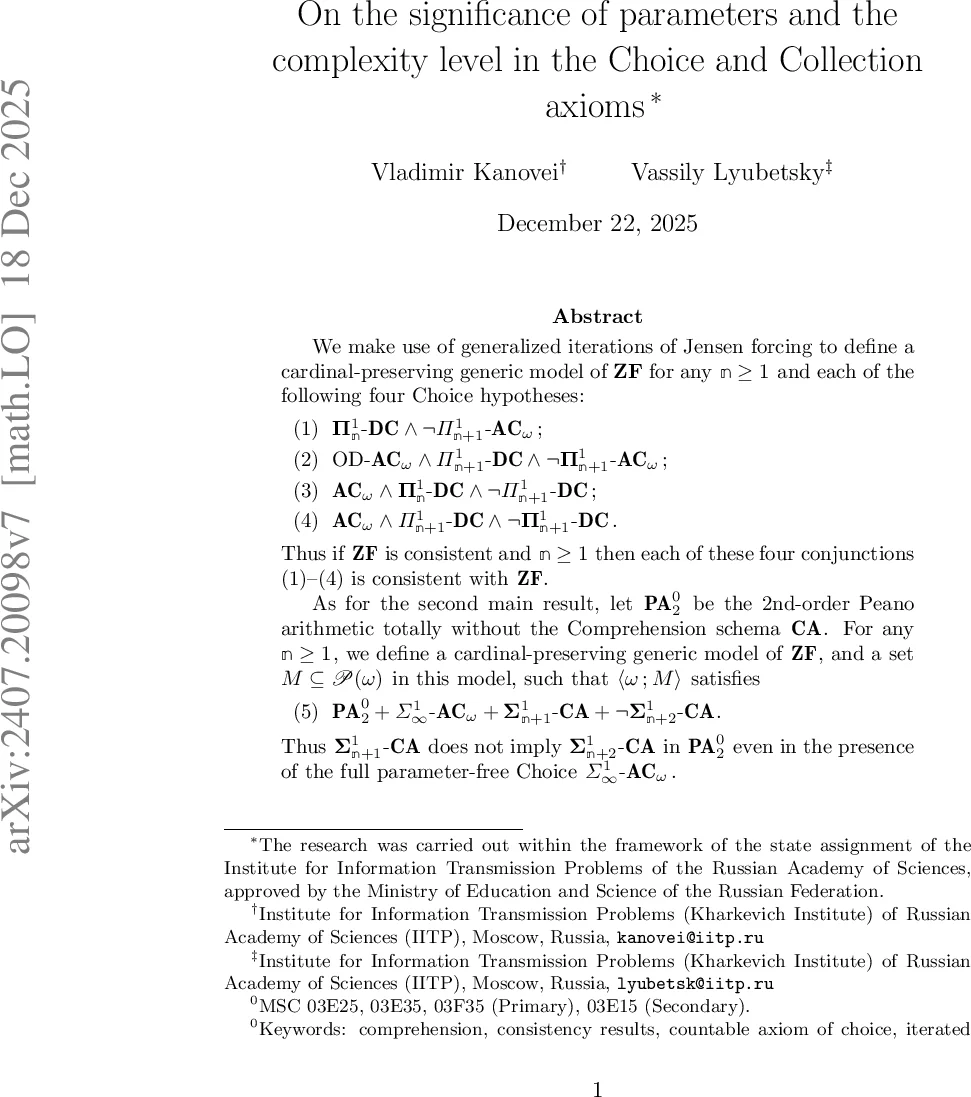
We make use of generalized iterations of Jensen forcing to define a cardinal-preserving generic model of ZF for any $n\ge 1$ and each of the following four Choice hypotheses: (1) $\text{DC}(\mathbfΠ^1_n)\land\neg\text{AC}ω(\varPi^1{n+1}),;$ (2) $\text{AC}ω(\text{OD})\land\text{DC}(\varPi^1{n+1})\land \neg\text{AC}ω(\mathbfΠ^1{n+1});$ (3) $\text{AC}ω\land\text{DC}(\mathbfΠ^1_n)\land\neg\text{DC}(\varPi^1{n+1});$ (4) $\text{AC}ω\land\text{DC}(\varPi^1{n+1})\land\neg\text{DC}(\mathbfΠ^1_{n+1}).$ Thus if ZF is consistent and $n\ge1$ then each of these four conjunctions (1)–(4) is consistent with ZF. As for the second main result, let PA$^0_2$ be the 2nd-order Peano arithmetic without the Comprehension schema $\text{CA}$. For any $n\ge1$, we define a cardinal-preserving generic model of ZF, and a set $M\subseteq\mathcal P(ω)$ in this model, such that $\langleω, M\rangle$ satisfies (5) PA$^0_2$ + $\text{AC}ω(\varSigma^1{\infty})$ + $\text{CA}(\mathbfΣ^1_{n+1})$ + $\neg\text{CA}(\mathbfΣ^1_{n+1})$. Thus $\text{CA}(\mathbfΣ^1_{n+1})$ does not imply $\text{CA}(\mathbfΣ^1_{n+2})$ in PA$^0_2$ even in the presence of the full parameter-free (countable) Choice $\text{AC}ω(\varSigma^1{\infty}).$
💡 Research Summary
The paper investigates fine‑grained interactions between restricted forms of the Countable Axiom of Choice (AC ω) and Dependent Choice (DC) in set theory, as well as between Comprehension schemata (CA) in second‑order arithmetic. Using generalized iterations of Jensen forcing, the authors construct cardinal‑preserving generic extensions of the constructible universe L that realize four distinct combinations of choice principles at any given projective level n ≥ 1. The first main theorem (Theorem 1.1) produces four models V₁,…,V₄, each satisfying ZF and respectively: (1) Π¹ₙ‑DC together with the failure of Π¹ₙ₊₁‑AC ω; (2) ordinal‑definable AC ω together with Π¹ₙ₊₁‑DC but the failure of Π¹ₙ₊₁‑AC ω; (3) AC ω together with Π¹ₙ‑DC while Π¹ₙ₊₁‑DC fails; (4) AC ω together with Π¹ₙ₊₁‑DC while Π¹ₙ₊₁‑DC fails. These results demonstrate that the strength of choice principles depends crucially on three parameters: the type of axiom (AC ω vs. DC), the projective index n, and whether parameters (light‑face vs. bold‑face) are allowed in the defining formulas. The paper also clarifies the role of the class OD (ordinal‑definable sets) and shows that even with OD‑AC ω, higher‑level projective choice can still fail.
The second main theorem (Theorem 1.2) moves to second‑order Peano arithmetic. Let PA⁰₂ be PA² without any comprehension axioms. For any n ≥ 1 the authors build a cardinal‑preserving generic extension of L and a set M⊆𝒫(ω) such that the structure ⟨ω, M⟩ satisfies PA⁰₂ plus the full parameter‑free countable choice schema Σ¹_∞‑AC ω, the Σ¹ₙ₊₁ comprehension schema, but refutes Σ¹ₙ₊₂ comprehension. Hence Σ¹ₙ₊₁‑CA does not imply Σ¹ₙ₊₂‑CA even in the presence of the strongest parameter‑free choice principle. As a corollary, the full AC ω, DC, and CA schemata are not finitely axiomatizable over PA² + Σ¹_∞‑AC ω.
Technically, the constructions rely on two novel forcing lemmas: the “odd‑expansion” theorem, which splits forcing conditions into even and odd stages to block definability at a targeted projective level, and the “narrowing” theorem, which ensures that the fusion of conditions preserves countable choice. The authors employ symmetric subextensions and permutation groups to control parameters, thereby achieving light‑face (parameter‑free) definability while still obtaining the desired failures of higher‑level choice or comprehension. Detailed sections develop the machinery of iterated perfect sets, rudimentary sequences, and the hierarchy of normal forcings, culminating in the final forcing that yields the required models.
Overall, the paper significantly strengthens earlier independence results (e.g., Jensen, Levy, Guzicki) by providing a unified forcing framework that simultaneously preserves cardinals and isolates the exact influence of projective complexity and parameters on choice and comprehension. It opens avenues for further exploration of even/odd distinctions in forcing and for investigating the limits of choice principles in arithmetic under various consistency assumptions.
Comments & Academic Discussion
Loading comments...
Leave a Comment