Quantum theory for edge current and noise in 2D topological superconductors
We calculate the edge current and its fluctuations, i.e. noise, in a 2D topological superconductor using the T-matrix and the Green function techniques. We show that the current is zero for non-chiral edge states and non-zero for chiral edge states, while the edge noise is non-zero whatever the chirality of the edge states. By applying our results to toy models with chiral edge states, we find that the noise is closely related to the Chern number. The edge noise is non-zero only when the Chern number is non-zero, and the bulk noise exhibits a peak each time the Chern number varies, meaning that there is strong current fluctuations when a topological phase transition occurs. Our results suggest that the bulk noise could be seen as a topological susceptibility.
💡 Research Summary
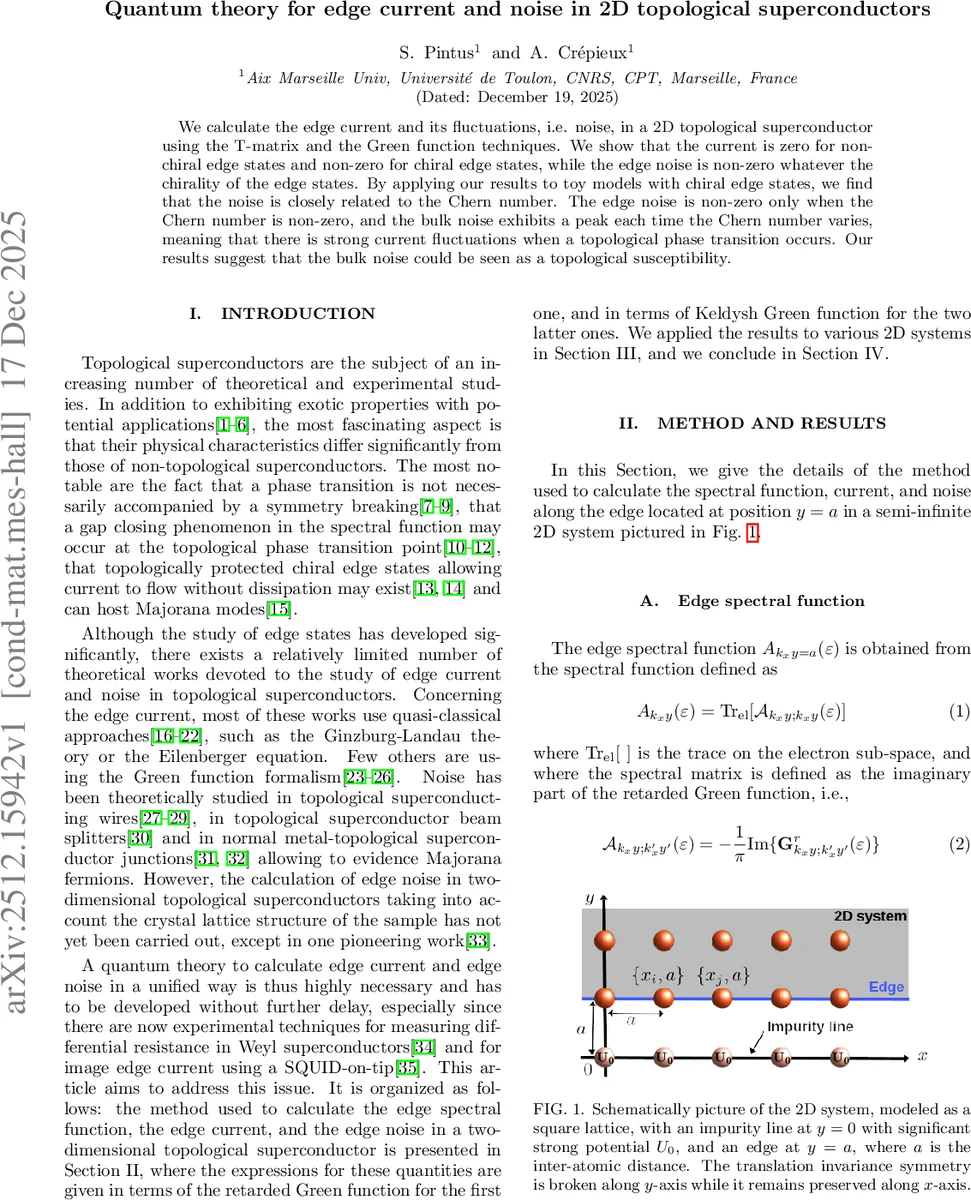
This paper presents a unified quantum‑theoretical framework for calculating both the edge current and its fluctuations (noise) in two‑dimensional topological superconductors. Using a combination of T‑matrix formalism and Green‑function techniques, the authors model a semi‑infinite lattice with a strong impurity line at y = 0, which creates a physical edge at y = a (the lattice spacing). The impurity line is treated exactly via a T‑matrix that depends only on the conserved momentum kₓ, allowing the retarded Green function Gᵣ(kₓ,y;kₓ′,y′,ε) to be expressed analytically in terms of the bare Green function of the clean system. From Gᵣ they obtain the edge spectral function A(kₓ,y,ε)=−(1/π)Im Tr Gᵣ(kₓ,y;kₓ,y,ε), which encodes the dispersion and weight of edge states.
The current operator is defined on nearest‑neighbor bonds with hopping amplitude t. After a partial Fourier transform along the edge direction and averaging over the x‑coordinate, the expectation value of the current becomes
⟨I_y⟩ = −(2e t/ħ)∫(dkₓ/2π)∫(dε/2π) Re
Comments & Academic Discussion
Loading comments...
Leave a Comment