Quantum Dynamics of a Nanorotor Driven by a Magnetic Field
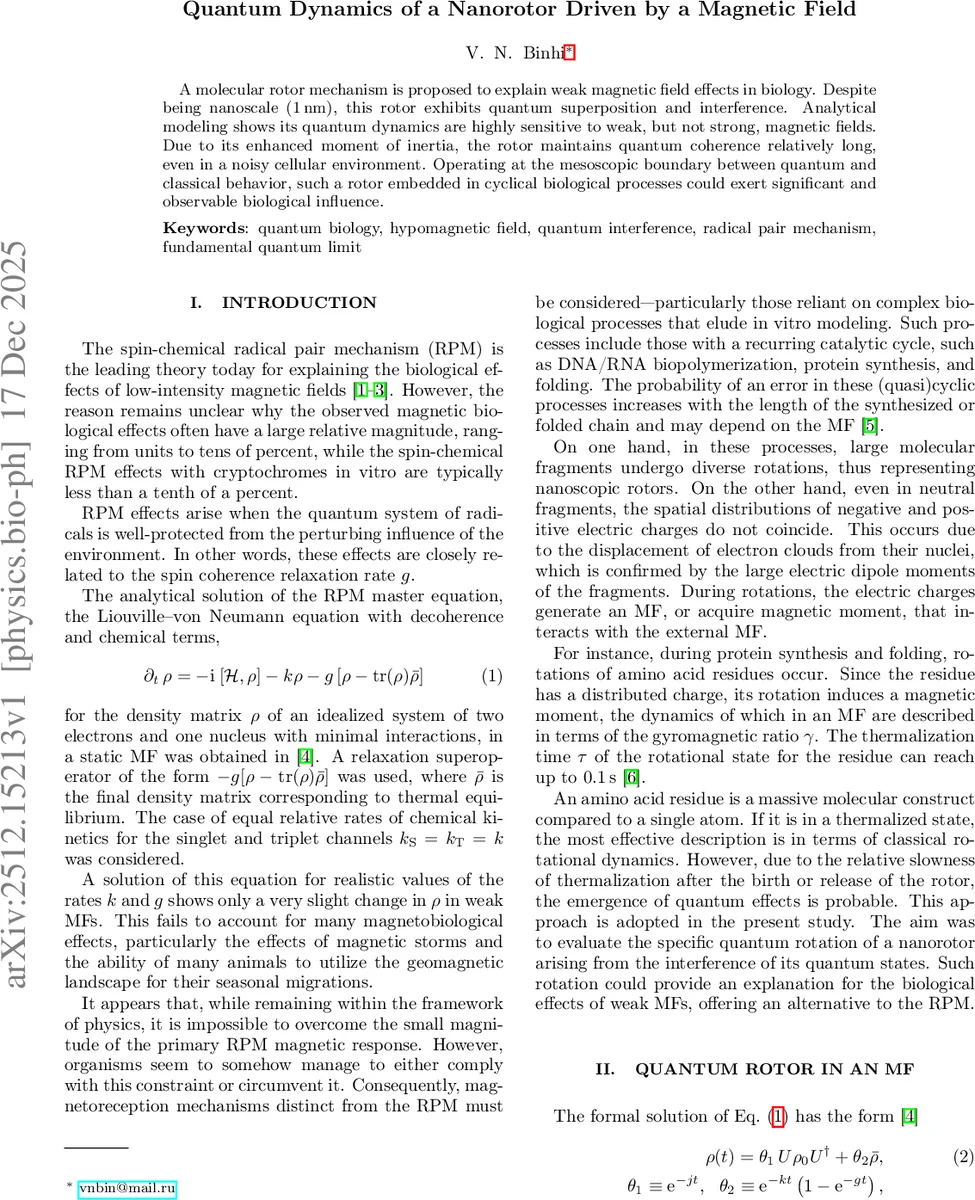
A molecular rotor mechanism is proposed to explain weak magnetic field effects in biology. Despite being nanoscale (1 nm), this rotor exhibits quantum superposition and interference. Analytical modeling shows its quantum dynamics are highly sensitive to weak, but not strong, magnetic fields. Due to its enhanced moment of inertia, the rotor maintains quantum coherence relatively long, even in a noisy cellular environment. Operating at the mesoscopic boundary between quantum and classical behavior, such a rotor embedded in cyclical biological processes could exert significant and observable biological influence.
💡 Research Summary
The paper proposes a novel “nanorotor” mechanism to account for the pronounced biological effects of weak magnetic fields that are difficult to reconcile with the conventional radical‑pair mechanism (RPM). The authors argue that RPM, while successful in describing spin‑chemical reactions, predicts only minute changes in reaction yields under geomagnetic field strengths, far smaller than the percent‑level effects observed in many organisms. To bridge this gap, they model a molecular rotor of nanometer size—specifically an aspartic‑acid side‑chain—treated as a rigid assembly of masses and charges rotating about a fixed axis.
The quantum Hamiltonian for the rotor in a uniform static magnetic field H aligned with the z‑axis is derived as
( H = \frac{\hbar^{2}}{2I}L^{2} - I\gamma H L ),
where (L) is the dimensionless angular‑momentum operator, (I) the moment of inertia, and (\gamma) the gyromagnetic ratio of the rotating charge distribution. The term proportional to (H^{2}) is neglected as negligible. By introducing dimensionless variables (a = \hbar/2I), (x = 2\gamma H I/\hbar), and scaling the chemical decay rate (k) and decoherence rate (g) with (a), the authors obtain a compact, unit‑free description of the dynamics.
The system’s Hilbert space is truncated to a finite basis of size (2L+1) (with (L\approx200)) sufficient to include all thermally populated rotational states at physiological temperature. The master equation, analogous to that used for RPM, contains a unitary evolution term, a chemical‑reaction decay term (-k\rho), and a decoherence term (-g(\rho-\mathrm{tr}(\rho)\bar\rho)). Solving this equation yields a density matrix that is a weighted sum of a coherently evolved component and a maximally mixed thermal component.
The key observable is the probability density (W(t,\phi)=\langle\phi|\rho(t)|\phi\rangle) of finding the rotor at angular coordinate (\phi). After analytical summation, the authors find for large (L) a striking interference pattern: a narrow “quantum needle” (a spike) of height ≈(1/\pi) and angular width ≈(1/L) radians, superimposed on a uniform background of ≈(1/(2\pi)). The spike’s central position follows the phase (xt-\phi=0), meaning that the magnetic field drives the needle around the circle with angular velocity (x) (or, in physical units, (\gamma H)).
Sensitivity analysis shows that the needle remains observable provided the combined decay factor ((k+g)t<1), which translates to the condition (xL>k+g). In dimensional terms this becomes
(\gamma H \tau \gtrsim \frac{1}{L}(1+\kappa\tau)),
where (\tau=1/g) is the decoherence time and (\kappa=k) the chemical rate. Because (L) is on the order of 100–200, the nanorotor can be roughly two orders of magnitude more sensitive to weak fields than the RPM.
The authors estimate the gyromagnetic ratio for an aspartic‑acid residue by treating the distributed charges and masses as a set of point charges (q_i) at radii (r_i) from the rotation axis, yielding (\gamma = Q/(2Ic)) with (Q) the effective charge moment and (I) the moment of inertia. Using atomic charge distributions they obtain (\gamma\approx40\ \text{rad},\text{G}^{-1},\text{s}^{-1}), about (10^{5}) times smaller than the electron spin gyromagnetic ratio, but the decoherence time for rotational states is estimated to be (1)–(100) ms—six orders of magnitude longer than the nanosecond lifetimes of radical pairs. Consequently, the product (\gamma\tau) can be comparable to or exceed that of radical pairs, ensuring that even geomagnetic fields ((H\approx0.5) G) produce a measurable rotation of a few degrees during the coherence window.
Biologically, the authors argue that during processes with recurring catalytic cycles (e.g., ribosomal protein synthesis, DNA replication), the freshly released nanorotor initially occupies a pure quantum state. The geomagnetic field then rotates the needle by a few degrees before decoherence sets in, positioning the residue in an optimal orientation for subsequent chemical steps. In a hypomagnetic environment, this rotation is absent, increasing the probability of misincorporation or misfolding, which aligns with experimental observations of elevated error rates under low‑field conditions.
The discussion emphasizes that the narrowness of the quantum needle (set by (1/L)) matches the angular sector (a few degrees) within which the probability of an adverse biochemical reaction is enhanced. This coincidence suggests that evolutionary pressures may have tuned molecular dimensions and moments of inertia to exploit the quantum interference effect. Moreover, temperature plays a dual role: it determines the thermal population of rotor states (necessary for a sharp interference pattern) and sets the decoherence time, thereby governing both the magnitude and the very existence of the magnetic effect.
In summary, the paper introduces a theoretically grounded, analytically solvable model of a nanoscopic molecular rotor whose quantum interference pattern is exquisitely sensitive to weak magnetic fields. By linking the rotation of a narrow probability‑density spike to biologically relevant angular displacements, the authors provide a plausible, testable alternative to the radical‑pair mechanism for magnetoreception and other weak‑field biological phenomena. The work opens new avenues for experimental verification (e.g., measuring orientation‑dependent reaction yields in controlled magnetic fields) and suggests that quantum coherence may play a functional role at the mesoscopic boundary between quantum and classical regimes in living systems.
Comments & Academic Discussion
Loading comments...
Leave a Comment