Thermal properties of interplanetary coronal mass ejections at 1 AU and their connection to geoeffectiveness across solar cycles 23-25
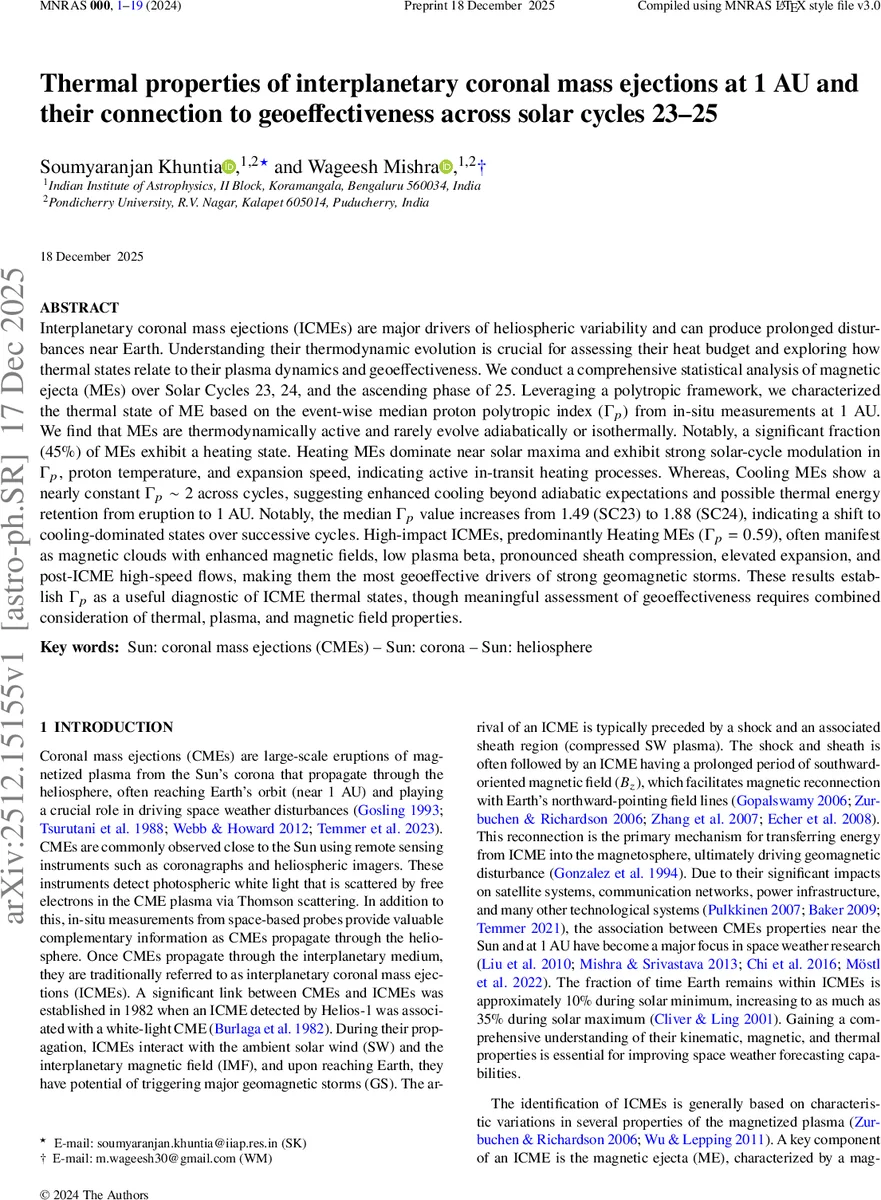
Interplanetary coronal mass ejections (ICMEs) are major drivers of heliospheric variability and can produce prolonged disturbances near Earth. Understanding their thermodynamic evolution is crucial for assessing their heat budget and exploring how thermal states relate to their plasma dynamics and geoeffectiveness. We conduct a comprehensive statistical analysis of magnetic ejecta (MEs) over Solar Cycles 23, 24, and the ascending phase of 25. Leveraging a polytropic framework, we characterized the thermal state of ME based on the event-wise median proton polytropic index (Gamma_p) from in-situ measurements at 1 AU. We find that MEs are thermodynamically active and rarely evolve adiabatically or isothermally. Notably, a significant fraction (45%) of MEs exhibit a heating state. Heating MEs dominate near solar maxima and exhibit strong solar-cycle modulation in Gamma_p, proton temperature, and expansion speed, indicating active in-transit heating processes. Whereas, Cooling MEs show a nearly constant Gamma_p = 2 across cycles, suggesting enhanced cooling beyond adiabatic expectations and possible thermal energy retention from eruption to 1 AU. Notably, the median Gamma_p value increases from 1.49 (SC23) to 1.88 (SC24), indicating a shift to cooling-dominated states over successive cycles. High-impact ICMEs, predominantly Heating MEs (Gamma_p = 0.59), often manifest as magnetic clouds with enhanced magnetic fields, low plasma beta, pronounced sheath compression, elevated expansion, and post-ICME high-speed flows, making them the most geoeffective drivers of strong geomagnetic storms. These results establish Gamma_p as a useful diagnostic of ICME thermal states, though meaningful assessment of geoeffectiveness requires combined consideration of thermal, plasma, and magnetic field properties.
💡 Research Summary
The paper presents a comprehensive statistical investigation of the thermal properties of interplanetary coronal mass ejections (ICMEs) at 1 AU, covering Solar Cycles 23, 24, and the rising phase of Cycle 25. Using the OMNI database and the Richardson‑Cane (RC) ICME catalog, the authors analyze 604 magnetic ejecta (ME) events from June 1996 to December 2024. For each event they compute the event‑wise median proton polytropic index (Γₚ) from in‑situ proton temperature and density measurements, adopting the relation p ∝ ρ^Γ (T ∝ ρ^{Γ‑1}). This index serves as a diagnostic of the thermal state: values near 1 indicate near‑isothermal behavior, values near 5/3 correspond to adiabatic expansion, and deviations signal additional heating or cooling processes.
The analysis reveals that ICMEs are thermodynamically active and rarely evolve strictly adiabatically or isothermally. Approximately 45 % of the MEs fall into a “heating” category (Γₚ < 1.5), while the remainder cluster around Γₚ ≈ 2, representing a “cooling” regime. Heating MEs dominate during solar maxima, showing strong solar‑cycle modulation in Γₚ, proton temperature, and expansion speed, implying active in‑transit heating mechanisms such as Alfvénic turbulence, shock‑driven compression, or magnetic reconnection. Cooling MEs exhibit a nearly constant Γₚ ≈ 2 across cycles, suggesting enhanced cooling beyond simple adiabatic expansion, possibly due to radiative losses or efficient energy transfer to the ambient solar wind.
A notable solar‑cycle trend is observed in the median Γₚ: it rises from 1.49 in Cycle 23 to 1.88 in Cycle 24, indicating a shift from heating‑dominated to cooling‑dominated thermal states as solar activity declines. This shift aligns with broader changes in background solar‑wind conditions, such as reduced dynamic pressure and altered plasma beta.
The authors further explore the geoeffectiveness of ICMEs by applying Superposed Epoch Analysis (SEA) to subsets categorized by magnetic cloud (MC) presence, thermal state, and geomagnetic storm intensity (Dst ≤ ‑150 nT). High‑impact ICMEs are overwhelmingly heating MEs (median Γₚ ≈ 0.59) and are typically identified as magnetic clouds. These events display enhanced magnetic field strength, low plasma beta, pronounced sheath compression, elevated expansion speeds, and post‑ICME high‑speed streams (> 600 km s⁻¹). Such combined plasma and magnetic signatures maximize energy transfer to Earth’s magnetosphere, producing the strongest geomagnetic storms. In contrast, cooling MEs tend to have weaker Bz, higher beta, and slower expansion, resulting in comparatively modest geomagnetic responses.
The study concludes that the proton polytropic index Γₚ is a valuable diagnostic for classifying ICME thermal states and for revealing solar‑cycle dependent behavior. However, reliable forecasting of geomagnetic storm severity requires an integrated approach that combines Γₚ with key electromagnetic parameters (e.g., southward Bz, V·Bz, sheath pressure) and dynamic features (expansion speed, post‑ICME flows). The findings provide a framework for improving space‑weather prediction models by incorporating thermodynamic diagnostics alongside traditional magnetic and kinematic indicators.
Comments & Academic Discussion
Loading comments...
Leave a Comment