Curvature-Induced Magnon Frequency Combs
Generating magnon frequency combs (MFCs) with tunable spacing via a single-frequency driving is crucial for practical applications but it typically relies on complex spin textures like skyrmions or vortices. Here, we theoretically and numerically demonstrate MFC generation in geometrically curved ferromagnetic thin films using single-frequency microwave excitation, without topological spin textures. We first show that the curvature transforms the planar ferromagnetic resonance into a localized, redshifted magnon bound state, which, under non-resonant driving, activates sequential three-magnon scattering processes assisted by the curvature-driven effective anisotropy and Dzyaloshinskii-Moriya interaction. It finally produces equally spaced, robust frequency combs with spacing exactly set by the bound mode frequency. Moreover, we find that the curvature gradient at the hybrid interface mimics an analog event horizon, with the bound state’s redshift resembling gravitational effects in black hole physics. Micromagnetic simulations confirm these curvature-driven nonlinear phenomenon, unveiling a novel geometric strategy for controlling magnon interactions and advancing compact magnonic devices.
💡 Research Summary
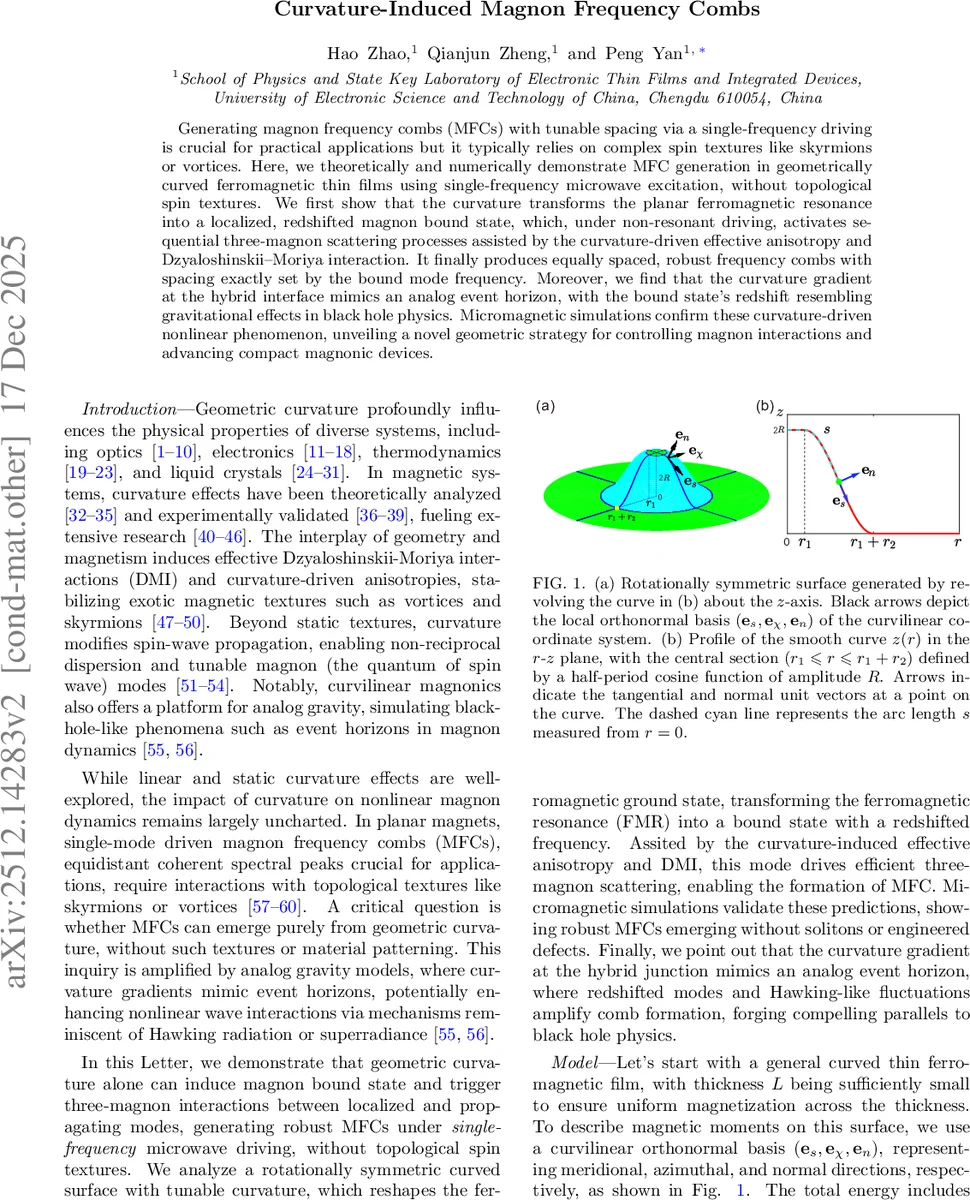
In this work the authors demonstrate that pure geometric curvature of a ferromagnetic thin film can generate magnon frequency combs (MFCs) under a single‑frequency microwave drive, without relying on topological spin textures such as skyrmions or vortices. The study begins by modeling a rotationally symmetric curved surface generated by revolving a smooth height profile z(r) about the z‑axis. Using a curvilinear orthonormal basis (e_s, e_χ, e_n) they write the total magnetic energy as exchange plus a perpendicular anisotropy term. Curvature introduces a geometric vector potential Γ and a modified spin connection Ω, which together produce an effective Dzyaloshinskii‑Moriya interaction (DMI) and an additional curvature‑induced anisotropy.
Solving the static Landau‑Lifshitz‑Gilbert (LLG) equation yields a ground‑state polar angle Θ(r) that deviates from the planar uniform state; the deviation grows with the surface height R. Linearizing the LLG around this ground state leads to coupled wave equations that can be cast into a Schrödinger‑like eigenvalue problem with an effective potential U_eff(r). For small R the potential forms a well centred at the curved region, supporting a localized magnon bound state with azimuthal quantum number m = –1. The bound‑state frequency ω_b is red‑shifted relative to the planar ferromagnetic resonance ω_FMR = 2γK, and the shift scales with the curvature depth and the arc length of the curved region. An analytical expression (Eq. 10) matches micromagnetic simulations for modest curvature.
The nonlinear regime is treated with a vectorial Hamiltonian formalism. The bound mode (c_r) acts as a mediator for three‑magnon processes: two incident magnons (c_k, c_q) can combine into a higher‑frequency magnon (c_p) or split, conserving energy and momentum. The Heisenberg equations of motion (Eq. 14) include Gilbert damping α and the external drive of amplitude h at frequency ω_d≈10 GHz. A threshold drive h_c is derived, h_c≈α²ω_k√(2μ₀V₃)⁻¹, where V₃ is the three‑magnon interaction vertex. Importantly, V₃ scales linearly with curvature for small R (V₃∝R) and quadratically for larger R (V₃∝R²), implying that the required drive amplitude decreases as curvature increases (h_c∝R⁻²).
Full micromagnetic simulations (COMSOL Micromagnetic Module) using YIG parameters confirm the theory. At low drive amplitudes (μ₀h < 100 mT) the spectrum shows only the drive frequency and its weak harmonics. Once the drive exceeds a critical value (≈150 mT), sidebands appear at frequencies ω_d ± n ω_b (n = 1,2,…), forming an evenly spaced comb. The spacing equals the bound‑state frequency ω_b, and the comb persists over a wide range of drive powers. A secondary comb emerges around the second harmonic (20 GHz), demonstrating that the mechanism works for multiple carrier frequencies. The bound‑state frequency itself shifts slightly with drive strength due to four‑magnon interactions, producing a quadratic (low‑power) and linear (high‑power) dependence on h, as extracted from the simulations.
Beyond the magnonic physics, the authors draw an analogy with analog gravity. The abrupt curvature gradient at the interface between the curved region and the flat film creates a potential barrier that mimics an event horizon for magnons. The red‑shift of the bound mode is interpreted as a gravitational red‑shift, and the authors estimate an effective Hawking temperature T_H≈ℏv_m/(8πk_Bℓ)≈44 mK for R = 45 nm, where v_m is the magnon group velocity and ℓ a curvature‑dependent magnetic length. Although this temperature is tiny, it suggests that quantum‑like fluctuations could seed the comb formation, reminiscent of Hawking radiation enhancing black‑hole spectra.
In summary, the paper establishes that curvature alone can (i) localize a magnon bound state, (ii) enhance three‑magnon scattering via curvature‑induced DMI and anisotropy, and (iii) generate robust, tunable magnon frequency combs under a single‑frequency microwave drive. This eliminates the need for engineered spin‑texture patterns or resonant cavities, opening a new geometric route for magnonic device engineering. Potential applications include compact frequency comb generators for microwave photonics, magnon‑based signal processing, and experimental platforms for analog gravity phenomena in condensed‑matter systems.
Comments & Academic Discussion
Loading comments...
Leave a Comment