Walsh-Floquet Theory of Periodic Kick Drives
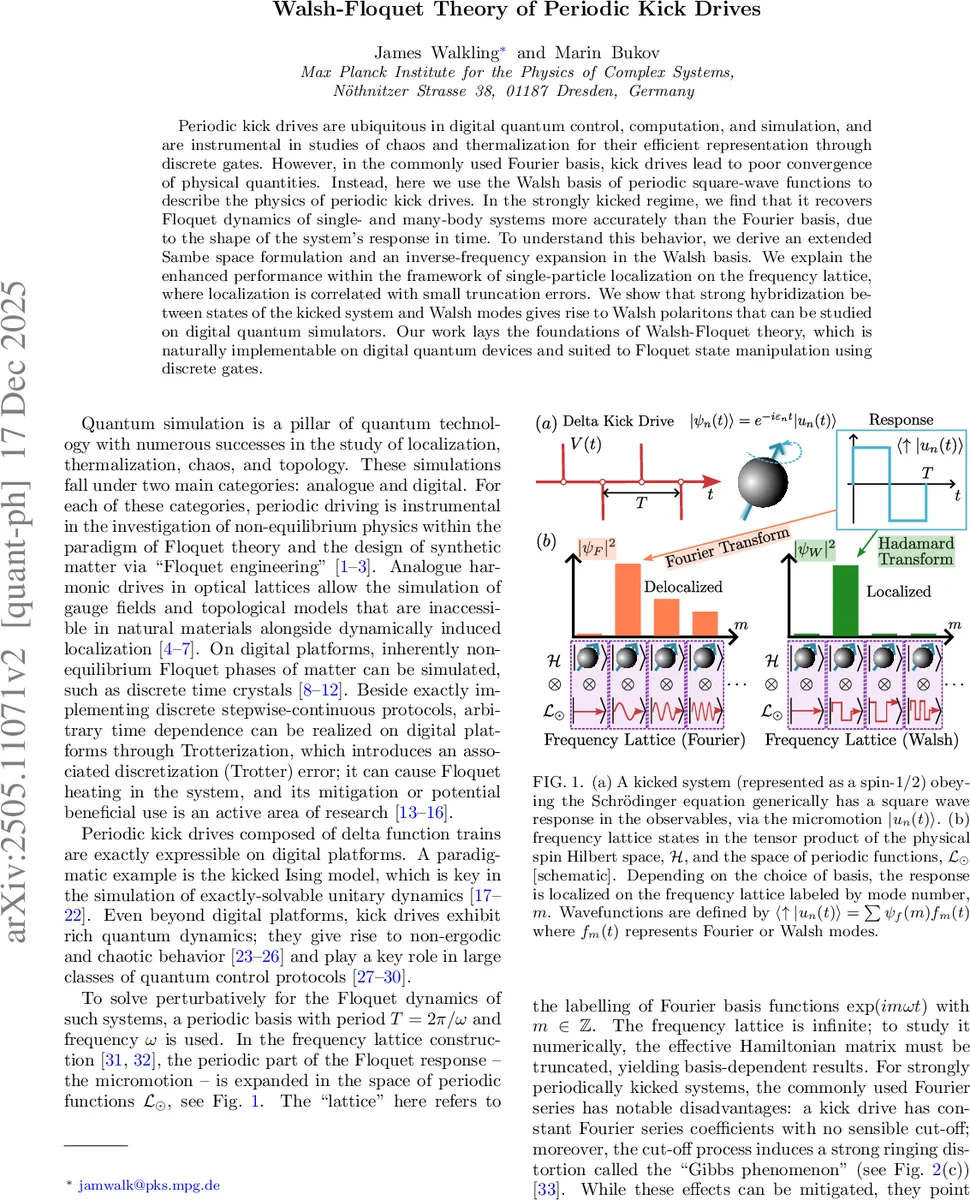
Periodic kick drives are ubiquitous in digital quantum control, computation, and simulation, and are instrumental in studies of chaos and thermalization for their efficient representation through discrete gates. However, in the commonly used Fourier basis, kick drives lead to poor convergence of physical quantities. Instead, here we use the Walsh basis of periodic square-wave functions to describe the physics of periodic kick drives. In the strongly kicked regime, we find that it recovers Floquet dynamics of single- and many-body systems more accurately than the Fourier basis, due to the shape of the system’s response in time. To understand this behavior, we derive an extended Sambe space formulation and an inverse-frequency expansion in the Walsh basis. We explain the enhanced performance within the framework of single-particle localization on the frequency lattice, where localization is correlated with small truncation errors. We show that strong hybridization between states of the kicked system and Walsh modes gives rise to Walsh polaritons that can be studied on digital quantum simulators. Our work lays the foundations of Walsh-Floquet theory, which is naturally implementable on digital quantum devices and suited to Floquet state manipulation using discrete gates.
💡 Research Summary
This paper introduces a Walsh‑Floquet framework for describing periodically kicked quantum systems, which are central to digital quantum control, simulation, and studies of chaos and thermalization. Traditional analyses employ a Fourier basis to expand the time‑periodic part of the Floquet problem. However, a kicked drive is a train of delta‑function pulses, whose Fourier series contains constant‑amplitude coefficients extending to arbitrarily high frequencies. Truncating such a series inevitably discards an infinite set of relevant harmonics, leading to severe Gibbs ringing and poor convergence of physical observables such as quasienergies.
The authors propose to replace the Fourier basis with the Walsh basis, a set of orthonormal, piecewise‑constant square‑wave functions that take only the values ±1. The Walsh functions are generated from Hadamard matrices of order 2ⁿ, yielding N = 2ⁿ basis elements that discretize the period T into N equal time steps. Because the basis itself is already a time‑discretization, a kicked response—essentially a square‑wave in the observables—can be captured with far fewer non‑zero coefficients than in the Fourier representation.
To embed the Walsh basis into Floquet theory, the authors extend the Sambe space (the tensor product of the physical Hilbert space and the space of periodic functions) and replace the usual time‑derivative operator –i∂ₜ with a block‑diagonal translation generator 𝔾̂ that acts correctly on the finite Walsh set. The quasienergy operator becomes Q̂ = Ĥ − i𝔾̂, and its eigenvalues εₙ + mω (modulo ω) give the quasienergies. The spectrum of 𝔾̂ matches that of the continuous derivative for any truncation size N, ensuring that the Walsh formulation reproduces the exact Floquet spectrum in the limit N → ∞.
A central insight is that the accuracy of a truncated Floquet calculation is governed by the localization of the Floquet states on the “frequency lattice” (the photon index m). The authors quantify localization using the participation entropy S = −∑ₘ|ũₘ|² log |ũₘ|², where ũₘ are the expansion coefficients in a chosen basis. In the Walsh basis, strongly kicked systems (large kick amplitude hₓ) produce coefficients that decay roughly as 1/m, leading to tight localization and low entropy. By contrast, the Fourier basis yields coefficients of roughly equal magnitude across all m because the kick’s Fourier coefficients are constant; the resulting states are delocalized, and truncation introduces large errors.
The paper validates these ideas with numerical simulations of both a single spin‑½ system and a many‑body mixed‑field Ising model (MFIM). For a single spin driven with ω = 10 and varying static field h_z, the Walsh basis (N = 32) reproduces quasienergy phases with errors up to three orders of magnitude smaller than the Fourier basis (N = 31) when the kick strength hₓ approaches π/2. In the many‑body case (L = 3 and L = 6 spins), the Walsh representation remains accurate over a broad parameter regime, delivering quasienergy errors below 1 % for kick amplitudes up to π/2, whereas the Fourier representation often fails to converge even with comparable mode counts.
Beyond numerical accuracy, the authors identify “Walsh polaritons”: hybrid excitations formed by strong coupling between system states and Walsh modes. Because Walsh modes correspond to simple digital operations (Hadamard transforms), these polaritons can be prepared and probed on existing gate‑based quantum processors without requiring analog control of continuous waveforms.
In summary, the Walsh‑Floquet approach offers a natural, digitally friendly representation for periodically kicked quantum dynamics. By aligning the basis with the intrinsic square‑wave nature of kicks, it achieves superior convergence, provides a clear localization‑based error metric, and opens pathways to experimentally accessible hybrid excitations on quantum computers. The work lays the groundwork for future extensions to non‑periodic pulse sequences, multi‑frequency kicks, and experimental demonstrations of Walsh polaritons in near‑term quantum devices.
Comments & Academic Discussion
Loading comments...
Leave a Comment