A guide to Tauberian theorems for arithmetic applications
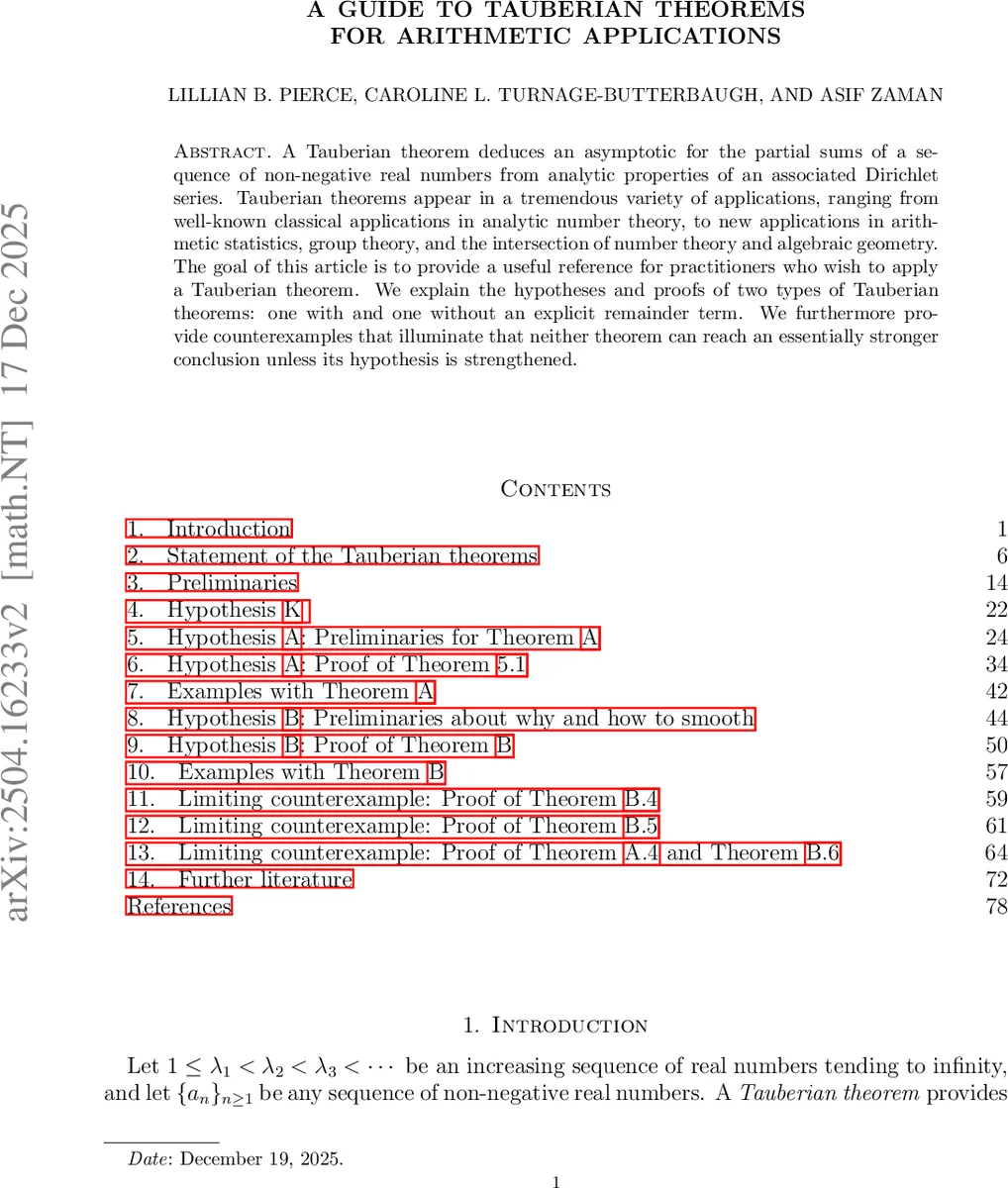
A Tauberian theorem deduces an asymptotic for the partial sums of a sequence of non-negative real numbers from analytic properties of an associated Dirichlet series. Tauberian theorems appear in a tremendous variety of applications, ranging from well-known classical applications in analytic number theory, to new applications in arithmetic statistics, group theory, and the intersection of number theory and algebraic geometry. The goal of this article is to provide a useful reference for practitioners who wish to apply a Tauberian theorem. We explain the hypotheses and proofs of two types of Tauberian theorems: one with and one without an explicit remainder term. We furthermore provide counterexamples that illuminate that neither theorem can reach an essentially stronger conclusion unless its hypothesis is strengthened.
💡 Research Summary
The paper “A guide to Tauberian theorems for arithmetic applications” provides a concise yet thorough reference for practitioners who need to translate analytic information about Dirichlet series into asymptotic estimates for partial sums of non‑negative sequences. After a motivating introduction that surveys classical uses (Prime Number Theorem, representation of integers as sums of two squares) and recent developments in Manin’s conjecture, subgroup growth, and counting number fields, the authors focus on two concrete Tauberian theorems, labelled Theorem A and Theorem B.
Theorem A rests on a minimal hypothesis (Hypothesis A): the Dirichlet series (A(s)=\sum a_n\lambda_n^{-s}) is holomorphic for (\Re s>\alpha) and has a single pole of order (m) at (s=\alpha), with meromorphic continuation to a neighbourhood of the line (\Re s=\alpha). Under these conditions the partial sum (S(x)=\sum_{\lambda_n\le x}a_n) satisfies the classic asymptotic
\
Comments & Academic Discussion
Loading comments...
Leave a Comment