Finding New Debris Discs at Sub-millimetre Wavelengths
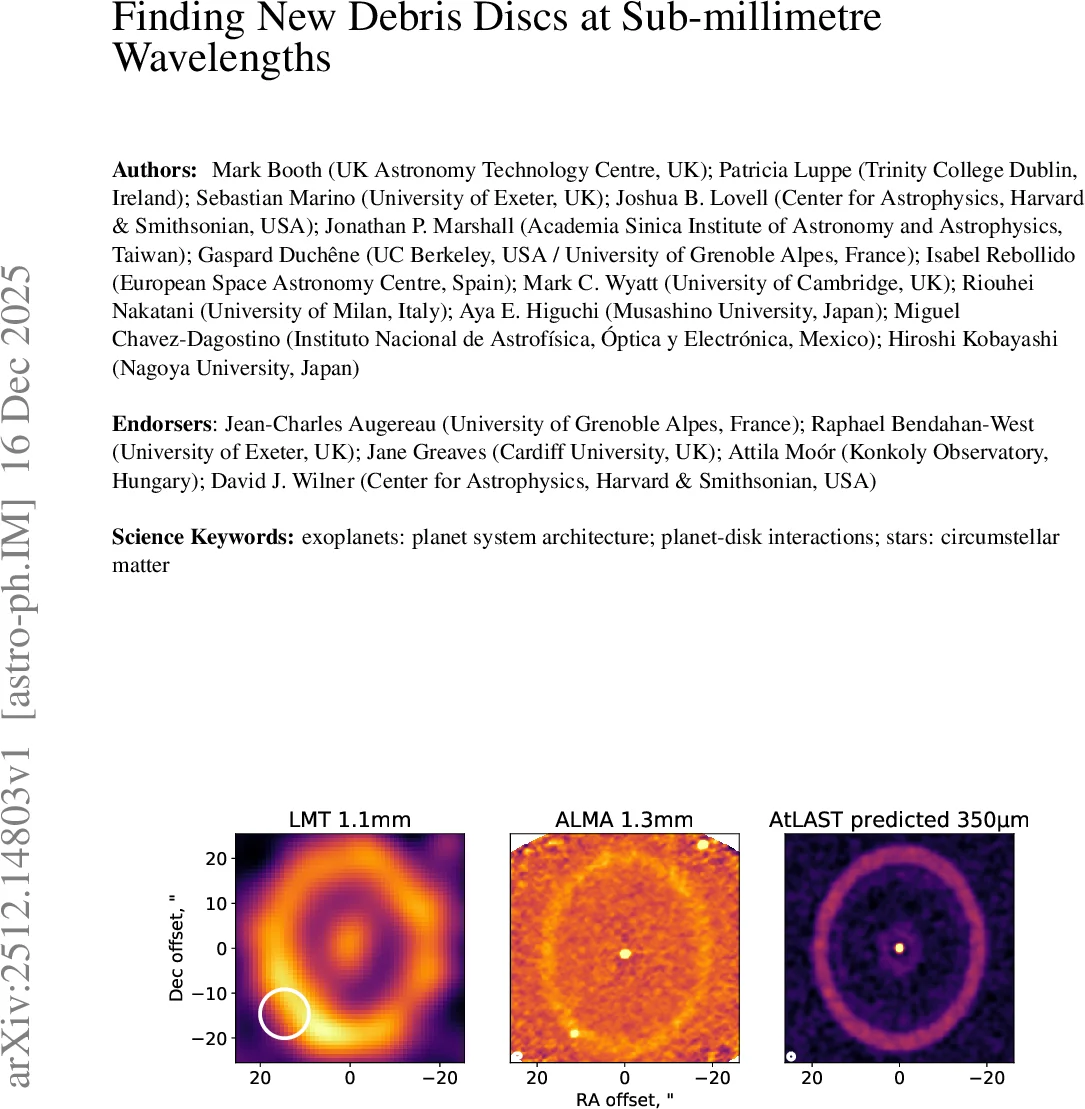
Debris discs reveal the architectures and dynamical histories of planetary systems. Sub-millimetre observations trace large dust grains within debris discs, revealing their bulk properties. Debris discs have so far only been detected around ~20% of stars, representing the bright end of the population. A new facility is required to reach fainter discs, overcoming the confusion limit, with multiwavelength capabilities for characterisation, sensitivity to large-scale emission for nearby targets and a large field of view for surveying distant populations. All of this is made possible with the Atacama Large Aperture Submillimetre Telescope (AtLAST).
💡 Research Summary
The white paper presents a compelling case for a new, 50‑meter single‑dish sub‑millimetre telescope—AtLAST (Atacama Large Aperture Submillimetre Telescope)—to dramatically expand our knowledge of debris discs around nearby and distant stars. Current surveys have detected debris discs around only ~20 % of nearby stars, and those detections represent the bright tail of the underlying population. The faint, Kuiper‑belt‑like discs that dominate the majority of systems remain beyond the reach of existing facilities because of limited sensitivity, confusion noise, and insufficient field‑of‑view.
AtLAST is designed to operate from 0.3 mm to 10 mm, with a maximum instantaneous field of view of 2 degrees and an angular resolution better than 5 arcseconds at wavelengths shorter than 1 mm. These specifications directly address two major scientific goals.
-
Detecting faint, nearby debris discs – At 860 µm, AtLAST can achieve a point‑source sensitivity of ~21 µJy beam⁻¹ in one hour, sufficient to detect dust at the fractional luminosity of the Solar System’s Kuiper belt (≈5 × 10⁻⁷) around Sun‑like stars within 10 pc. For M dwarfs, the detection rate is expected to increase by an order of magnitude, providing a statistically meaningful sample of previously unseen discs. Observations at 350 µm add higher resolution (≈1.7 arcsec) to resolve structures as small as a few astronomical units, enabling direct measurement of disc size, morphology, and the spectral slope needed to infer collisional cascades.
-
Tracing the birth of debris discs – Class III young stellar objects (YSOs) represent the transition from protoplanetary to debris discs, yet they are largely invisible at sub‑mm wavelengths due to their low dust masses. With a 2‑degree field of view and simultaneous multi‑band coverage, AtLAST can map all star‑forming regions within 1 kpc in a few thousand hours, increasing the known population of Class III YSOs by at least an order of magnitude. A sensitivity limit of ~30 µJy would allow detection of discs down to ~0.02 M⊕, providing the first robust constraints on the rapid dust‑mass decline that theoretical models predict.
Technical requirements outlined include: (i) operation in the 350–870 µm window to capture the peak of cold dust emission while probing parent planetesimal belts; (ii) ability to recover emission on scales up to an arcminute, which only a single‑dish can achieve without filtering out extended flux; (iii) a 50‑m primary mirror to push the confusion limit low enough for Kuiper‑belt‑level detections; and (iv) a large‑format, multi‑band detector array to enable rapid, wide‑area surveys.
By delivering unprecedented sensitivity, resolution, and mapping speed, AtLAST will fill the observational gap between space‑based infrared surveys and high‑resolution interferometers such as ALMA. It will provide the bulk dust mass measurements needed to link disc properties with planetary architectures uncovered by upcoming facilities like the ELT, HWO, and LIFE. In summary, AtLAST promises to transform debris‑disc science, revealing the hidden majority of planetary systems, charting the early evolution of debris, and supplying essential context for the search for habitable worlds.
Comments & Academic Discussion
Loading comments...
Leave a Comment