An Ice Christmas Tree: Fast Three-Dimensional Printing of Ice Structures via Evaporative Cooling in Vacuum
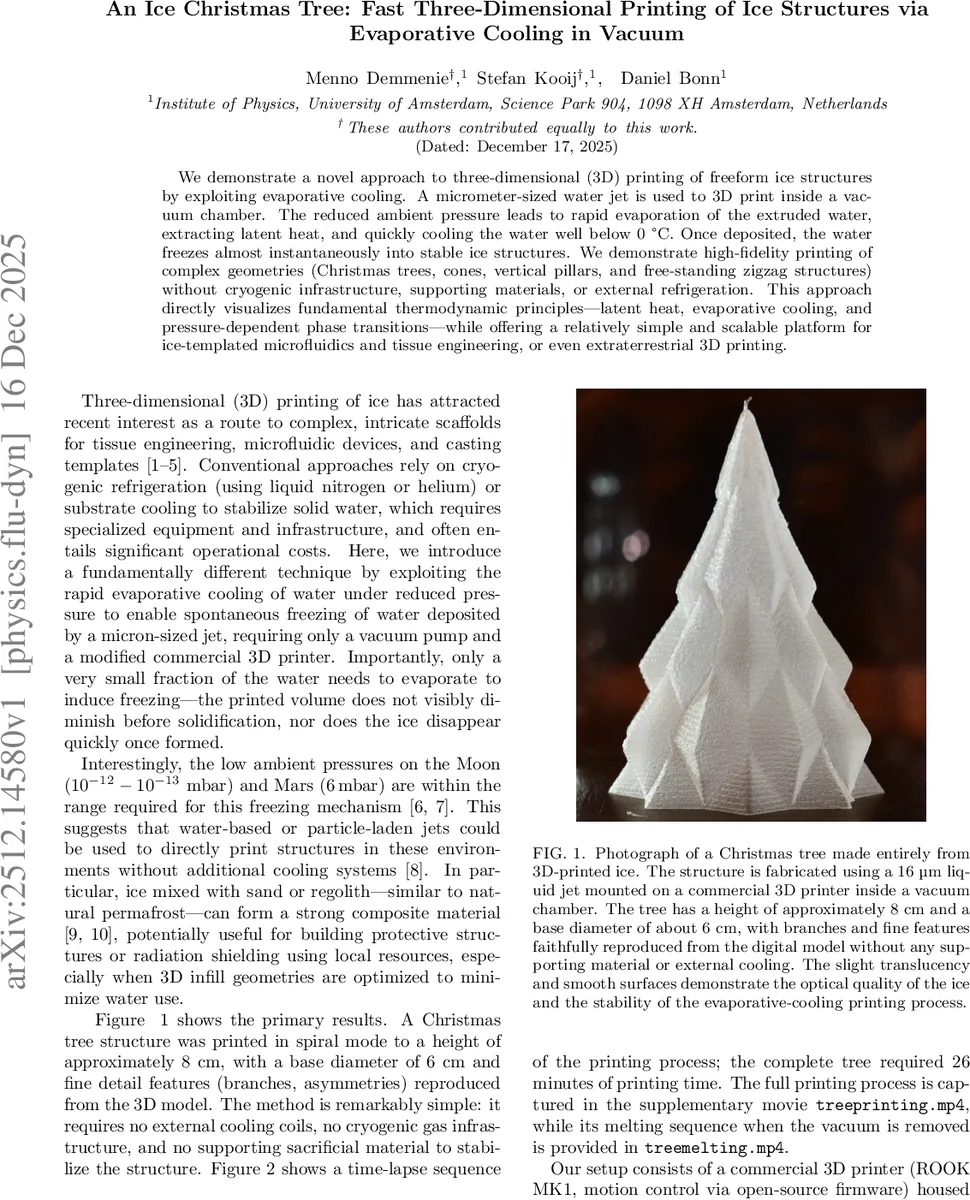
We demonstrate a novel approach to three-dimensional (3D) printing of freeform ice structures by exploiting evaporative cooling. A micrometer-sized water jet is used to 3D print inside a vacuum chamber. The reduced ambient pressure leads to rapid evaporation of the extruded water, extracting latent heat, and quickly cooling the water well below 0 °C. Once deposited, the water freezes almost instantaneously into stable ice structures. We demonstrate high-fidelity printing of complex geometries (Christmas trees, cones, vertical pillars, and free-standing zigzag structures) without cryogenic infrastructure, supporting materials, or external refrigeration. This approach directly visualizes fundamental thermodynamic principles – latent heat, evaporative cooling, and pressure-dependent phase transitions – while offering a relatively simple and scalable platform for ice-templated microfluidics and tissue engineering, or even extraterrestrial 3D printing.
💡 Research Summary
This paper presents a groundbreaking approach to the 3D printing of freeform ice structures by leveraging the principle of evaporative cooling within a vacuum environment. Traditionally, 3D printing with ice has been significantly hindered by the material’s low melting point and structural instability, necessitating expensive cryogenic infrastructure or the use of sacrificial support materials to maintain complex geometries. These requirements add substantial complexity and cost to the manufacturing process.
The researchers overcome these challenges by utilizing a micro-sized water jet inside a vacuum chamber. In a reduced-pressure environment, the rate of evaporation increases dramatically. As the water evaporates, it extracts latent heat from the remaining liquid, a process known as evaporative cooling. This rapid heat extraction causes the temperature of the extruded water to drop well below 0 °C almost instantaneously upon deposition. Consequently, the water freezes into a solid state immediately, allowing for the creation of stable, free-standing ice structures without the need for external refrigeration or complex support systems.
The study demonstrates the high-fidelity printing of various complex geometries, including Christmas trees, cones, vertical pillars, and even intricate, free-standing zigzag structures. The ability to print such high-resolution, complex shapes without support materials proves the precision and stability of this novel method. This approach effectively visualizes fundamental thermodynamic principles, such as latent heat, evaporative cooling, and pressure-dependent phase transitions, in a practical engineering context.
The implications of this technology are far-reaching. In the field of microfluidics, it offers a scalable platform for creating ice-templated micro-channels. In tissue engineering, it provides a method for fabricating precise scaffolds for cell growth. Furthermore, the simplicity and lack of heavy cryogenic equipment make this technology a prime candidate for extraterrestrial 3D printing, where utilizing local resources (like water ice found on the Moon or Mars) is crucial for long-term space exploration. This research marks a significant advancement in additive manufacturing, turning a thermodynamic phenomenon into a powerful tool for precision engineering.
Comments & Academic Discussion
Loading comments...
Leave a Comment