Hyperbolic Brunnian Theta Curves
A nontrivial $θ$-curve in $S^3$ is Brunnian if each of its cycles is the unknot. We show that if the exterior of a Brunnian $θ$-curve is atoroidal, then it does not contain an essential annulus. Previously, Ozawa-Tsutsumi showed that there is no essential disc. Consequently, by Thurston’s work, the exterior of an atoroidal Brunnian $θ$-curve is hyperbolic with totally geodesic boundary. It follows that Brunnian $θ$-curves of low bridge number have exteriors that are hyperbolic with totally geodesic boundary. We also show that two Brunnian $θ$-curves are isotopic if and only if they are neighborhood isotopic and classify Brunnian spines of genus 2 handlebody knots. We rely heavily on a classification of annuli in the exteriors of genus two handlebody knots by Koda-Ozawa and further developed by Wang in conjunction with sutured manifold theory results of Taylor.
💡 Research Summary
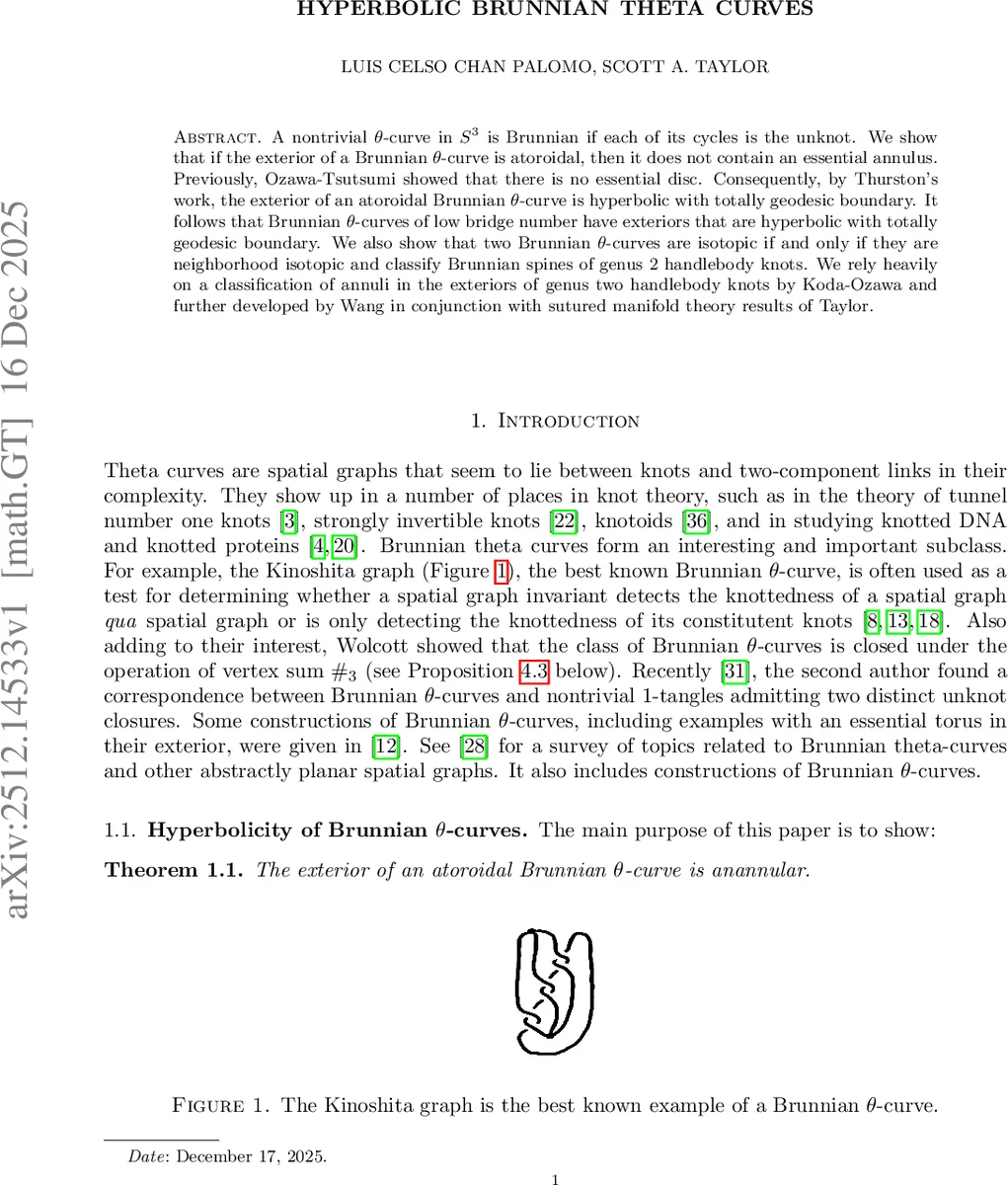
The paper studies spatial theta‑curves (graphs with two vertices and three edges) in the 3‑sphere that satisfy the Brunnian property: every constituent cycle is an unknot, yet the whole graph is non‑trivial. Building on earlier work of Ozawa‑Tsutsumi, which showed that a Brunnian theta‑curve has no essential disc in its exterior, the authors prove that if the exterior is atoroidal (contains no essential torus) then it also contains no essential annulus. This is Theorem 1.1.
The proof relies on a detailed classification of essential annuli in the exteriors of genus‑2 handlebody knots, due to Koda‑Ozawa and later refined by Wang. For any essential annulus Q in such an exterior one can find a “guardrail” – an essential disc A in the handlebody whose boundary is disjoint from ∂Q. The authors analyze all possible configurations of Q and its guardrail relative to the theta‑curve. If both boundary components of Q lie on the same constituent cycle, they can be joined by an annulus in the boundary of a regular neighbourhood, producing an essential torus, contradicting atoroidality. If the boundary components are meridional curves of the third edge, the guardrail coincides with a meridian of the theta‑curve, again yielding a torus. The remaining case forces the boundary components to be preferred longitudes of two cycles; this would also give a torus. Hence no essential annulus can exist.
Thurston’s hyperbolicity criteria imply that a non‑trivial spatial graph whose exterior contains no essential sphere, disc, annulus, or torus is hyperbolic. Consequently, Corollary 1.2 states that any atoroidal Brunnian theta‑curve is both pm‑hyperbolic (hyperbolic with parabolic meridians) and tg‑hyperbolic (hyperbolic with totally geodesic boundary).
The authors then connect this result to bridge number. Using Schubert’s satellite bridge‑number inequality and the work of Taylor‑Tomova on bridge spheres for spatial graphs, they show that a Brunnian theta‑curve with bridge number ≤ 7/2 must be atoroidal; otherwise the existence of an essential torus forces a wrapping number ω ≥ 2, which together with the bridge number of the core knot yields a lower bound of 4, contradicting the hypothesis. Hence Corollary 1.3: all Brunnian theta‑curves of bridge number at most 7/2 are hyperbolic in both senses.
The paper also addresses the classification of spines of genus‑2 handlebody knots. Theorem 1.6 proves that two Brunnian theta‑curves are ambient isotopic if and only if their regular neighbourhoods are isotopic; equivalently, a genus‑2 handlebody knot admits at most one Brunnian spine up to equivalence. This follows from the same annulus‑classification machinery.
Finally, the authors pose several open questions: whether a toroidal Brunnian theta‑curve can contain an essential annulus (Question 1.7); whether Brunnian theta‑curves are determined by their complements (Conjecture); and how hyperbolic volumes behave under the trivial vertex sum of Brunnian theta‑curves (Question 1.8). They also discuss relationships with knotoids and hyperbolic volume invariants.
Overall, the work combines classical 3‑manifold techniques, sutured‑manifold theory, and recent annulus classifications to give a complete picture of the geometry of Brunnian theta‑curves, establishing that atoroidal examples are necessarily hyperbolic with totally geodesic boundary and that low‑bridge‑number examples fall into this category.
Comments & Academic Discussion
Loading comments...
Leave a Comment